

78
4 Scalable Interdigitated Photoconductive Emitters for the Electrical …
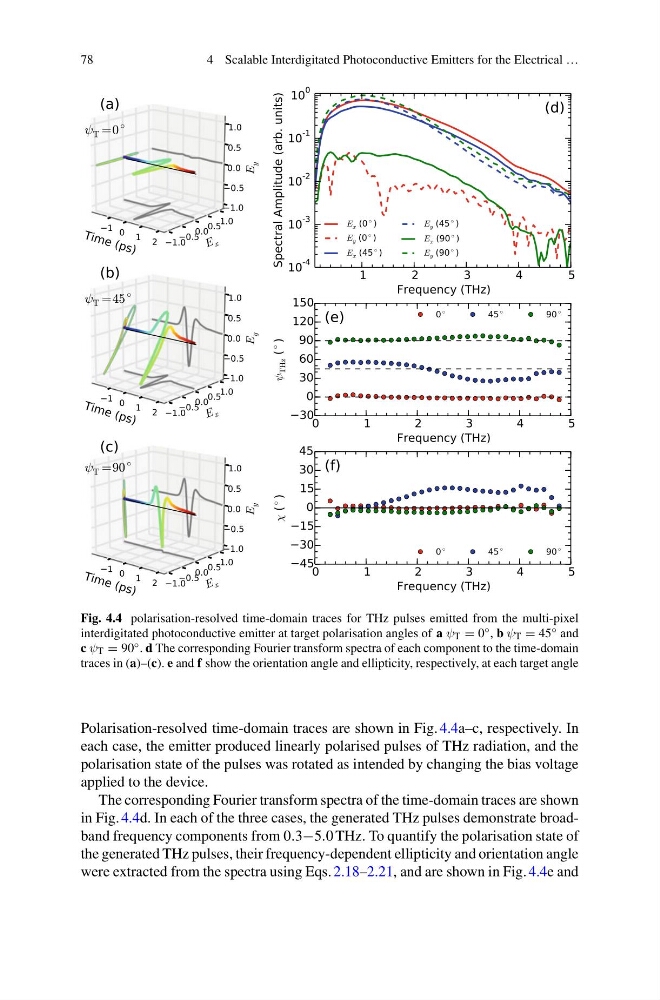
Fig. 4.4 polarisation-resolved time-domain traces for THz pulses emitted from the multi-pixel
interdigitated photoconductive emitter at target polarisation angles of a ψ T = 0 ◦ , b ψ T = 45 ◦ and
c ψ T = 90 ◦ . d The corresponding Fourier transform spectra of each component to the time-domain
traces in (a)–(c). e and f show the orientation angle and ellipticity, respectively, at each target angle
Polarisation-resolved time-domain traces are shown in Fig. 4.4a–c, respectively. In
each case, the emitter produced linearly polarised pulses of THz radiation, and the
polarisation state of the pulses was rotated as intended by changing the bias voltage
applied to the device.
The corresponding Fourier transform spectra of the time-domain traces are shown
in Fig. 4.4d. In each of the three cases, the generated THz pulses demonstrate broadband frequency components from 0.3−5.0 THz. To quantify the polarisation state of
the generated THz pulses, their frequency-dependent ellipticity and orientation angle
were extracted from the spectra using Eqs. 2.18–2.21, and are shown in Fig. 4.4e and
4 Scalable Interdigitated Photoconductive Emitters for the Electrical …
Fig. 4.4 polarisation-resolved time-domain traces for THz pulses emitted from the multi-pixel
interdigitated photoconductive emitter at target polarisation angles of a ψ T = 0 ◦ , b ψ T = 45 ◦ and
c ψ T = 90 ◦ . d The corresponding Fourier transform spectra of each component to the time-domain
traces in (a)–(c). e and f show the orientation angle and ellipticity, respectively, at each target angle
Polarisation-resolved time-domain traces are shown in Fig. 4.4a–c, respectively. In
each case, the emitter produced linearly polarised pulses of THz radiation, and the
polarisation state of the pulses was rotated as intended by changing the bias voltage
applied to the device.
The corresponding Fourier transform spectra of the time-domain traces are shown
in Fig. 4.4d. In each of the three cases, the generated THz pulses demonstrate broadband frequency components from 0.3−5.0 THz. To quantify the polarisation state of
the generated THz pulses, their frequency-dependent ellipticity and orientation angle
were extracted from the spectra using Eqs. 2.18–2.21, and are shown in Fig. 4.4e and