

70
4 Scalable Interdigitated Photoconductive Emitters for the Electrical …
et al., AIP Advances 9, 045323 (2019). Content reproduced with permission, licensed
under a creative commons license (CC BY 4.0), available at https://creativecommons.
org/licenses/by/4.0/.
4.1 Photoconductive Emitter Geometry and Terahertz
Polarisation State
Starting with a description of the radiation produced by a small dipole, this section
will provide a brief overview of how pulses of THz radiation with complex polarisation states can be created using PCEs with novel geometries.
4.1.1 Electric Dipole Radiation from Photoconductive
Emitters
The source of THz radiation emitted by PCEs is the transient photocurrent in the
device, generated by the time-varying electric dipoles created in the semiconductor as
free carriers are photoexcited, accelerated away from each other and then recombined
on sub-picosecond timescales. In a PCE these can be approximated as Hertzian
dipoles, as the dipole size is much smaller than the wavelength of light generated; a
frequency of 1 THz corresponds to a wavelength of 300 µm, whereas the dipole size
in an interdigitated PCE is restricted to a few µm by the size of the gaps between
electrodes. The components of the electric field radiated by such a dipole can be
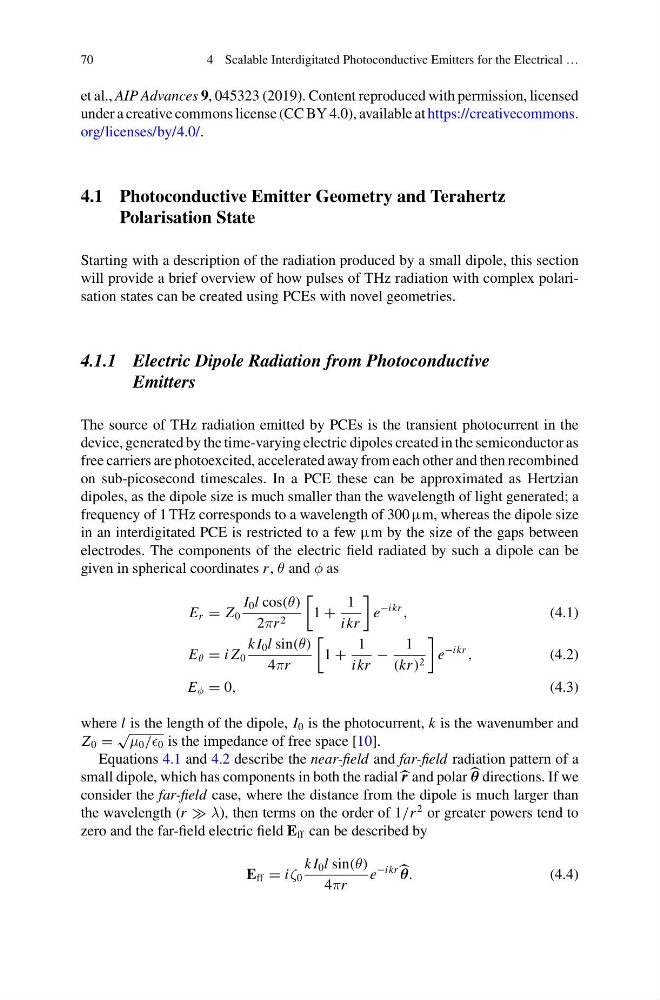
given in spherical coordinates r , θ and φ as
E r = Z 0
I 0 l cos(θ)
2πr 2
1 +
1
ikr
e
−ikr
,
(4.1)
E θ = i Z 0
k I 0 l sin(θ)
4πr
1 +
1
ikr
−
1
(kr) 2
e
−ikr
,
(4.2)
E φ = 0,
(4.3)
where l is the length of the dipole, I 0 is the photocurrent, k is the wavenumber and
Z 0 =
√
μ 0 / 0 is the impedance of free space [10].
Equations 4.1 and 4.2 describe the near-field and far-field radiation pattern of a
small dipole, which has components in both the radial r and polar θ directions. If we
consider the far-field case, where the distance from the dipole is much larger than
the wavelength (r λ), then terms on the order of 1/r
2 or greater powers tend to
zero and the far-field electric field E ff can be described by
E ff = iζ 0
k I 0 l sin(θ)
4πr
e
−ikr θ.
(4.4)
4 Scalable Interdigitated Photoconductive Emitters for the Electrical …
et al., AIP Advances 9, 045323 (2019). Content reproduced with permission, licensed
under a creative commons license (CC BY 4.0), available at https://creativecommons.
org/licenses/by/4.0/.
4.1 Photoconductive Emitter Geometry and Terahertz
Polarisation State
Starting with a description of the radiation produced by a small dipole, this section
will provide a brief overview of how pulses of THz radiation with complex polarisation states can be created using PCEs with novel geometries.
4.1.1 Electric Dipole Radiation from Photoconductive
Emitters
The source of THz radiation emitted by PCEs is the transient photocurrent in the
device, generated by the time-varying electric dipoles created in the semiconductor as
free carriers are photoexcited, accelerated away from each other and then recombined
on sub-picosecond timescales. In a PCE these can be approximated as Hertzian
dipoles, as the dipole size is much smaller than the wavelength of light generated; a
frequency of 1 THz corresponds to a wavelength of 300 µm, whereas the dipole size
in an interdigitated PCE is restricted to a few µm by the size of the gaps between
electrodes. The components of the electric field radiated by such a dipole can be
given in spherical coordinates r , θ and φ as
E r = Z 0
I 0 l cos(θ)
2πr 2
1 +
1
ikr
e
−ikr
,
(4.1)
E θ = i Z 0
k I 0 l sin(θ)
4πr
1 +
1
ikr
−
1
(kr) 2
e
−ikr
,
(4.2)
E φ = 0,
(4.3)
where l is the length of the dipole, I 0 is the photocurrent, k is the wavenumber and
Z 0 =
√
μ 0 / 0 is the impedance of free space [10].
Equations 4.1 and 4.2 describe the near-field and far-field radiation pattern of a
small dipole, which has components in both the radial r and polar θ directions. If we
consider the far-field case, where the distance from the dipole is much larger than
the wavelength (r λ), then terms on the order of 1/r
2 or greater powers tend to
zero and the far-field electric field E ff can be described by
E ff = iζ 0
k I 0 l sin(θ)
4πr
e
−ikr θ.
(4.4)