

3.1 Investigating Anisotropy at Terahertz Frequencies
43
absorption. The interested reader is directed towards the data in Ref. [1], which is a
very good demonstration of this effect.
3.1.2 Terahertz Polarimetry and Ellipsometry
Polarimetry can be defined as the characterisation of materials via the measurement
and interpretation of the polarisation state of light after interaction with the material.
Ellipsometry is the application of polarimetry to investigate the optical properties of
thin films or surfaces [2, 3]. By measuring the change in the polarisation state of light
with an initially well-defined polarisation state, the optical properties of the material
can be inferred. Anisotropy in the sample can be investigated changing the relative
orientations of the THz electric or magnetic fields and the in-plane crystallographic
directions; this can be achieved by either rotating the polarisation state of the incident
THz radiation, or by rotating the sample [4, 5].
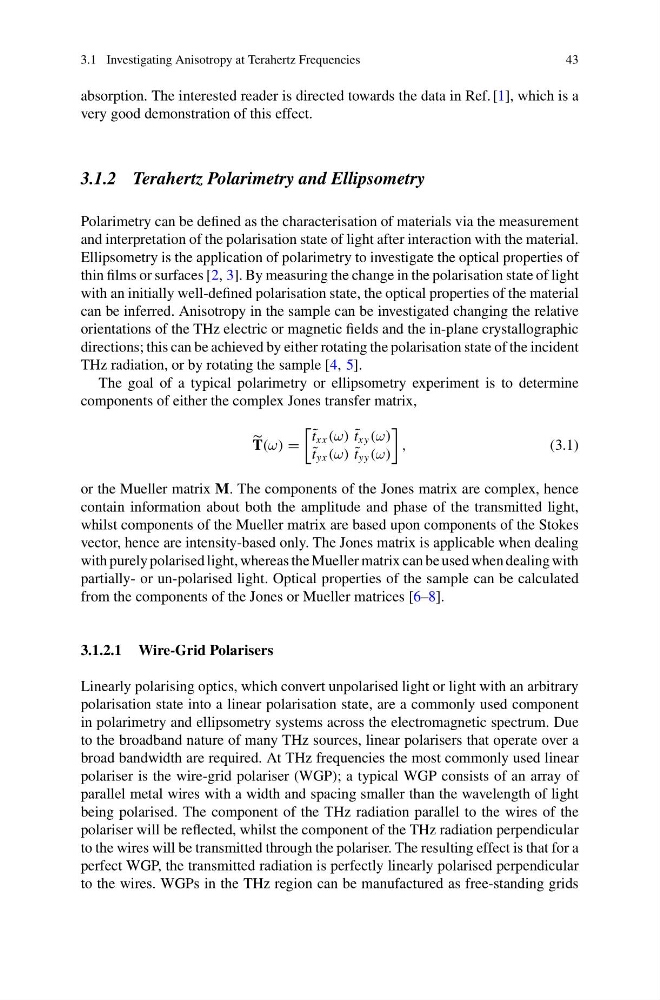
The goal of a typical polarimetry or ellipsometry experiment is to determine
components of either the complex Jones transfer matrix,
T(ω) =
˜
t xx (ω) ˜
t xy (ω)
˜
t yx (ω) ˜
t yy (ω)
,
(3.1)
or the Mueller matrix M. The components of the Jones matrix are complex, hence
contain information about both the amplitude and phase of the transmitted light,
whilst components of the Mueller matrix are based upon components of the Stokes
vector, hence are intensity-based only. The Jones matrix is applicable when dealing
with purely polarised light, whereas the Mueller matrix can be used when dealing with
partially- or un-polarised light. Optical properties of the sample can be calculated
from the components of the Jones or Mueller matrices [6–8].
3.1.2.1 Wire-Grid Polarisers
Linearly polarising optics, which convert unpolarised light or light with an arbitrary
polarisation state into a linear polarisation state, are a commonly used component
in polarimetry and ellipsometry systems across the electromagnetic spectrum. Due
to the broadband nature of many THz sources, linear polarisers that operate over a
broad bandwidth are required. At THz frequencies the most commonly used linear
polariser is the wire-grid polariser (WGP); a typical WGP consists of an array of
parallel metal wires with a width and spacing smaller than the wavelength of light
being polarised. The component of the THz radiation parallel to the wires of the
polariser will be reflected, whilst the component of the THz radiation perpendicular
to the wires will be transmitted through the polariser. The resulting effect is that for a
perfect WGP, the transmitted radiation is perfectly linearly polarised perpendicular
to the wires. WGPs in the THz region can be manufactured as free-standing grids
43
absorption. The interested reader is directed towards the data in Ref. [1], which is a
very good demonstration of this effect.
3.1.2 Terahertz Polarimetry and Ellipsometry
Polarimetry can be defined as the characterisation of materials via the measurement
and interpretation of the polarisation state of light after interaction with the material.
Ellipsometry is the application of polarimetry to investigate the optical properties of
thin films or surfaces [2, 3]. By measuring the change in the polarisation state of light
with an initially well-defined polarisation state, the optical properties of the material
can be inferred. Anisotropy in the sample can be investigated changing the relative
orientations of the THz electric or magnetic fields and the in-plane crystallographic
directions; this can be achieved by either rotating the polarisation state of the incident
THz radiation, or by rotating the sample [4, 5].
The goal of a typical polarimetry or ellipsometry experiment is to determine
components of either the complex Jones transfer matrix,
T(ω) =
˜
t xx (ω) ˜
t xy (ω)
˜
t yx (ω) ˜
t yy (ω)
,
(3.1)
or the Mueller matrix M. The components of the Jones matrix are complex, hence
contain information about both the amplitude and phase of the transmitted light,
whilst components of the Mueller matrix are based upon components of the Stokes
vector, hence are intensity-based only. The Jones matrix is applicable when dealing
with purely polarised light, whereas the Mueller matrix can be used when dealing with
partially- or un-polarised light. Optical properties of the sample can be calculated
from the components of the Jones or Mueller matrices [6–8].
3.1.2.1 Wire-Grid Polarisers
Linearly polarising optics, which convert unpolarised light or light with an arbitrary
polarisation state into a linear polarisation state, are a commonly used component
in polarimetry and ellipsometry systems across the electromagnetic spectrum. Due
to the broadband nature of many THz sources, linear polarisers that operate over a
broad bandwidth are required. At THz frequencies the most commonly used linear
polariser is the wire-grid polariser (WGP); a typical WGP consists of an array of
parallel metal wires with a width and spacing smaller than the wavelength of light
being polarised. The component of the THz radiation parallel to the wires of the
polariser will be reflected, whilst the component of the THz radiation perpendicular
to the wires will be transmitted through the polariser. The resulting effect is that for a
perfect WGP, the transmitted radiation is perfectly linearly polarised perpendicular
to the wires. WGPs in the THz region can be manufactured as free-standing grids