

2.4 Extracting Sample Properties and Polarisation Information …
37
If we disregard higher powers of ˜
n, then we may derive similar expressions for the
change in the real part of the complex refractive index and the change in absorption
coefficient,
n rs (ω) =
c
ωd
φ(ω),
(2.16)
α rs (ω) = −
2
d
ln |
T (ω)|.
(2.17)
2.4.2 Ellipticity and Orientation Angle
When studying birefringent materials, it is important to know the polarisation state
of the THz pulse after propagation through the material. In the majority of results
presented in this thesis, I will describe the polarisation state of the THz pulses in
terms of the ellipticity χ and the orientation angle ψ, defined in Sect. 1.2.
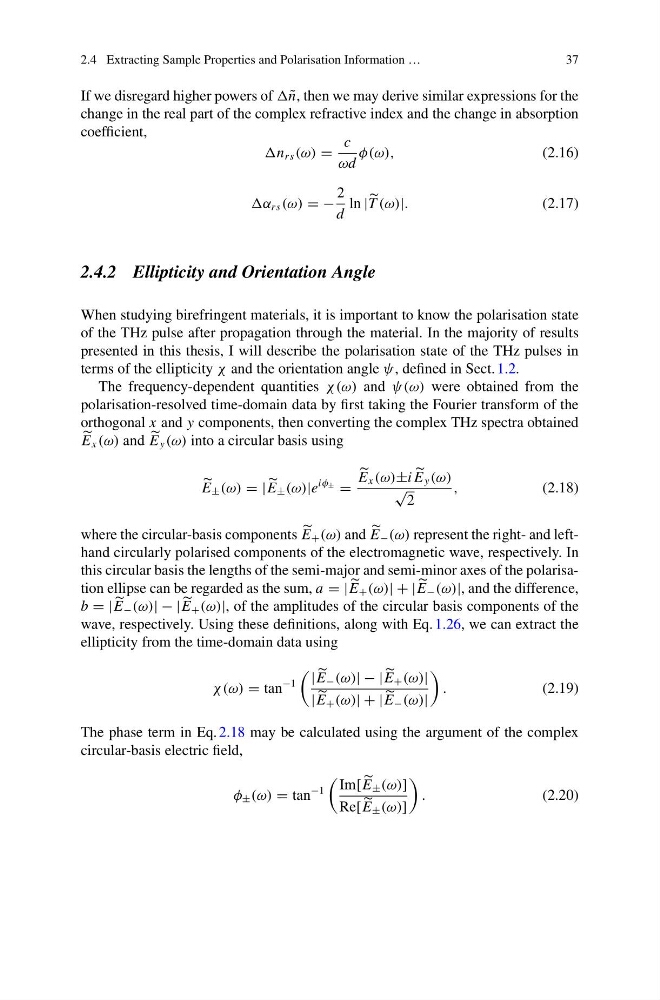
The frequency-dependent quantities χ(ω) and ψ(ω) were obtained from the
polarisation-resolved time-domain data by first taking the Fourier transform of the
orthogonal x and y components, then converting the complex THz spectra obtained
E x (ω) and
E y (ω) into a circular basis using
E ± (ω) = |
E ± (ω)|e
iφ ± =
E x (ω)±i
E y (ω)
√
2
,
(2.18)
where the circular-basis components
E + (ω) and
E − (ω) represent the right- and lefthand circularly polarised components of the electromagnetic wave, respectively. In
this circular basis the lengths of the semi-major and semi-minor axes of the polarisation ellipse can be regarded as the sum, a = |
E + (ω)| + |
E − (ω)|, and the difference,
b = |
E − (ω)| − |
E + (ω)|, of the amplitudes of the circular basis components of the
wave, respectively. Using these definitions, along with Eq. 1.26, we can extract the
ellipticity from the time-domain data using
χ(ω) = tan
−1
|
E − (ω)| − |
E + (ω)|
|
E + (ω)| + |
E − (ω)|
.
(2.19)
The phase term in Eq. 2.18 may be calculated using the argument of the complex
circular-basis electric field,
φ ± (ω) = tan
−1
Im[
E ± (ω)]
Re[
E ± (ω)]
.
(2.20)
37
If we disregard higher powers of ˜
n, then we may derive similar expressions for the
change in the real part of the complex refractive index and the change in absorption
coefficient,
n rs (ω) =
c
ωd
φ(ω),
(2.16)
α rs (ω) = −
2
d
ln |
T (ω)|.
(2.17)
2.4.2 Ellipticity and Orientation Angle
When studying birefringent materials, it is important to know the polarisation state
of the THz pulse after propagation through the material. In the majority of results
presented in this thesis, I will describe the polarisation state of the THz pulses in
terms of the ellipticity χ and the orientation angle ψ, defined in Sect. 1.2.
The frequency-dependent quantities χ(ω) and ψ(ω) were obtained from the
polarisation-resolved time-domain data by first taking the Fourier transform of the
orthogonal x and y components, then converting the complex THz spectra obtained
E x (ω) and
E y (ω) into a circular basis using
E ± (ω) = |
E ± (ω)|e
iφ ± =
E x (ω)±i
E y (ω)
√
2
,
(2.18)
where the circular-basis components
E + (ω) and
E − (ω) represent the right- and lefthand circularly polarised components of the electromagnetic wave, respectively. In
this circular basis the lengths of the semi-major and semi-minor axes of the polarisation ellipse can be regarded as the sum, a = |
E + (ω)| + |
E − (ω)|, and the difference,
b = |
E − (ω)| − |
E + (ω)|, of the amplitudes of the circular basis components of the
wave, respectively. Using these definitions, along with Eq. 1.26, we can extract the
ellipticity from the time-domain data using
χ(ω) = tan
−1
|
E − (ω)| − |
E + (ω)|
|
E + (ω)| + |
E − (ω)|
.
(2.19)
The phase term in Eq. 2.18 may be calculated using the argument of the complex
circular-basis electric field,
φ ± (ω) = tan
−1
Im[
E ± (ω)]
Re[
E ± (ω)]
.
(2.20)