

1.3 Electromagnons in Improper Ferroelectrics
17
1.3.3 Improper Ferroelectricity and Electromagnons in CuO
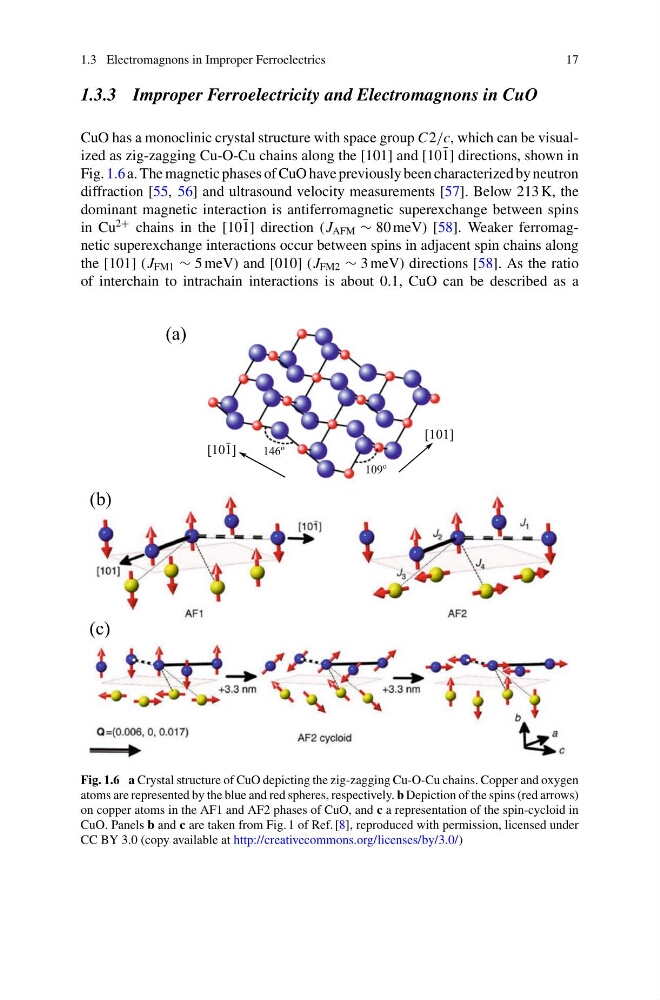
CuO has a monoclinic crystal structure with space group C2/c, which can be visualized as zig-zagging Cu-O-Cu chains along the [101] and [10 ¯
1] directions, shown in
Fig. 1.6 a. The magnetic phases of CuO have previously been characterized by neutron
diffraction [55, 56] and ultrasound velocity measurements [57]. Below 213 K, the
dominant magnetic interaction is antiferromagnetic superexchange between spins
in Cu
2+ chains in the [10 ¯
1] direction (J AFM ∼ 80 meV) [58]. Weaker ferromagnetic superexchange interactions occur between spins in adjacent spin chains along
the [101] (J FM1 ∼ 5 meV) and [010] (J FM2 ∼ 3 meV) directions [58]. As the ratio
of interchain to intrachain interactions is about 0.1, CuO can be described as a
(b)
(c)
(a)
146
o
109
o
[101]
[101]
Fig. 1.6 a Crystal structure of CuO depicting the zig-zagging Cu-O-Cu chains. Copper and oxygen
atoms are represented by the blue and red spheres, respectively. b Depiction of the spins (red arrows)
on copper atoms in the AF1 and AF2 phases of CuO, and c a representation of the spin-cycloid in
CuO. Panels b and c are taken from Fig. 1 of Ref. [8], reproduced with permission, licensed under
CC BY 3.0 (copy available at http://creativecommons.org/licenses/by/3.0/)
17
1.3.3 Improper Ferroelectricity and Electromagnons in CuO
CuO has a monoclinic crystal structure with space group C2/c, which can be visualized as zig-zagging Cu-O-Cu chains along the [101] and [10 ¯
1] directions, shown in
Fig. 1.6 a. The magnetic phases of CuO have previously been characterized by neutron
diffraction [55, 56] and ultrasound velocity measurements [57]. Below 213 K, the
dominant magnetic interaction is antiferromagnetic superexchange between spins
in Cu
2+ chains in the [10 ¯
1] direction (J AFM ∼ 80 meV) [58]. Weaker ferromagnetic superexchange interactions occur between spins in adjacent spin chains along
the [101] (J FM1 ∼ 5 meV) and [010] (J FM2 ∼ 3 meV) directions [58]. As the ratio
of interchain to intrachain interactions is about 0.1, CuO can be described as a
(b)
(c)
(a)
146
o
109
o
[101]
[101]
Fig. 1.6 a Crystal structure of CuO depicting the zig-zagging Cu-O-Cu chains. Copper and oxygen
atoms are represented by the blue and red spheres, respectively. b Depiction of the spins (red arrows)
on copper atoms in the AF1 and AF2 phases of CuO, and c a representation of the spin-cycloid in
CuO. Panels b and c are taken from Fig. 1 of Ref. [8], reproduced with permission, licensed under
CC BY 3.0 (copy available at http://creativecommons.org/licenses/by/3.0/)