

1.1 Crystal Optics
7
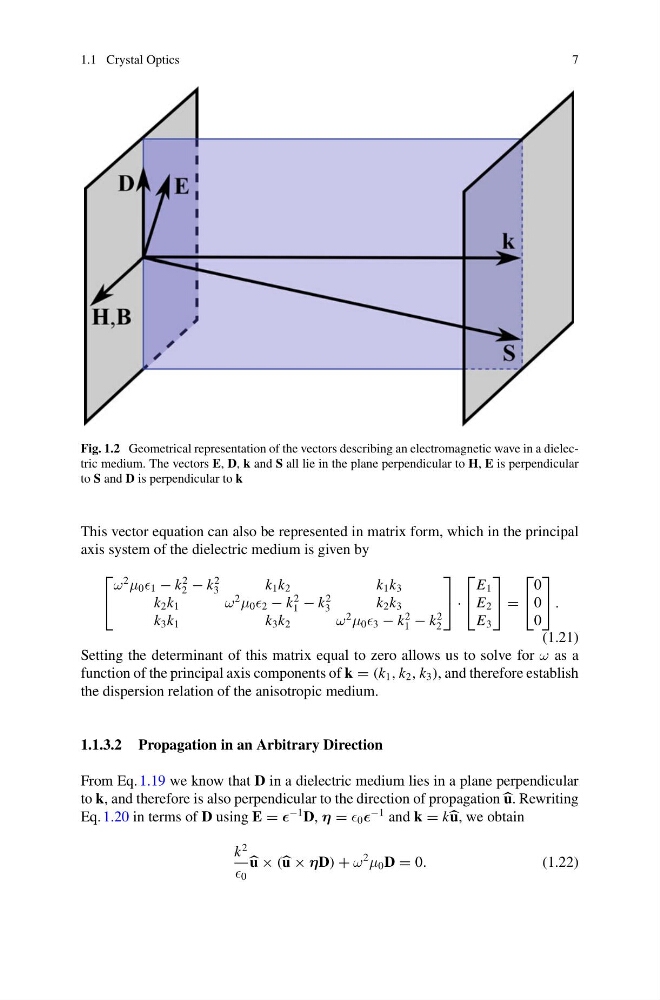
Fig. 1.2 Geometrical representation of the vectors describing an electromagnetic wave in a dielectric medium. The vectors E, D, k and S all lie in the plane perpendicular to H, E is perpendicular
to S and D is perpendicular to k
This vector equation can also be represented in matrix form, which in the principal
axis system of the dielectric medium is given by
⎡
⎣
ω
2
μ 0 1 − k
2
2 − k
2
3
k 1 k 2
k 1 k 3
k 2 k 1
ω
2
μ 0 2 − k
2
1 − k
2
3
k 2 k 3
k 3 k 1
k 3 k 2
ω
2
μ 0 3 − k
2
1 − k
2
2
⎤
⎦ ·
⎡
⎣
E 1
E 2
E 3
⎤
⎦ =
⎡
⎣
0
0
0
⎤
⎦ .
(1.21)
Setting the determinant of this matrix equal to zero allows us to solve for ω as a
function of the principal axis components of k = (k 1 , k 2 , k 3 ), and therefore establish
the dispersion relation of the anisotropic medium.
1.1.3.2 Propagation in an Arbitrary Direction
From Eq. 1.19 we know that D in a dielectric medium lies in a plane perpendicular
to k, and therefore is also perpendicular to the direction of propagation u. Rewriting
Eq. 1.20 in terms of D using E =
−1 D, η = 0
−1 and k = k u, we obtain
k
2
0
u × ( u × ηD) + ω
2
μ 0 D = 0.
(1.22)
7
Fig. 1.2 Geometrical representation of the vectors describing an electromagnetic wave in a dielectric medium. The vectors E, D, k and S all lie in the plane perpendicular to H, E is perpendicular
to S and D is perpendicular to k
This vector equation can also be represented in matrix form, which in the principal
axis system of the dielectric medium is given by
⎡
⎣
ω
2
μ 0 1 − k
2
2 − k
2
3
k 1 k 2
k 1 k 3
k 2 k 1
ω
2
μ 0 2 − k
2
1 − k
2
3
k 2 k 3
k 3 k 1
k 3 k 2
ω
2
μ 0 3 − k
2
1 − k
2
2
⎤
⎦ ·
⎡
⎣
E 1
E 2
E 3
⎤
⎦ =
⎡
⎣
0
0
0
⎤
⎦ .
(1.21)
Setting the determinant of this matrix equal to zero allows us to solve for ω as a
function of the principal axis components of k = (k 1 , k 2 , k 3 ), and therefore establish
the dispersion relation of the anisotropic medium.
1.1.3.2 Propagation in an Arbitrary Direction
From Eq. 1.19 we know that D in a dielectric medium lies in a plane perpendicular
to k, and therefore is also perpendicular to the direction of propagation u. Rewriting
Eq. 1.20 in terms of D using E =
−1 D, η = 0
−1 and k = k u, we obtain
k
2
0
u × ( u × ηD) + ω
2
μ 0 D = 0.
(1.22)