

4
1 Introduction
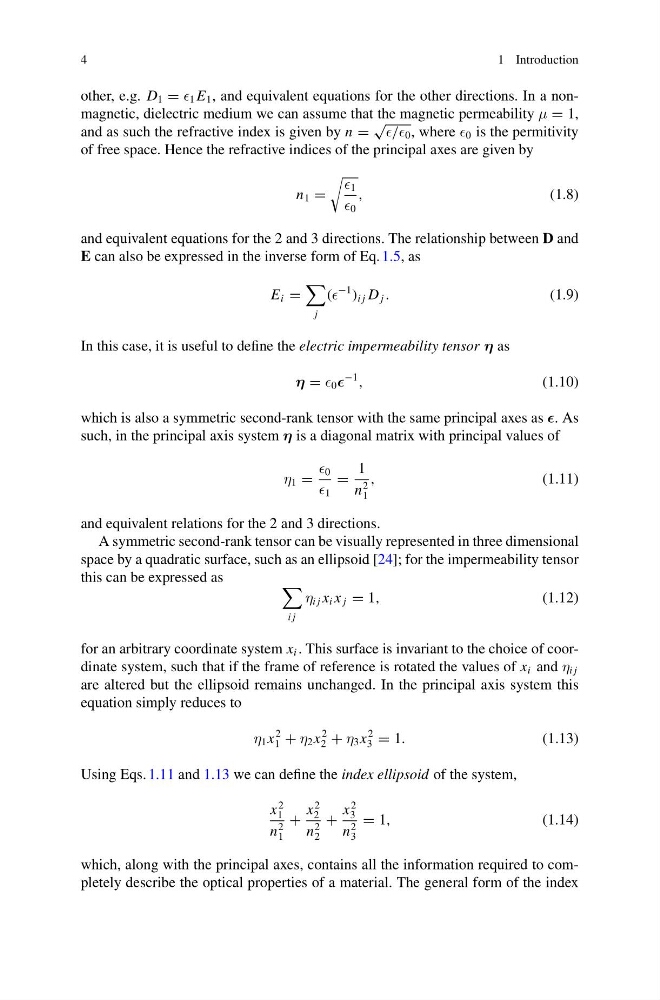
other, e.g. D 1 = 1 E 1 , and equivalent equations for the other directions. In a nonmagnetic, dielectric medium we can assume that the magnetic permeability μ = 1,
and as such the refractive index is given by n =
√ / 0 , where 0 is the permitivity
of free space. Hence the refractive indices of the principal axes are given by
n 1 =
1
0
,
(1.8)
and equivalent equations for the 2 and 3 directions. The relationship between D and
E can also be expressed in the inverse form of Eq. 1.5, as
E i =
j
(
−1
) i j D j .
(1.9)
In this case, it is useful to define the electric impermeability tensor η as
η = 0
−1
,
(1.10)
which is also a symmetric second-rank tensor with the same principal axes as . As
such, in the principal axis system η is a diagonal matrix with principal values of
η 1 =
0
1
=
1
n
2
1
,
(1.11)
and equivalent relations for the 2 and 3 directions.
A symmetric second-rank tensor can be visually represented in three dimensional
space by a quadratic surface, such as an ellipsoid [24]; for the impermeability tensor
this can be expressed as
i j
η i j x i x j = 1,
(1.12)
for an arbitrary coordinate system x i . This surface is invariant to the choice of coordinate system, such that if the frame of reference is rotated the values of x i and η i j
are altered but the ellipsoid remains unchanged. In the principal axis system this
equation simply reduces to
η 1 x
2
1 + η 2 x
2
2 + η 3 x
2
3 = 1.
(1.13)
Using Eqs. 1.11 and 1.13 we can define the index ellipsoid of the system,
x
2
1
n
2
1
+
x
2
2
n
2
2
+
x
2
3
n
2
3
= 1,
(1.14)
which, along with the principal axes, contains all the information required to completely describe the optical properties of a material. The general form of the index
1 Introduction
other, e.g. D 1 = 1 E 1 , and equivalent equations for the other directions. In a nonmagnetic, dielectric medium we can assume that the magnetic permeability μ = 1,
and as such the refractive index is given by n =
√ / 0 , where 0 is the permitivity
of free space. Hence the refractive indices of the principal axes are given by
n 1 =
1
0
,
(1.8)
and equivalent equations for the 2 and 3 directions. The relationship between D and
E can also be expressed in the inverse form of Eq. 1.5, as
E i =
j
(
−1
) i j D j .
(1.9)
In this case, it is useful to define the electric impermeability tensor η as
η = 0
−1
,
(1.10)
which is also a symmetric second-rank tensor with the same principal axes as . As
such, in the principal axis system η is a diagonal matrix with principal values of
η 1 =
0
1
=
1
n
2
1
,
(1.11)
and equivalent relations for the 2 and 3 directions.
A symmetric second-rank tensor can be visually represented in three dimensional
space by a quadratic surface, such as an ellipsoid [24]; for the impermeability tensor
this can be expressed as
i j
η i j x i x j = 1,
(1.12)
for an arbitrary coordinate system x i . This surface is invariant to the choice of coordinate system, such that if the frame of reference is rotated the values of x i and η i j
are altered but the ellipsoid remains unchanged. In the principal axis system this
equation simply reduces to
η 1 x
2
1 + η 2 x
2
2 + η 3 x
2
3 = 1.
(1.13)
Using Eqs. 1.11 and 1.13 we can define the index ellipsoid of the system,
x
2
1
n
2
1
+
x
2
2
n
2
2
+
x
2
3
n
2
3
= 1,
(1.14)
which, along with the principal axes, contains all the information required to completely describe the optical properties of a material. The general form of the index