

5.5 Electric Field-Dependent THz Transmission of CuO
107
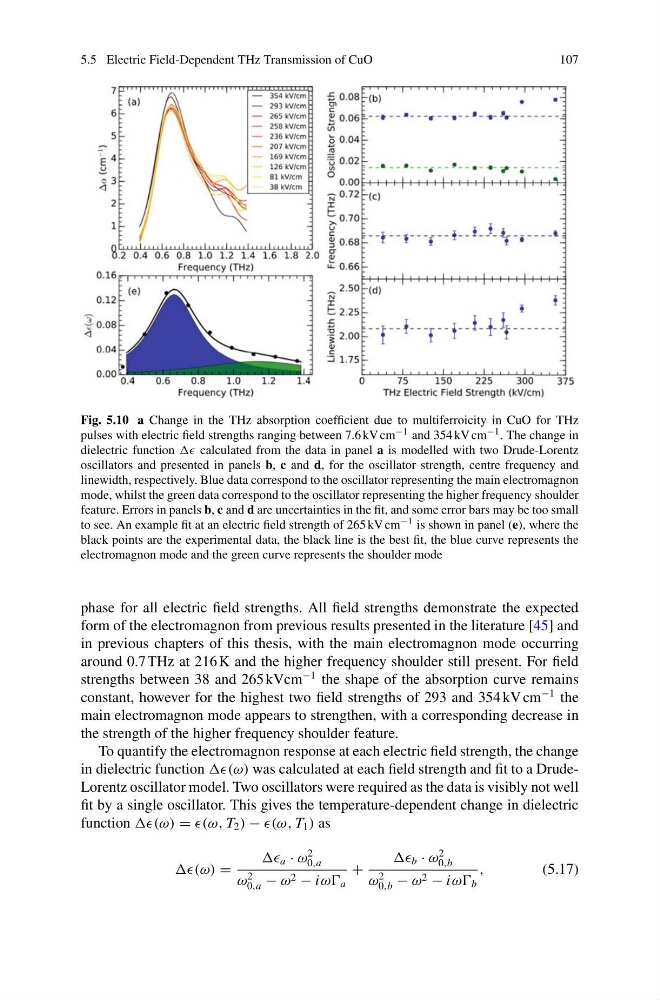
Fig. 5.10 a Change in the THz absorption coefficient due to multiferroicity in CuO for THz
pulses with electric field strengths ranging between 7.6 kV cm −1 and 354 kV cm −1 . The change in
dielectric function calculated from the data in panel a is modelled with two Drude-Lorentz
oscillators and presented in panels b, c and d, for the oscillator strength, centre frequency and
linewidth, respectively. Blue data correspond to the oscillator representing the main electromagnon
mode, whilst the green data correspond to the oscillator representing the higher frequency shoulder
feature. Errors in panels b, c and d are uncertainties in the fit, and some error bars may be too small
to see. An example fit at an electric field strength of 265 kV cm −1 is shown in panel (e), where the
black points are the experimental data, the black line is the best fit, the blue curve represents the
electromagnon mode and the green curve represents the shoulder mode
phase for all electric field strengths. All field strengths demonstrate the expected
form of the electromagnon from previous results presented in the literature [45] and
in previous chapters of this thesis, with the main electromagnon mode occurring
around 0.7 THz at 216 K and the higher frequency shoulder still present. For field
strengths between 38 and 265 kVcm
−1 the shape of the absorption curve remains
constant, however for the highest two field strengths of 293 and 354 kV cm
−1 the
main electromagnon mode appears to strengthen, with a corresponding decrease in
the strength of the higher frequency shoulder feature.
To quantify the electromagnon response at each electric field strength, the change
in dielectric function was calculated at each field strength and fit to a DrudeLorentz oscillator model. Two oscillators were required as the data is visibly not well
fit by a single oscillator. This gives the temperature-dependent change in dielectric
function = T 2 ) − T 1 ) as
=
a · ω
2
0,a
ω
2
0,a − ω 2 − iωω a
+
b · ω
2
0,b
ω
2
0,b − ω 2 − iωω b
,
(5.17)
107
Fig. 5.10 a Change in the THz absorption coefficient due to multiferroicity in CuO for THz
pulses with electric field strengths ranging between 7.6 kV cm −1 and 354 kV cm −1 . The change in
dielectric function calculated from the data in panel a is modelled with two Drude-Lorentz
oscillators and presented in panels b, c and d, for the oscillator strength, centre frequency and
linewidth, respectively. Blue data correspond to the oscillator representing the main electromagnon
mode, whilst the green data correspond to the oscillator representing the higher frequency shoulder
feature. Errors in panels b, c and d are uncertainties in the fit, and some error bars may be too small
to see. An example fit at an electric field strength of 265 kV cm −1 is shown in panel (e), where the
black points are the experimental data, the black line is the best fit, the blue curve represents the
electromagnon mode and the green curve represents the shoulder mode
phase for all electric field strengths. All field strengths demonstrate the expected
form of the electromagnon from previous results presented in the literature [45] and
in previous chapters of this thesis, with the main electromagnon mode occurring
around 0.7 THz at 216 K and the higher frequency shoulder still present. For field
strengths between 38 and 265 kVcm
−1 the shape of the absorption curve remains
constant, however for the highest two field strengths of 293 and 354 kV cm
−1 the
main electromagnon mode appears to strengthen, with a corresponding decrease in
the strength of the higher frequency shoulder feature.
To quantify the electromagnon response at each electric field strength, the change
in dielectric function was calculated at each field strength and fit to a DrudeLorentz oscillator model. Two oscillators were required as the data is visibly not well
fit by a single oscillator. This gives the temperature-dependent change in dielectric
function = T 2 ) − T 1 ) as
=
a · ω
2
0,a
ω
2
0,a − ω 2 − iωω a
+
b · ω
2
0,b
ω
2
0,b − ω 2 − iωω b
,
(5.17)