

western Himalayan (WH) stations recorded a significant
warming trend especially from 1975 onwards. This is also
supported by tree-ring chronologies of the region which
indicated rapid growth of tree rings in the recent decades
especially at higher altitudes (Borgaonkar et al. 2009). This
chapter provides an assessment of the current state of knowledge of the weather and climate aspects of the HKH region.
Thematic assessments of socio-economic and other sectorial
impacts are covered in the “Hindu Kush Himalaya Assessment
report” (Wester et al. 2019) and the “IPCC Special report on
Ocean and Cryosphere in a Changing Climate, Chapter 2:
High Mountain Areas” (IPCC SROC 2019).
Box 11.1 Weather and climate of Himalaya
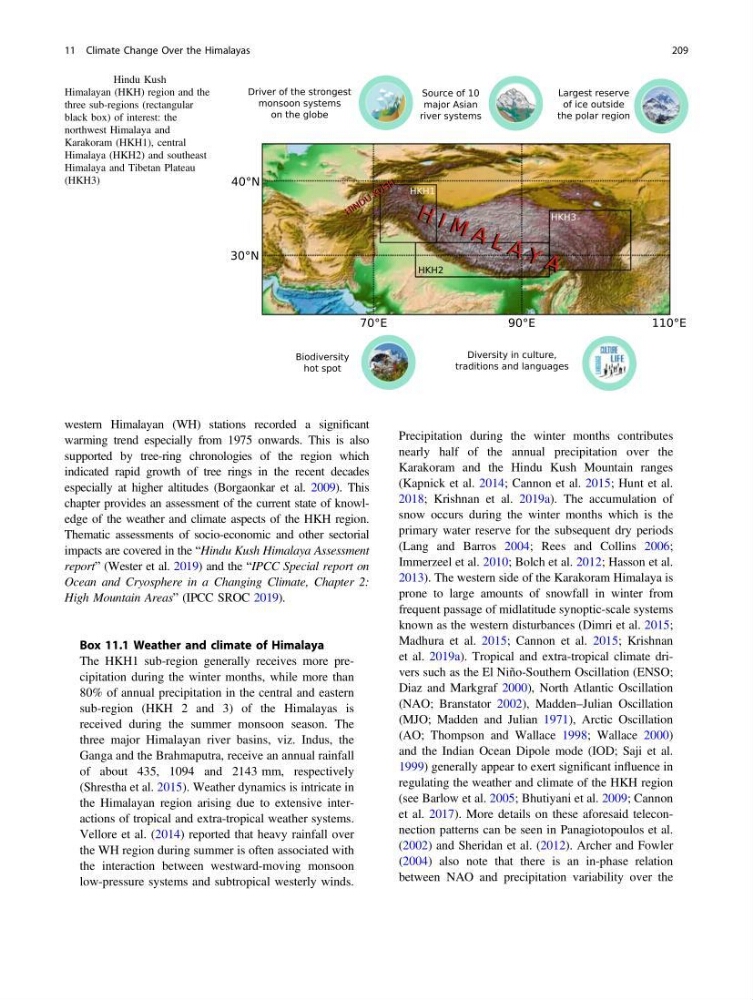
The HKH1 sub-region generally receives more precipitation during the winter months, while more than
80% of annual precipitation in the central and eastern
sub-region (HKH 2 and 3) of the Himalayas is
received during the summer monsoon season. The
three major Himalayan river basins, viz. Indus, the
Ganga and the Brahmaputra, receive an annual rainfall
of about 435, 1094 and 2143 mm, respectively
(Shrestha et al. 2015). Weather dynamics is intricate in
the Himalayan region arising due to extensive interactions of tropical and extra-tropical weather systems.
Vellore et al. (2014) reported that heavy rainfall over
the WH region during summer is often associated with
the interaction between westward-moving monsoon
low-pressure systems and subtropical westerly winds.
Precipitation during the winter months contributes
nearly half of the annual precipitation over the
Karakoram and the Hindu Kush Mountain ranges
(Kapnick et al. 2014; Cannon et al. 2015; Hunt et al.
2018; Krishnan et al. 2019a). The accumulation of
snow occurs during the winter months which is the
primary water reserve for the subsequent dry periods
(Lang and Barros 2004; Rees and Collins 2006;
Immerzeel et al. 2010; Bolch et al. 2012; Hasson et al.
2013). The western side of the Karakoram Himalaya is
prone to large amounts of snowfall in winter from
frequent passage of midlatitude synoptic-scale systems
known as the western disturbances (Dimri et al. 2015;
Madhura et al. 2015; Cannon et al. 2015; Krishnan
et al. 2019a). Tropical and extra-tropical climate drivers such as the El Niño-Southern Oscillation (ENSO;
Diaz and Markgraf 2000), North Atlantic Oscillation
(NAO; Branstator 2002), Madden–Julian Oscillation
(MJO; Madden and Julian 1971), Arctic Oscillation
(AO; Thompson and Wallace 1998; Wallace 2000)
and the Indian Ocean Dipole mode (IOD; Saji et al.
1999) generally appear to exert significant influence in
regulating the weather and climate of the HKH region
(see Barlow et al. 2005; Bhutiyani et al. 2009; Cannon
et al. 2017). More details on these aforesaid teleconnection patterns can be seen in Panagiotopoulos et al.
(2002) and Sheridan et al. (2012). Archer and Fowler
(2004) also note that there is an in-phase relation
between NAO and precipitation variability over the
Fig. 11.1 Hindu Kush
Himalayan (HKH) region and the
three sub-regions (rectangular
black box) of interest: the
northwest Himalaya and
Karakoram (HKH1), central
Himalaya (HKH2) and southeast
Himalaya and Tibetan Plateau
(HKH3)
11 Climate Change Over the Himalayas
209
warming trend especially from 1975 onwards. This is also
supported by tree-ring chronologies of the region which
indicated rapid growth of tree rings in the recent decades
especially at higher altitudes (Borgaonkar et al. 2009). This
chapter provides an assessment of the current state of knowledge of the weather and climate aspects of the HKH region.
Thematic assessments of socio-economic and other sectorial
impacts are covered in the “Hindu Kush Himalaya Assessment
report” (Wester et al. 2019) and the “IPCC Special report on
Ocean and Cryosphere in a Changing Climate, Chapter 2:
High Mountain Areas” (IPCC SROC 2019).
Box 11.1 Weather and climate of Himalaya
The HKH1 sub-region generally receives more precipitation during the winter months, while more than
80% of annual precipitation in the central and eastern
sub-region (HKH 2 and 3) of the Himalayas is
received during the summer monsoon season. The
three major Himalayan river basins, viz. Indus, the
Ganga and the Brahmaputra, receive an annual rainfall
of about 435, 1094 and 2143 mm, respectively
(Shrestha et al. 2015). Weather dynamics is intricate in
the Himalayan region arising due to extensive interactions of tropical and extra-tropical weather systems.
Vellore et al. (2014) reported that heavy rainfall over
the WH region during summer is often associated with
the interaction between westward-moving monsoon
low-pressure systems and subtropical westerly winds.
Precipitation during the winter months contributes
nearly half of the annual precipitation over the
Karakoram and the Hindu Kush Mountain ranges
(Kapnick et al. 2014; Cannon et al. 2015; Hunt et al.
2018; Krishnan et al. 2019a). The accumulation of
snow occurs during the winter months which is the
primary water reserve for the subsequent dry periods
(Lang and Barros 2004; Rees and Collins 2006;
Immerzeel et al. 2010; Bolch et al. 2012; Hasson et al.
2013). The western side of the Karakoram Himalaya is
prone to large amounts of snowfall in winter from
frequent passage of midlatitude synoptic-scale systems
known as the western disturbances (Dimri et al. 2015;
Madhura et al. 2015; Cannon et al. 2015; Krishnan
et al. 2019a). Tropical and extra-tropical climate drivers such as the El Niño-Southern Oscillation (ENSO;
Diaz and Markgraf 2000), North Atlantic Oscillation
(NAO; Branstator 2002), Madden–Julian Oscillation
(MJO; Madden and Julian 1971), Arctic Oscillation
(AO; Thompson and Wallace 1998; Wallace 2000)
and the Indian Ocean Dipole mode (IOD; Saji et al.
1999) generally appear to exert significant influence in
regulating the weather and climate of the HKH region
(see Barlow et al. 2005; Bhutiyani et al. 2009; Cannon
et al. 2017). More details on these aforesaid teleconnection patterns can be seen in Panagiotopoulos et al.
(2002) and Sheridan et al. (2012). Archer and Fowler
(2004) also note that there is an in-phase relation
between NAO and precipitation variability over the
Fig. 11.1 Hindu Kush
Himalayan (HKH) region and the
three sub-regions (rectangular
black box) of interest: the
northwest Himalaya and
Karakoram (HKH1), central
Himalaya (HKH2) and southeast
Himalaya and Tibetan Plateau
(HKH3)
11 Climate Change Over the Himalayas
209