

Key Messages
• While the frequency of summer monsoon lows has significantly increased, the frequency of monsoon depressions has declined during 1951–2015 (high confidence)
• A significant rising trend in the amplitude of wintertime
western disturbances is observed during 1951–2015
(medium confidence).
• Climate models project a decline in the frequency of
monsoon low-pressure systems (LPS) by the end of
twenty-first century (medium confidence).
• Climate models also project a poleward shift in monsoon
LPS activity by the end of the twenty-first century which
is likely to enhance heavy rainfall occurrences over
northern India (medium confidence).
7.1 Introduction
The weather over the Indian subcontinent is distinctly influenced by various synoptic-scale weather systems, viz., monsoon lows, monsoon depressions, mid-tropospheric cyclones,
tropical cyclones and western disturbances (Sikka 2006).
These synoptic-scale weather systems have horizontal
dimensions varying from 100 to 2000 km and temporal
dimensions ranging from a few to several days (Wallace and
Hobbs 2006; Ding and Sikka 2006). They bring floods,
snowstorms, and avalanches to Indian landmass, subsequently
modulating the annual mean Indian rainfall (Ajayamohan
et al. 2010; Revadekar et al. 2016; Sikka 2006; Hunt et al.
2016a, b). Since Indian agriculture depends on seasonal rains,
the inter-annual variability in the synoptic-scale weather
systems plays an instrumental role in the socio-economic
fabric of the country (e.g. Ajayamohan et al. 2010; Hunt et al.
2016a, b). This chapter provides an assessment of observed
and future changes in synoptic weather systems during boreal
summer (i.e., monsoon lows and depressions) and winter to
spring season (i.e., western disturbances).
7.1.1 Monsoon Low-Pressure Systems
The synoptic-scale weather systems formed during the
Indian summer monsoon season (June to September, JJAS)
have varying intensities, collectively referred as the
low-pressure systems (LPS; Mooley 1973; Sikka 1977; Saha
et al. 1981; Mooley and Shukla 1989; Krishnamurthy and
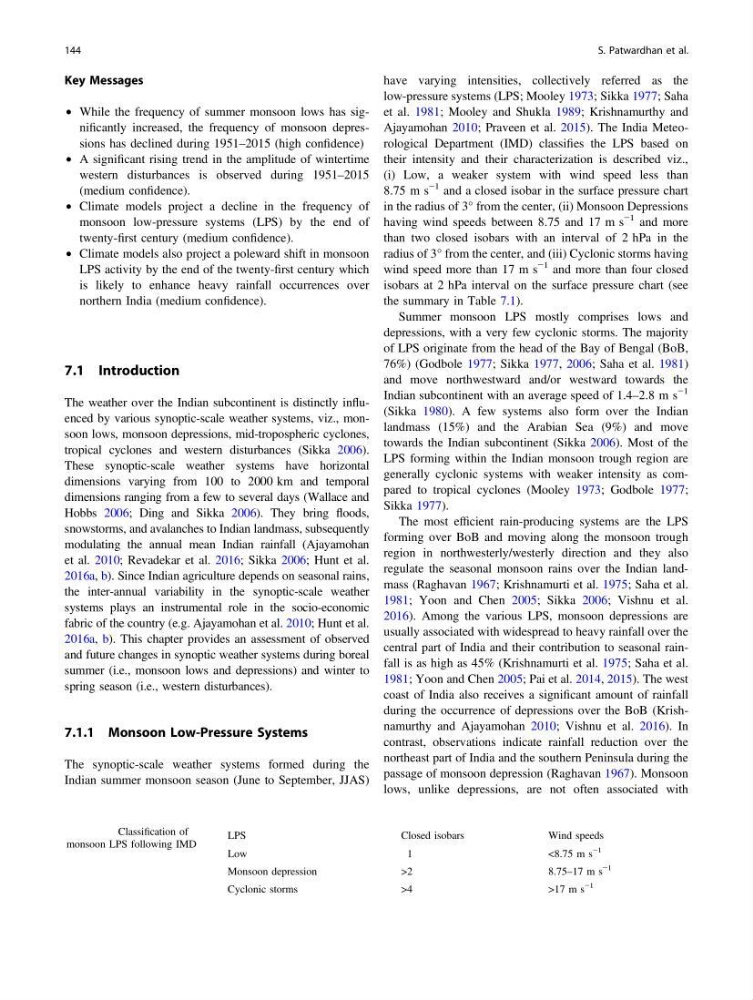
Ajayamohan 2010; Praveen et al. 2015). The India Meteorological Department (IMD) classifies the LPS based on
their intensity and their characterization is described viz.,
(i) Low, a weaker system with wind speed less than
8.75 m s
−1 and a closed isobar in the surface pressure chart
in the radius of 3° from the center, (ii) Monsoon Depressions
having wind speeds between 8.75 and 17 m s
−1 and more
than two closed isobars with an interval of 2 hPa in the
radius of 3° from the center, and (iii) Cyclonic storms having
wind speed more than 17 m s
−1 and more than four closed
isobars at 2 hPa interval on the surface pressure chart (see
the summary in Table 7.1).
Summer monsoon LPS mostly comprises lows and
depressions, with a very few cyclonic storms. The majority
of LPS originate from the head of the Bay of Bengal (BoB,
76%) (Godbole 1977; Sikka 1977, 2006; Saha et al. 1981)
and move northwestward and/or westward towards the
Indian subcontinent with an average speed of 1.4–2.8 m s
−1
(Sikka 1980). A few systems also form over the Indian
landmass (15%) and the Arabian Sea (9%) and move
towards the Indian subcontinent (Sikka 2006). Most of the
LPS forming within the Indian monsoon trough region are
generally cyclonic systems with weaker intensity as compared to tropical cyclones (Mooley 1973; Godbole 1977;
Sikka 1977).
The most efficient rain-producing systems are the LPS
forming over BoB and moving along the monsoon trough
region in northwesterly/westerly direction and they also
regulate the seasonal monsoon rains over the Indian landmass (Raghavan 1967; Krishnamurti et al. 1975; Saha et al.
1981; Yoon and Chen 2005; Sikka 2006; Vishnu et al.
2016). Among the various LPS, monsoon depressions are
usually associated with widespread to heavy rainfall over the
central part of India and their contribution to seasonal rainfall is as high as 45% (Krishnamurti et al. 1975; Saha et al.
1981; Yoon and Chen 2005; Pai et al. 2014, 2015). The west
coast of India also receives a significant amount of rainfall
during the occurrence of depressions over the BoB (Krishnamurthy and Ajayamohan 2010; Vishnu et al. 2016). In
contrast, observations indicate rainfall reduction over the
northeast part of India and the southern Peninsula during the
passage of monsoon depression (Raghavan 1967). Monsoon
lows, unlike depressions, are not often associated with
Table 7.1 Classification of
monsoon LPS following IMD
LPS
Closed isobars
Wind speeds
Low
1
<8.75 m s
−1
Monsoon depression
>2
8.75–17 m s
−1
Cyclonic storms
>4
>17 m s
−1
144
S. Patwardhan et al.
• While the frequency of summer monsoon lows has significantly increased, the frequency of monsoon depressions has declined during 1951–2015 (high confidence)
• A significant rising trend in the amplitude of wintertime
western disturbances is observed during 1951–2015
(medium confidence).
• Climate models project a decline in the frequency of
monsoon low-pressure systems (LPS) by the end of
twenty-first century (medium confidence).
• Climate models also project a poleward shift in monsoon
LPS activity by the end of the twenty-first century which
is likely to enhance heavy rainfall occurrences over
northern India (medium confidence).
7.1 Introduction
The weather over the Indian subcontinent is distinctly influenced by various synoptic-scale weather systems, viz., monsoon lows, monsoon depressions, mid-tropospheric cyclones,
tropical cyclones and western disturbances (Sikka 2006).
These synoptic-scale weather systems have horizontal
dimensions varying from 100 to 2000 km and temporal
dimensions ranging from a few to several days (Wallace and
Hobbs 2006; Ding and Sikka 2006). They bring floods,
snowstorms, and avalanches to Indian landmass, subsequently
modulating the annual mean Indian rainfall (Ajayamohan
et al. 2010; Revadekar et al. 2016; Sikka 2006; Hunt et al.
2016a, b). Since Indian agriculture depends on seasonal rains,
the inter-annual variability in the synoptic-scale weather
systems plays an instrumental role in the socio-economic
fabric of the country (e.g. Ajayamohan et al. 2010; Hunt et al.
2016a, b). This chapter provides an assessment of observed
and future changes in synoptic weather systems during boreal
summer (i.e., monsoon lows and depressions) and winter to
spring season (i.e., western disturbances).
7.1.1 Monsoon Low-Pressure Systems
The synoptic-scale weather systems formed during the
Indian summer monsoon season (June to September, JJAS)
have varying intensities, collectively referred as the
low-pressure systems (LPS; Mooley 1973; Sikka 1977; Saha
et al. 1981; Mooley and Shukla 1989; Krishnamurthy and
Ajayamohan 2010; Praveen et al. 2015). The India Meteorological Department (IMD) classifies the LPS based on
their intensity and their characterization is described viz.,
(i) Low, a weaker system with wind speed less than
8.75 m s
−1 and a closed isobar in the surface pressure chart
in the radius of 3° from the center, (ii) Monsoon Depressions
having wind speeds between 8.75 and 17 m s
−1 and more
than two closed isobars with an interval of 2 hPa in the
radius of 3° from the center, and (iii) Cyclonic storms having
wind speed more than 17 m s
−1 and more than four closed
isobars at 2 hPa interval on the surface pressure chart (see
the summary in Table 7.1).
Summer monsoon LPS mostly comprises lows and
depressions, with a very few cyclonic storms. The majority
of LPS originate from the head of the Bay of Bengal (BoB,
76%) (Godbole 1977; Sikka 1977, 2006; Saha et al. 1981)
and move northwestward and/or westward towards the
Indian subcontinent with an average speed of 1.4–2.8 m s
−1
(Sikka 1980). A few systems also form over the Indian
landmass (15%) and the Arabian Sea (9%) and move
towards the Indian subcontinent (Sikka 2006). Most of the
LPS forming within the Indian monsoon trough region are
generally cyclonic systems with weaker intensity as compared to tropical cyclones (Mooley 1973; Godbole 1977;
Sikka 1977).
The most efficient rain-producing systems are the LPS
forming over BoB and moving along the monsoon trough
region in northwesterly/westerly direction and they also
regulate the seasonal monsoon rains over the Indian landmass (Raghavan 1967; Krishnamurti et al. 1975; Saha et al.
1981; Yoon and Chen 2005; Sikka 2006; Vishnu et al.
2016). Among the various LPS, monsoon depressions are
usually associated with widespread to heavy rainfall over the
central part of India and their contribution to seasonal rainfall is as high as 45% (Krishnamurti et al. 1975; Saha et al.
1981; Yoon and Chen 2005; Pai et al. 2014, 2015). The west
coast of India also receives a significant amount of rainfall
during the occurrence of depressions over the BoB (Krishnamurthy and Ajayamohan 2010; Vishnu et al. 2016). In
contrast, observations indicate rainfall reduction over the
northeast part of India and the southern Peninsula during the
passage of monsoon depression (Raghavan 1967). Monsoon
lows, unlike depressions, are not often associated with
Table 7.1 Classification of
monsoon LPS following IMD
LPS
Closed isobars
Wind speeds
Low
1
<8.75 m s
−1
Monsoon depression
>2
8.75–17 m s
−1
Cyclonic storms
>4
>17 m s
−1
144
S. Patwardhan et al.