

variation in spectral width was also largely variable with
airmass characteristics (Bera et al. 2019). CAIPEEX observations have also documented both higher ice mass and
number concentration in monsoon clouds, compared to
pre-monsoon clouds with warm microphysics in the monsoon
clouds determining the ice and mixed-phase microphysical
properties whereas boundary layer moisture plays a key role
in the initial developmental stages (Patade et al. 2014).
Documenting the aerosol and associated activation characteristics as cloud condensation nuclei or ice nuclei particles (INP) is essential for better characterization in numerical
models. Observational data from Nainital shows that
enhanced CCN concentrations coincide more with periods of
aerosol absorption as compared to periods of aerosol scattering (Gogoi et al. 2015). Aerosol chemical composition,
aerosol number size distribution, and CCN data show that
the predictability of CCN improves when SOA component is
considered in hygroscopicity estimates (Singla et al. 2017).
Precipitation susceptibility estimates showed that clouds
having medium liquid water content (0.6–0.8 mm) were
highly affected due to aerosols (Leena et al. 2018). The
vertical variation of aerosol as CCN is important, as the
CCN spectral characteristics are significantly different near
the surface and the cloud base (Varghese et al. 2016). Vertical distribution of aerosol types reveals a mixture of both
biomass burning and dust aerosols (Padmakumari et al.
2013). The role of aged BC particle or bioaerosol acting as
CCN or INP is yet to be investigated over the Indian region.
Physical and chemical characterization of aerosol along with
CCN and INP activity is required in future studies.
Numerical investigation of aerosol effect over the monsoon region shows that cloud microphysics processes are
important for a break to active transition during monsoon
season with higher concentrations of absorbing aerosols
producing invigoration of convection strong moisture convergence and increased upper level heating (Hazra et al.
2013). Within the deep convective clouds during monsoon,
an increase in soluble aerosol led to a marginal increase in
precipitation attributing to enhanced updrafts in the warm
phase and invigoration of mixed-phase cloud processes
(Gayatri et al. 2017). Mixed-phase clouds contribute a
significant part of monsoon clouds, which are least understood and need further focused process studies. A systematic approach aerosol impact on the cloud system effects
needs to be investigated, and the regional impacts on precipitation through redistribution of clouds need to be
understood.
5.2.7 Impact of Convective Transport
of Aerosols
During the monsoon season, deep convection transports
boundary layer aerosols from Asia to the UTLS (Fadnavis
et al. 2013, 2017). These aerosols form a layer near the
tropopause (13–18 km) known as the Asian Tropopause
Aerosol Layer ‘ATAL’ (Vernier et al. 2009). Development
of the ATAL is associated with convective transport of
aerosols from the lower atmosphere to the UTLS (Fadnavis
et al. 2013; Vernier et al. 2015). Observations from satellites
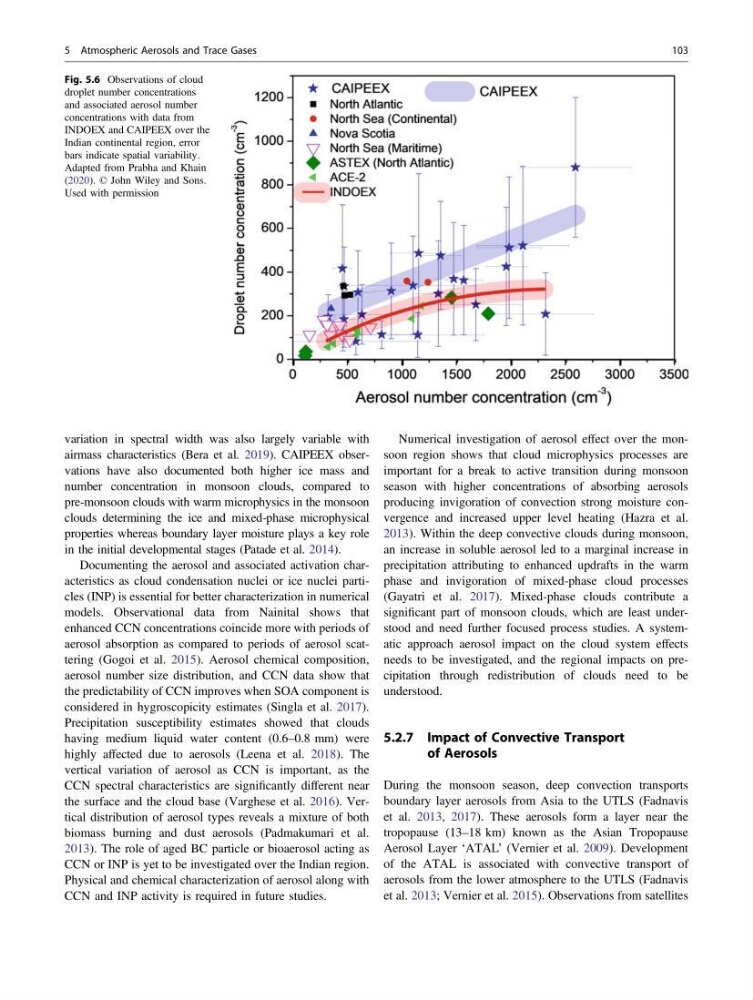
Fig. 5.6 Observations of cloud
droplet number concentrations
and associated aerosol number
concentrations with data from
INDOEX and CAIPEEX over the
Indian continental region, error
bars indicate spatial variability.
Adapted from Prabha and Khain
(2020). © John Wiley and Sons.
Used with permission
5 Atmospheric Aerosols and Trace Gases
103
airmass characteristics (Bera et al. 2019). CAIPEEX observations have also documented both higher ice mass and
number concentration in monsoon clouds, compared to
pre-monsoon clouds with warm microphysics in the monsoon
clouds determining the ice and mixed-phase microphysical
properties whereas boundary layer moisture plays a key role
in the initial developmental stages (Patade et al. 2014).
Documenting the aerosol and associated activation characteristics as cloud condensation nuclei or ice nuclei particles (INP) is essential for better characterization in numerical
models. Observational data from Nainital shows that
enhanced CCN concentrations coincide more with periods of
aerosol absorption as compared to periods of aerosol scattering (Gogoi et al. 2015). Aerosol chemical composition,
aerosol number size distribution, and CCN data show that
the predictability of CCN improves when SOA component is
considered in hygroscopicity estimates (Singla et al. 2017).
Precipitation susceptibility estimates showed that clouds
having medium liquid water content (0.6–0.8 mm) were
highly affected due to aerosols (Leena et al. 2018). The
vertical variation of aerosol as CCN is important, as the
CCN spectral characteristics are significantly different near
the surface and the cloud base (Varghese et al. 2016). Vertical distribution of aerosol types reveals a mixture of both
biomass burning and dust aerosols (Padmakumari et al.
2013). The role of aged BC particle or bioaerosol acting as
CCN or INP is yet to be investigated over the Indian region.
Physical and chemical characterization of aerosol along with
CCN and INP activity is required in future studies.
Numerical investigation of aerosol effect over the monsoon region shows that cloud microphysics processes are
important for a break to active transition during monsoon
season with higher concentrations of absorbing aerosols
producing invigoration of convection strong moisture convergence and increased upper level heating (Hazra et al.
2013). Within the deep convective clouds during monsoon,
an increase in soluble aerosol led to a marginal increase in
precipitation attributing to enhanced updrafts in the warm
phase and invigoration of mixed-phase cloud processes
(Gayatri et al. 2017). Mixed-phase clouds contribute a
significant part of monsoon clouds, which are least understood and need further focused process studies. A systematic approach aerosol impact on the cloud system effects
needs to be investigated, and the regional impacts on precipitation through redistribution of clouds need to be
understood.
5.2.7 Impact of Convective Transport
of Aerosols
During the monsoon season, deep convection transports
boundary layer aerosols from Asia to the UTLS (Fadnavis
et al. 2013, 2017). These aerosols form a layer near the
tropopause (13–18 km) known as the Asian Tropopause
Aerosol Layer ‘ATAL’ (Vernier et al. 2009). Development
of the ATAL is associated with convective transport of
aerosols from the lower atmosphere to the UTLS (Fadnavis
et al. 2013; Vernier et al. 2015). Observations from satellites
Fig. 5.6 Observations of cloud
droplet number concentrations
and associated aerosol number
concentrations with data from
INDOEX and CAIPEEX over the
Indian continental region, error
bars indicate spatial variability.
Adapted from Prabha and Khain
(2020). © John Wiley and Sons.
Used with permission
5 Atmospheric Aerosols and Trace Gases
103