

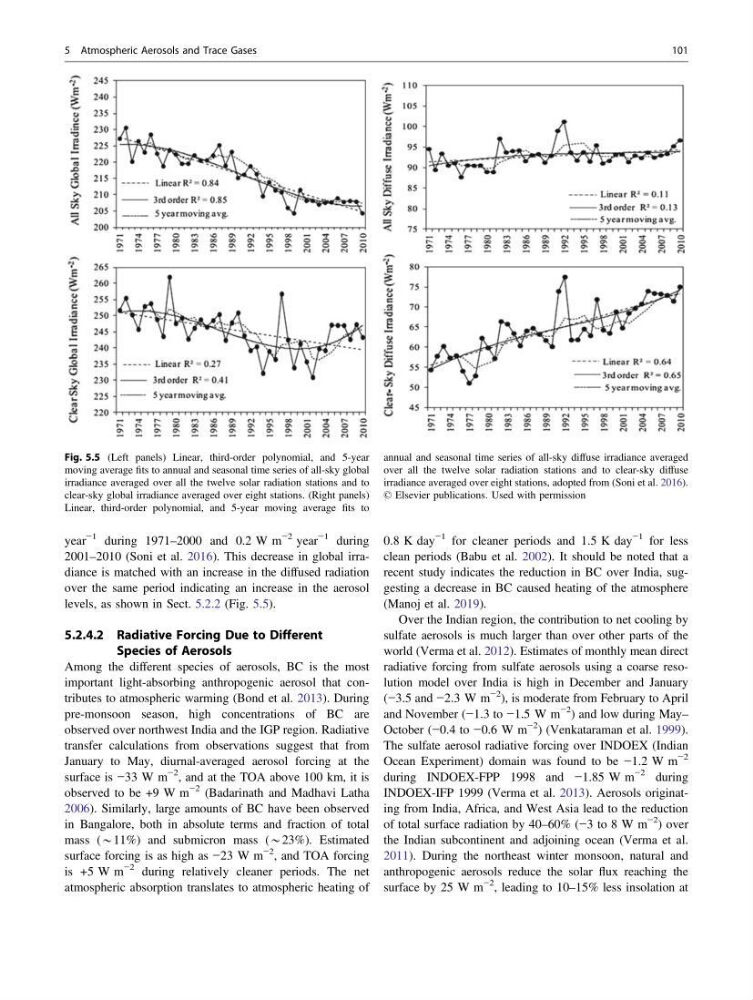
year
−1 during 1971–2000 and 0.2 W m
−2 year
−1 during
2001–2010 (Soni et al. 2016). This decrease in global irradiance is matched with an increase in the diffused radiation
over the same period indicating an increase in the aerosol
levels, as shown in Sect. 5.2.2 (Fig. 5.5).
5.2.4.2 Radiative Forcing Due to Different
Species of Aerosols
Among the different species of aerosols, BC is the most
important light-absorbing anthropogenic aerosol that contributes to atmospheric warming (Bond et al. 2013). During
pre-monsoon season, high concentrations of BC are
observed over northwest India and the IGP region. Radiative
transfer calculations from observations suggest that from
January to May, diurnal-averaged aerosol forcing at the
surface is −33 W m
−2 , and at the TOA above 100 km, it is
observed to be +9 W m
−2 (Badarinath and Madhavi Latha
2006). Similarly, large amounts of BC have been observed
in Bangalore, both in absolute terms and fraction of total
mass (*11%) and submicron mass (*23%). Estimated
surface forcing is as high as −23 W m
−2 , and TOA forcing
is +5 W m
−2 during relatively cleaner periods. The net
atmospheric absorption translates to atmospheric heating of
0.8 K day
−1 for cleaner periods and 1.5 K day
−1 for less
clean periods (Babu et al. 2002). It should be noted that a
recent study indicates the reduction in BC over India, suggesting a decrease in BC caused heating of the atmosphere
(Manoj et al. 2019).
Over the Indian region, the contribution to net cooling by
sulfate aerosols is much larger than over other parts of the
world (Verma et al. 2012). Estimates of monthly mean direct
radiative forcing from sulfate aerosols using a coarse resolution model over India is high in December and January
(−3.5 and −2.3 W m
−2 ), is moderate from February to April
and November (−1.3 to −1.5 W m
−2
) and low during May–
October (−0.4 to −0.6 W m
−2 ) (Venkataraman et al. 1999).
The sulfate aerosol radiative forcing over INDOEX (Indian
Ocean Experiment) domain was found to be −1.2 W m
−2
during INDOEX-FPP 1998 and −1.85 W m
−2 during
INDOEX-IFP 1999 (Verma et al. 2013). Aerosols originating from India, Africa, and West Asia lead to the reduction
of total surface radiation by 40–60% (−3 to 8 W m
−2 ) over
the Indian subcontinent and adjoining ocean (Verma et al.
2011). During the northeast winter monsoon, natural and
anthropogenic aerosols reduce the solar flux reaching the
surface by 25 W m
−2 , leading to 10–15% less insolation at
Fig. 5.5 (Left panels) Linear, third-order polynomial, and 5-year
moving average fits to annual and seasonal time series of all-sky global
irradiance averaged over all the twelve solar radiation stations and to
clear-sky global irradiance averaged over eight stations. (Right panels)
Linear, third-order polynomial, and 5-year moving average fits to
annual and seasonal time series of all-sky diffuse irradiance averaged
over all the twelve solar radiation stations and to clear-sky diffuse
irradiance averaged over eight stations, adopted from (Soni et al. 2016).
© Elsevier publications. Used with permission
5 Atmospheric Aerosols and Trace Gases
101
−1 during 1971–2000 and 0.2 W m
−2 year
−1 during
2001–2010 (Soni et al. 2016). This decrease in global irradiance is matched with an increase in the diffused radiation
over the same period indicating an increase in the aerosol
levels, as shown in Sect. 5.2.2 (Fig. 5.5).
5.2.4.2 Radiative Forcing Due to Different
Species of Aerosols
Among the different species of aerosols, BC is the most
important light-absorbing anthropogenic aerosol that contributes to atmospheric warming (Bond et al. 2013). During
pre-monsoon season, high concentrations of BC are
observed over northwest India and the IGP region. Radiative
transfer calculations from observations suggest that from
January to May, diurnal-averaged aerosol forcing at the
surface is −33 W m
−2 , and at the TOA above 100 km, it is
observed to be +9 W m
−2 (Badarinath and Madhavi Latha
2006). Similarly, large amounts of BC have been observed
in Bangalore, both in absolute terms and fraction of total
mass (*11%) and submicron mass (*23%). Estimated
surface forcing is as high as −23 W m
−2 , and TOA forcing
is +5 W m
−2 during relatively cleaner periods. The net
atmospheric absorption translates to atmospheric heating of
0.8 K day
−1 for cleaner periods and 1.5 K day
−1 for less
clean periods (Babu et al. 2002). It should be noted that a
recent study indicates the reduction in BC over India, suggesting a decrease in BC caused heating of the atmosphere
(Manoj et al. 2019).
Over the Indian region, the contribution to net cooling by
sulfate aerosols is much larger than over other parts of the
world (Verma et al. 2012). Estimates of monthly mean direct
radiative forcing from sulfate aerosols using a coarse resolution model over India is high in December and January
(−3.5 and −2.3 W m
−2 ), is moderate from February to April
and November (−1.3 to −1.5 W m
−2
) and low during May–
October (−0.4 to −0.6 W m
−2 ) (Venkataraman et al. 1999).
The sulfate aerosol radiative forcing over INDOEX (Indian
Ocean Experiment) domain was found to be −1.2 W m
−2
during INDOEX-FPP 1998 and −1.85 W m
−2 during
INDOEX-IFP 1999 (Verma et al. 2013). Aerosols originating from India, Africa, and West Asia lead to the reduction
of total surface radiation by 40–60% (−3 to 8 W m
−2 ) over
the Indian subcontinent and adjoining ocean (Verma et al.
2011). During the northeast winter monsoon, natural and
anthropogenic aerosols reduce the solar flux reaching the
surface by 25 W m
−2 , leading to 10–15% less insolation at
Fig. 5.5 (Left panels) Linear, third-order polynomial, and 5-year
moving average fits to annual and seasonal time series of all-sky global
irradiance averaged over all the twelve solar radiation stations and to
clear-sky global irradiance averaged over eight stations. (Right panels)
Linear, third-order polynomial, and 5-year moving average fits to
annual and seasonal time series of all-sky diffuse irradiance averaged
over all the twelve solar radiation stations and to clear-sky diffuse
irradiance averaged over eight stations, adopted from (Soni et al. 2016).
© Elsevier publications. Used with permission
5 Atmospheric Aerosols and Trace Gases
101