

and precipitation. An increase in CCN forming aerosols in a cloudy region produces more, but smaller,
cloud droplets reflecting more solar radiation to space
leading to a cooling of the Earth’s surface, known as
the first indirect effect (cloud-albedo effect). Also,
smaller droplets suppress collision coalescence
requiring longer growth time to reach raindrop size,
increasing the cloud albedo and enhancing the cooling
effect, known as the cloud-lifetime effect or the second
indirect effect. In contrast, in a saturated and buoyant
environment, an increase in CCN forming aerosols can
invigorate the cloud through microphysical processes;
however, there is significant uncertainty in such
impacts.
Furthermore, absorbing aerosols alter the air temperature causing an increase in lower level static stability inhibiting convection leading to a decrease in
cloud cover, known as the semi-direct effect. However, the net effect of absorbing aerosols on precipitation depends on the vertical variation of the particles
and background conditions.
Ozone, photo-chemically active trace gas, plays a crucial
role in the climate system due to its implications on radiative
processes and resulting dynamical changes. The majority of
(ninety percent) the ozone in the atmosphere occurs in the
stratosphere, where it is formed naturally by chemical
reactions involving solar ultraviolet radiation (sunlight) and
oxygen molecules (WMO 2019a). Remaining 10% of ozone
occurring in the troposphere is mainly produced from precursor gases (e.g., methane (CH4), nitrogen oxides (NO x ),
volatile organic compounds (VOCs), carbon monoxide
(CO), methane (CH 4 )). The industrialization, vehicular
emission, and other anthropogenic activities have accelerated the emission growth of ozone precursors leading to a
continued rise in tropospheric ozone concentrations (Sinha
et al. 2014). On the contrary, addition of these gases and
ozone-depleting substances (ODSs) produces significant
stratospheric ozone loss leading to chemical and dynamical
changes in the troposphere and stratosphere. The measurements over India during the past two–three decades show
rapid changes in ozone (O 3 ) mixing ratios in the troposphere
and stratosphere. Considering the critical role of atmospheric
ozone in the climate system, in this chapter, we document an
assessment of emissions of ozone precursors, trends in ozone
and related gases, the influence of transport processes on
their distribution over the Indian region.
It is difficult to detangle the cause and effect of climate
change. The temperature changes have significantly been
affected by the atmospheric burden of aerosols and traces
gases. The transport processes produce a significant impact
on the redistribution of aerosols and trace gases (e.g., dust
transport from West Asia in pre-monsoon season; monsoon
convection-based lifting of aerosols and trace gases into the
lower stratosphere, tropopause folding events in the
winter/pre-monsoon season). The changes in their concentrations at the receptor region affect the temperature, radiative forcing, clouds, and aerosol-cloud interactions.
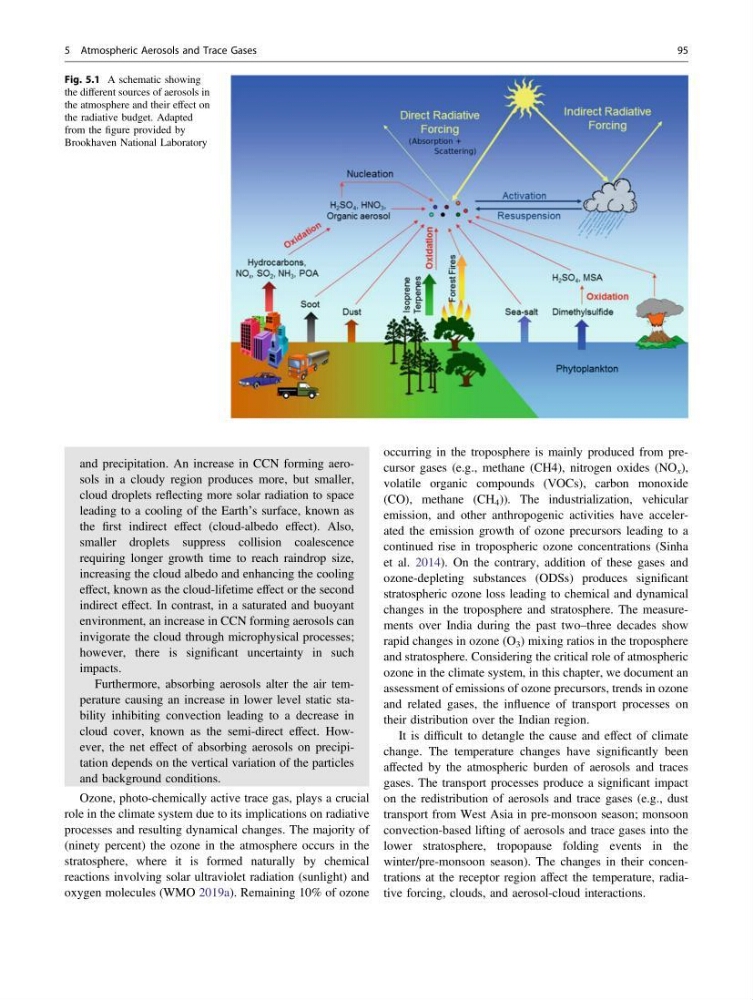
Fig. 5.1 A schematic showing
the different sources of aerosols in
the atmosphere and their effect on
the radiative budget. Adapted
from the figure provided by
Brookhaven National Laboratory
5 Atmospheric Aerosols and Trace Gases
95
cloud droplets reflecting more solar radiation to space
leading to a cooling of the Earth’s surface, known as
the first indirect effect (cloud-albedo effect). Also,
smaller droplets suppress collision coalescence
requiring longer growth time to reach raindrop size,
increasing the cloud albedo and enhancing the cooling
effect, known as the cloud-lifetime effect or the second
indirect effect. In contrast, in a saturated and buoyant
environment, an increase in CCN forming aerosols can
invigorate the cloud through microphysical processes;
however, there is significant uncertainty in such
impacts.
Furthermore, absorbing aerosols alter the air temperature causing an increase in lower level static stability inhibiting convection leading to a decrease in
cloud cover, known as the semi-direct effect. However, the net effect of absorbing aerosols on precipitation depends on the vertical variation of the particles
and background conditions.
Ozone, photo-chemically active trace gas, plays a crucial
role in the climate system due to its implications on radiative
processes and resulting dynamical changes. The majority of
(ninety percent) the ozone in the atmosphere occurs in the
stratosphere, where it is formed naturally by chemical
reactions involving solar ultraviolet radiation (sunlight) and
oxygen molecules (WMO 2019a). Remaining 10% of ozone
occurring in the troposphere is mainly produced from precursor gases (e.g., methane (CH4), nitrogen oxides (NO x ),
volatile organic compounds (VOCs), carbon monoxide
(CO), methane (CH 4 )). The industrialization, vehicular
emission, and other anthropogenic activities have accelerated the emission growth of ozone precursors leading to a
continued rise in tropospheric ozone concentrations (Sinha
et al. 2014). On the contrary, addition of these gases and
ozone-depleting substances (ODSs) produces significant
stratospheric ozone loss leading to chemical and dynamical
changes in the troposphere and stratosphere. The measurements over India during the past two–three decades show
rapid changes in ozone (O 3 ) mixing ratios in the troposphere
and stratosphere. Considering the critical role of atmospheric
ozone in the climate system, in this chapter, we document an
assessment of emissions of ozone precursors, trends in ozone
and related gases, the influence of transport processes on
their distribution over the Indian region.
It is difficult to detangle the cause and effect of climate
change. The temperature changes have significantly been
affected by the atmospheric burden of aerosols and traces
gases. The transport processes produce a significant impact
on the redistribution of aerosols and trace gases (e.g., dust
transport from West Asia in pre-monsoon season; monsoon
convection-based lifting of aerosols and trace gases into the
lower stratosphere, tropopause folding events in the
winter/pre-monsoon season). The changes in their concentrations at the receptor region affect the temperature, radiative forcing, clouds, and aerosol-cloud interactions.
Fig. 5.1 A schematic showing
the different sources of aerosols in
the atmosphere and their effect on
the radiative budget. Adapted
from the figure provided by
Brookhaven National Laboratory
5 Atmospheric Aerosols and Trace Gases
95