

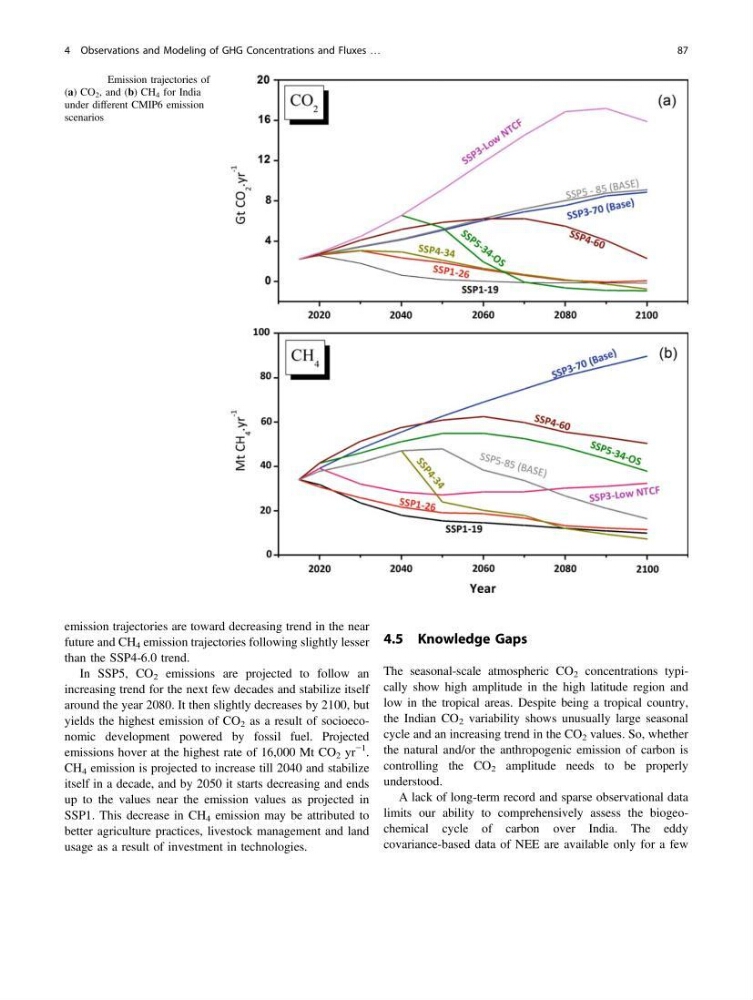
emission trajectories are toward decreasing trend in the near
future and CH 4 emission trajectories following slightly lesser
than the SSP4-6.0 trend.
In SSP5, CO 2 emissions are projected to follow an
increasing trend for the next few decades and stabilize itself
around the year 2080. It then slightly decreases by 2100, but
yields the highest emission of CO 2 as a result of socioeconomic development powered by fossil fuel. Projected
emissions hover at the highest rate of 16,000 Mt CO 2 yr
−1 .
CH 4 emission is projected to increase till 2040 and stabilize
itself in a decade, and by 2050 it starts decreasing and ends
up to the values near the emission values as projected in
SSP1. This decrease in CH 4 emission may be attributed to
better agriculture practices, livestock management and land
usage as a result of investment in technologies.
4.5 Knowledge Gaps
The seasonal-scale atmospheric CO 2 concentrations typically show high amplitude in the high latitude region and
low in the tropical areas. Despite being a tropical country,
the Indian CO 2 variability shows unusually large seasonal
cycle and an increasing trend in the CO 2 values. So, whether
the natural and/or the anthropogenic emission of carbon is
controlling the CO 2 amplitude needs to be properly
understood.
A lack of long-term record and sparse observational data
limits our ability to comprehensively assess the biogeochemical cycle of carbon over India. The eddy
covariance-based data of NEE are available only for a few
Fig. 4.6 Emission trajectories of
(a) CO 2 , and (b) CH 4 for India
under different CMIP6 emission
scenarios
4 Observations and Modeling of GHG Concentrations and Fluxes …
87
future and CH 4 emission trajectories following slightly lesser
than the SSP4-6.0 trend.
In SSP5, CO 2 emissions are projected to follow an
increasing trend for the next few decades and stabilize itself
around the year 2080. It then slightly decreases by 2100, but
yields the highest emission of CO 2 as a result of socioeconomic development powered by fossil fuel. Projected
emissions hover at the highest rate of 16,000 Mt CO 2 yr
−1 .
CH 4 emission is projected to increase till 2040 and stabilize
itself in a decade, and by 2050 it starts decreasing and ends
up to the values near the emission values as projected in
SSP1. This decrease in CH 4 emission may be attributed to
better agriculture practices, livestock management and land
usage as a result of investment in technologies.
4.5 Knowledge Gaps
The seasonal-scale atmospheric CO 2 concentrations typically show high amplitude in the high latitude region and
low in the tropical areas. Despite being a tropical country,
the Indian CO 2 variability shows unusually large seasonal
cycle and an increasing trend in the CO 2 values. So, whether
the natural and/or the anthropogenic emission of carbon is
controlling the CO 2 amplitude needs to be properly
understood.
A lack of long-term record and sparse observational data
limits our ability to comprehensively assess the biogeochemical cycle of carbon over India. The eddy
covariance-based data of NEE are available only for a few
Fig. 4.6 Emission trajectories of
(a) CO 2 , and (b) CH 4 for India
under different CMIP6 emission
scenarios
4 Observations and Modeling of GHG Concentrations and Fluxes …
87