

30
4 Stochastic Processes
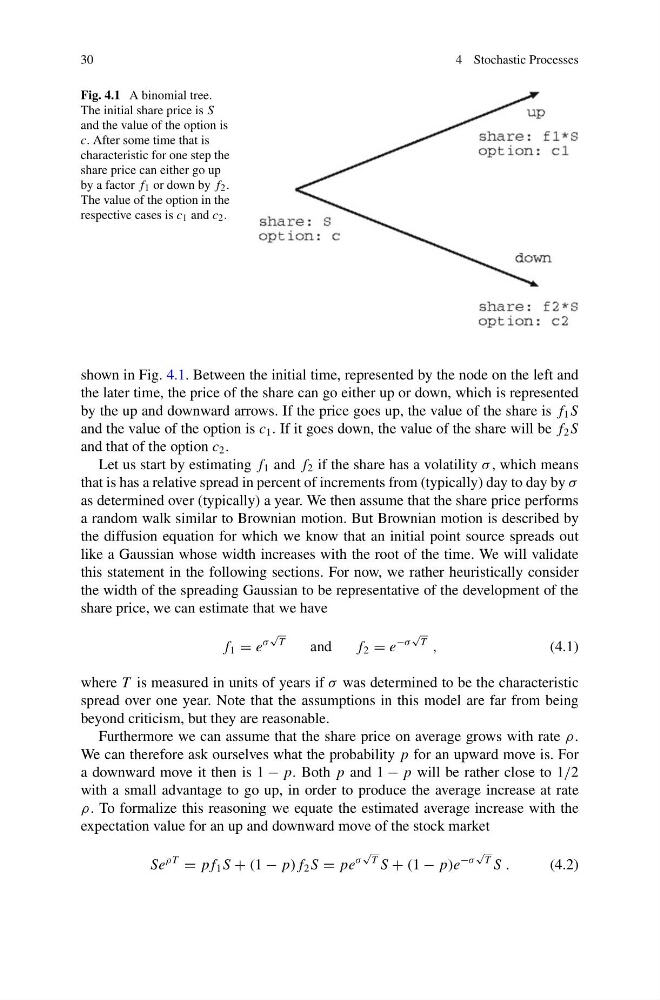
Fig. 4.1 A binomial tree.
The initial share price is S
and the value of the option is
c. After some time that is
characteristic for one step the
share price can either go up
by a factor f 1 or down by f 2 .
The value of the option in the
respective cases is c 1 and c 2 .
shown in Fig. 4.1. Between the initial time, represented by the node on the left and
the later time, the price of the share can go either up or down, which is represented
by the up and downward arrows. If the price goes up, the value of the share is f 1 S
and the value of the option is c 1 . If it goes down, the value of the share will be f 2 S
and that of the option c 2 .
Let us start by estimating f 1 and f 2 if the share has a volatility σ , which means
that is has a relative spread in percent of increments from (typically) day to day by σ
as determined over (typically) a year. We then assume that the share price performs
a random walk similar to Brownian motion. But Brownian motion is described by
the diffusion equation for which we know that an initial point source spreads out
like a Gaussian whose width increases with the root of the time. We will validate
this statement in the following sections. For now, we rather heuristically consider
the width of the spreading Gaussian to be representative of the development of the
share price, we can estimate that we have
f 1 = e
σ
√
T
and
f 2 = e
−σ
√
T
,
(4.1)
where T is measured in units of years if σ was determined to be the characteristic
spread over one year. Note that the assumptions in this model are far from being
beyond criticism, but they are reasonable.
Furthermore we can assume that the share price on average grows with rate ρ.
We can therefore ask ourselves what the probability p for an upward move is. For
a downward move it then is 1 − p. Both p and 1 − p will be rather close to 1/2
with a small advantage to go up, in order to produce the average increase at rate
ρ. To formalize this reasoning we equate the estimated average increase with the
expectation value for an up and downward move of the stock market
Se
ρT
= p f 1 S + (1 − p) f 2 S = pe
σ
√
T S + (1 − p)e
−σ
√
T S .
(4.2)
4 Stochastic Processes
Fig. 4.1 A binomial tree.
The initial share price is S
and the value of the option is
c. After some time that is
characteristic for one step the
share price can either go up
by a factor f 1 or down by f 2 .
The value of the option in the
respective cases is c 1 and c 2 .
shown in Fig. 4.1. Between the initial time, represented by the node on the left and
the later time, the price of the share can go either up or down, which is represented
by the up and downward arrows. If the price goes up, the value of the share is f 1 S
and the value of the option is c 1 . If it goes down, the value of the share will be f 2 S
and that of the option c 2 .
Let us start by estimating f 1 and f 2 if the share has a volatility σ , which means
that is has a relative spread in percent of increments from (typically) day to day by σ
as determined over (typically) a year. We then assume that the share price performs
a random walk similar to Brownian motion. But Brownian motion is described by
the diffusion equation for which we know that an initial point source spreads out
like a Gaussian whose width increases with the root of the time. We will validate
this statement in the following sections. For now, we rather heuristically consider
the width of the spreading Gaussian to be representative of the development of the
share price, we can estimate that we have
f 1 = e
σ
√
T
and
f 2 = e
−σ
√
T
,
(4.1)
where T is measured in units of years if σ was determined to be the characteristic
spread over one year. Note that the assumptions in this model are far from being
beyond criticism, but they are reasonable.
Furthermore we can assume that the share price on average grows with rate ρ.
We can therefore ask ourselves what the probability p for an upward move is. For
a downward move it then is 1 − p. Both p and 1 − p will be rather close to 1/2
with a small advantage to go up, in order to produce the average increase at rate
ρ. To formalize this reasoning we equate the estimated average increase with the
expectation value for an up and downward move of the stock market
Se
ρT
= p f 1 S + (1 − p) f 2 S = pe
σ
√
T S + (1 − p)e
−σ
√
T S .
(4.2)