

246
13 Solutions for Selected Exercises
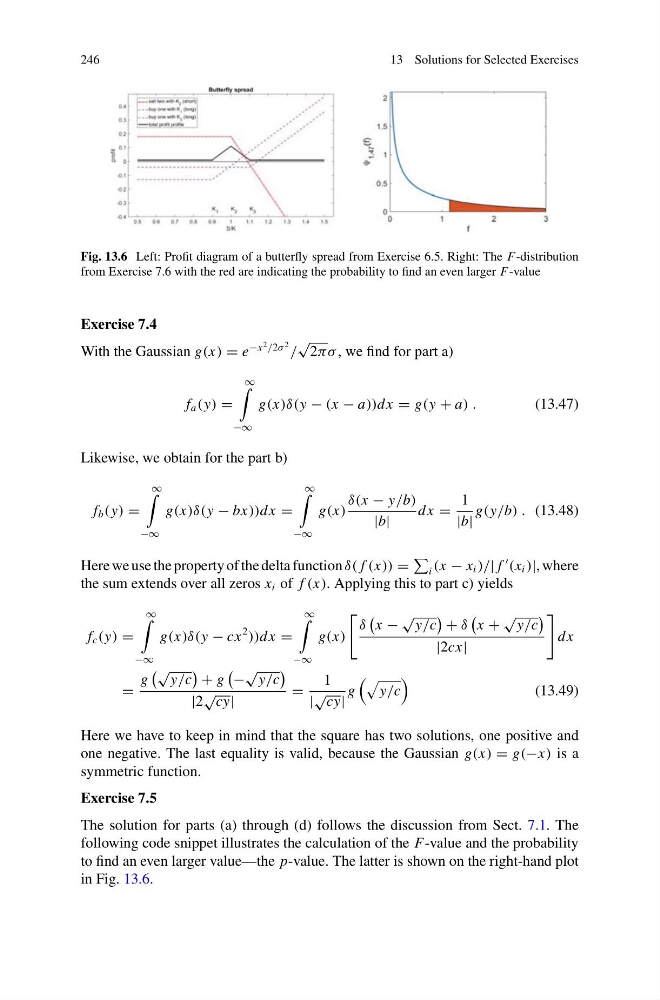
Fig. 13.6 Left: Profit diagram of a butterfly spread from Exercise 6.5. Right: The F-distribution
from Exercise 7.6 with the red are indicating the probability to find an even larger F-value
Exercise 7.4
With the Gaussian g(x) = e
−x
2 /2σ
2 /
√
2πσ , we find for part a)
f a (y) =
∞
−∞
g(x)δ(y − (x − a))dx = g(y + a) .
(13.47)
Likewise, we obtain for the part b)
f b (y) =
∞
−∞
g(x)δ(y − bx))dx =
∞
−∞
g(x)
δ(x − y/b)
|b|
dx =
1
|b|
g(y/b) . (13.48)
Here we use the property of the delta function δ( f (x)) =
i (x − x i )/| f
(x i )|, where
the sum extends over all zeros x i of f (x). Applying this to part c) yields
f c (y) =
∞
−∞
g(x)δ(y − cx
2
))dx =
∞
−∞
g(x)
δ
x −
√
y/c
+ δ
x +
√
y/c
|2cx|
dx
=
g
√
y/c
+ g
−
√
y/c
|2
√
cy|
=
1
|
√
cy|
g
y/c
(13.49)
Here we have to keep in mind that the square has two solutions, one positive and
one negative. The last equality is valid, because the Gaussian g(x) = g(−x) is a
symmetric function.
Exercise 7.5
The solution for parts (a) through (d) follows the discussion from Sect. 7.1. The
following code snippet illustrates the calculation of the F-value and the probability
to find an even larger value—the p-value. The latter is shown on the right-hand plot
in Fig. 13.6.
13 Solutions for Selected Exercises
Fig. 13.6 Left: Profit diagram of a butterfly spread from Exercise 6.5. Right: The F-distribution
from Exercise 7.6 with the red are indicating the probability to find an even larger F-value
Exercise 7.4
With the Gaussian g(x) = e
−x
2 /2σ
2 /
√
2πσ , we find for part a)
f a (y) =
∞
−∞
g(x)δ(y − (x − a))dx = g(y + a) .
(13.47)
Likewise, we obtain for the part b)
f b (y) =
∞
−∞
g(x)δ(y − bx))dx =
∞
−∞
g(x)
δ(x − y/b)
|b|
dx =
1
|b|
g(y/b) . (13.48)
Here we use the property of the delta function δ( f (x)) =
i (x − x i )/| f
(x i )|, where
the sum extends over all zeros x i of f (x). Applying this to part c) yields
f c (y) =
∞
−∞
g(x)δ(y − cx
2
))dx =
∞
−∞
g(x)
δ
x −
√
y/c
+ δ
x +
√
y/c
|2cx|
dx
=
g
√
y/c
+ g
−
√
y/c
|2
√
cy|
=
1
|
√
cy|
g
y/c
(13.49)
Here we have to keep in mind that the square has two solutions, one positive and
one negative. The last equality is valid, because the Gaussian g(x) = g(−x) is a
symmetric function.
Exercise 7.5
The solution for parts (a) through (d) follows the discussion from Sect. 7.1. The
following code snippet illustrates the calculation of the F-value and the probability
to find an even larger value—the p-value. The latter is shown on the right-hand plot
in Fig. 13.6.