

220
12 Cryptocurrencies
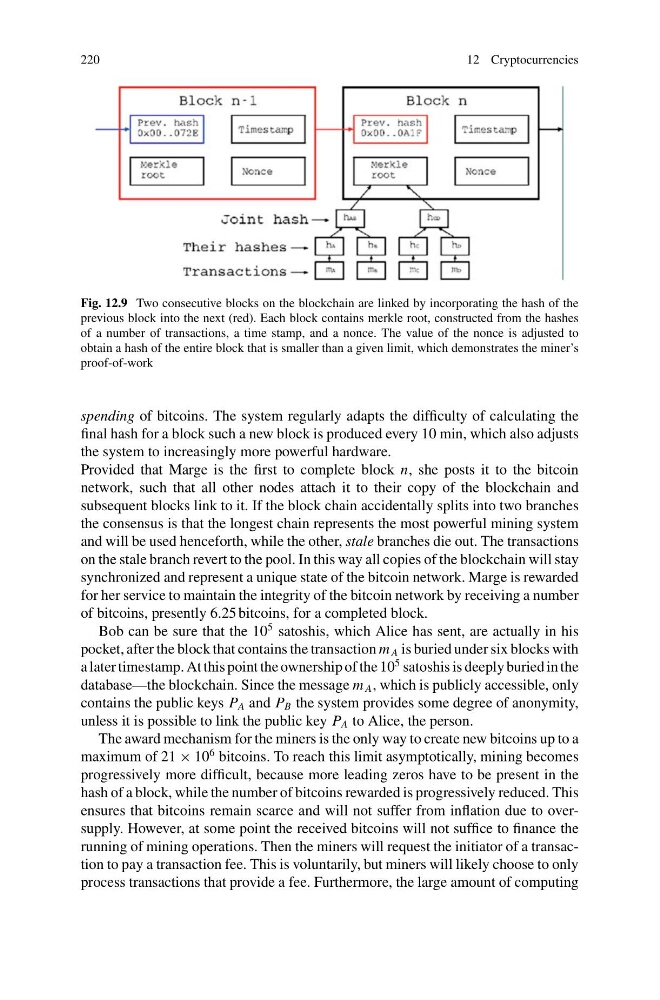
Fig. 12.9 Two consecutive blocks on the blockchain are linked by incorporating the hash of the
previous block into the next (red). Each block contains merkle root, constructed from the hashes
of a number of transactions, a time stamp, and a nonce. The value of the nonce is adjusted to
obtain a hash of the entire block that is smaller than a given limit, which demonstrates the miner’s
proof-of-work
spending of bitcoins. The system regularly adapts the difficulty of calculating the
final hash for a block such a new block is produced every 10 min, which also adjusts
the system to increasingly more powerful hardware.
Provided that Marge is the first to complete block n, she posts it to the bitcoin
network, such that all other nodes attach it to their copy of the blockchain and
subsequent blocks link to it. If the block chain accidentally splits into two branches
the consensus is that the longest chain represents the most powerful mining system
and will be used henceforth, while the other, stale branches die out. The transactions
on the stale branch revert to the pool. In this way all copies of the blockchain will stay
synchronized and represent a unique state of the bitcoin network. Marge is rewarded
for her service to maintain the integrity of the bitcoin network by receiving a number
of bitcoins, presently 6.25 bitcoins, for a completed block.
Bob can be sure that the 10
5 satoshis, which Alice has sent, are actually in his
pocket, after the block that contains the transaction m A is buried under six blocks with
a later timestamp. At this point the ownership of the 10
5 satoshis is deeply buried in the
database—the blockchain. Since the message m A , which is publicly accessible, only
contains the public keys P A and P B the system provides some degree of anonymity,
unless it is possible to link the public key P A to Alice, the person.
The award mechanism for the miners is the only way to create new bitcoins up to a
maximum of 21 × 10
6 bitcoins. To reach this limit asymptotically, mining becomes
progressively more difficult, because more leading zeros have to be present in the
hash of a block, while the number of bitcoins rewarded is progressively reduced. This
ensures that bitcoins remain scarce and will not suffer from inflation due to oversupply. However, at some point the received bitcoins will not suffice to finance the
running of mining operations. Then the miners will request the initiator of a transaction to pay a transaction fee. This is voluntarily, but miners will likely choose to only
process transactions that provide a fee. Furthermore, the large amount of computing
12 Cryptocurrencies
Fig. 12.9 Two consecutive blocks on the blockchain are linked by incorporating the hash of the
previous block into the next (red). Each block contains merkle root, constructed from the hashes
of a number of transactions, a time stamp, and a nonce. The value of the nonce is adjusted to
obtain a hash of the entire block that is smaller than a given limit, which demonstrates the miner’s
proof-of-work
spending of bitcoins. The system regularly adapts the difficulty of calculating the
final hash for a block such a new block is produced every 10 min, which also adjusts
the system to increasingly more powerful hardware.
Provided that Marge is the first to complete block n, she posts it to the bitcoin
network, such that all other nodes attach it to their copy of the blockchain and
subsequent blocks link to it. If the block chain accidentally splits into two branches
the consensus is that the longest chain represents the most powerful mining system
and will be used henceforth, while the other, stale branches die out. The transactions
on the stale branch revert to the pool. In this way all copies of the blockchain will stay
synchronized and represent a unique state of the bitcoin network. Marge is rewarded
for her service to maintain the integrity of the bitcoin network by receiving a number
of bitcoins, presently 6.25 bitcoins, for a completed block.
Bob can be sure that the 10
5 satoshis, which Alice has sent, are actually in his
pocket, after the block that contains the transaction m A is buried under six blocks with
a later timestamp. At this point the ownership of the 10
5 satoshis is deeply buried in the
database—the blockchain. Since the message m A , which is publicly accessible, only
contains the public keys P A and P B the system provides some degree of anonymity,
unless it is possible to link the public key P A to Alice, the person.
The award mechanism for the miners is the only way to create new bitcoins up to a
maximum of 21 × 10
6 bitcoins. To reach this limit asymptotically, mining becomes
progressively more difficult, because more leading zeros have to be present in the
hash of a block, while the number of bitcoins rewarded is progressively reduced. This
ensures that bitcoins remain scarce and will not suffer from inflation due to oversupply. However, at some point the received bitcoins will not suffice to finance the
running of mining operations. Then the miners will request the initiator of a transaction to pay a transaction fee. This is voluntarily, but miners will likely choose to only
process transactions that provide a fee. Furthermore, the large amount of computing