

218
12 Cryptocurrencies
12.8 Bitcoins and Blockchains
The cryptocurrency “Bitcoin” maintains an openly accessible database—the blockchain—that records all transaction of the underlying valuta—the bitcoins—from one
owner to the next. The structure of the blockchain database only permits adding new
transactions to the blockchain and reading previously written ones. In contast to
conventional databases is updating or deleting entries in the database not possible.
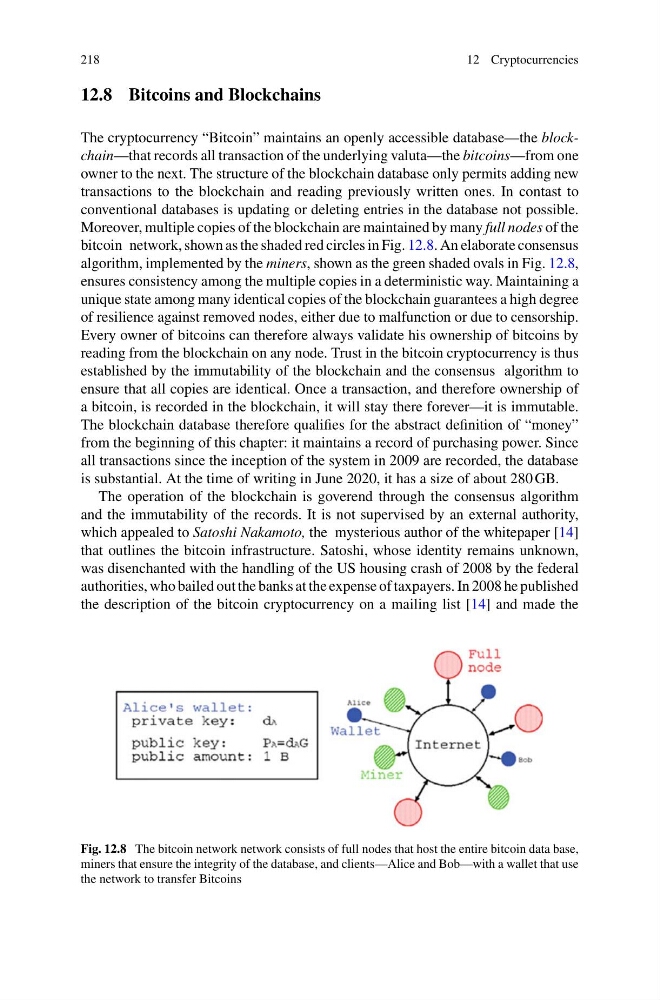
Moreover, multiple copies of the blockchain are maintained by many full nodes of the
bitcoin network, shown as the shaded red circles in Fig. 12.8. An elaborate consensus
algorithm, implemented by the miners, shown as the green shaded ovals in Fig. 12.8,
ensures consistency among the multiple copies in a deterministic way. Maintaining a
unique state among many identical copies of the blockchain guarantees a high degree
of resilience against removed nodes, either due to malfunction or due to censorship.
Every owner of bitcoins can therefore always validate his ownership of bitcoins by
reading from the blockchain on any node. Trust in the bitcoin cryptocurrency is thus
established by the immutability of the blockchain and the consensus algorithm to
ensure that all copies are identical. Once a transaction, and therefore ownership of
a bitcoin, is recorded in the blockchain, it will stay there forever—it is immutable.
The blockchain database therefore qualifies for the abstract definition of “money”
from the beginning of this chapter: it maintains a record of purchasing power. Since
all transactions since the inception of the system in 2009 are recorded, the database
is substantial. At the time of writing in June 2020, it has a size of about 280 GB.
The operation of the blockchain is goverend through the consensus algorithm
and the immutability of the records. It is not supervised by an external authority,
which appealed to Satoshi Nakamoto, the mysterious author of the whitepaper [14]
that outlines the bitcoin infrastructure. Satoshi, whose identity remains unknown,
was disenchanted with the handling of the US housing crash of 2008 by the federal
authorities, who bailed out the banks at the expense of taxpayers. In 2008 he published
the description of the bitcoin cryptocurrency on a mailing list [14] and made the
Fig. 12.8 The bitcoin network network consists of full nodes that host the entire bitcoin data base,
miners that ensure the integrity of the database, and clients—Alice and Bob—with a wallet that use
the network to transfer Bitcoins
12 Cryptocurrencies
12.8 Bitcoins and Blockchains
The cryptocurrency “Bitcoin” maintains an openly accessible database—the blockchain—that records all transaction of the underlying valuta—the bitcoins—from one
owner to the next. The structure of the blockchain database only permits adding new
transactions to the blockchain and reading previously written ones. In contast to
conventional databases is updating or deleting entries in the database not possible.
Moreover, multiple copies of the blockchain are maintained by many full nodes of the
bitcoin network, shown as the shaded red circles in Fig. 12.8. An elaborate consensus
algorithm, implemented by the miners, shown as the green shaded ovals in Fig. 12.8,
ensures consistency among the multiple copies in a deterministic way. Maintaining a
unique state among many identical copies of the blockchain guarantees a high degree
of resilience against removed nodes, either due to malfunction or due to censorship.
Every owner of bitcoins can therefore always validate his ownership of bitcoins by
reading from the blockchain on any node. Trust in the bitcoin cryptocurrency is thus
established by the immutability of the blockchain and the consensus algorithm to
ensure that all copies are identical. Once a transaction, and therefore ownership of
a bitcoin, is recorded in the blockchain, it will stay there forever—it is immutable.
The blockchain database therefore qualifies for the abstract definition of “money”
from the beginning of this chapter: it maintains a record of purchasing power. Since
all transactions since the inception of the system in 2009 are recorded, the database
is substantial. At the time of writing in June 2020, it has a size of about 280 GB.
The operation of the blockchain is goverend through the consensus algorithm
and the immutability of the records. It is not supervised by an external authority,
which appealed to Satoshi Nakamoto, the mysterious author of the whitepaper [14]
that outlines the bitcoin infrastructure. Satoshi, whose identity remains unknown,
was disenchanted with the handling of the US housing crash of 2008 by the federal
authorities, who bailed out the banks at the expense of taxpayers. In 2008 he published
the description of the bitcoin cryptocurrency on a mailing list [14] and made the
Fig. 12.8 The bitcoin network network consists of full nodes that host the entire bitcoin data base,
miners that ensure the integrity of the database, and clients—Alice and Bob—with a wallet that use
the network to transfer Bitcoins