

12.4 Continuous Information Channels
207
a high-resolution movie. But if someone turns on a faulty microwave oven in the
kitchen, the noise level P N increases, and the WiFi-router, also located in the kitchen,
increases the transmission power P S to maintain the channel capacity, so it is still
possible to enjoy the movie in the living room.
At this point we know how to characterize information—our bank details—and
how to transmit it from one point to another, both through discrete and through
continuous channels. But we still have to ensure that nobody falsifies the data on the
way, which can be done using cryptographic methods, the topic of the next section.
12.5 Cryptography Fundamentals
When sending data across a network, anyone can listen to the communication and,
unless special precautions are taken, even change the transmitted information. Some
level to guarantee the integrity of data is built into the lower levels of network communication, such as the internet protocol (IP) and the transfer control protocol (TCP),
but it guarantees neither privacy nor security against tampering, which makes it
unsuitable to transfer money, unless extra security measures are added. We therefore
have to consider methods to authorize and authenticate transfers across communication channels. In classical banking we went to the bank, used an identification card to
authenticate, and then sign a paper to authorize the transfer. Note that both id-cards
and personal signatures are “secrets” that are unique for each person. Let us therefore
look at sending secrets across communication channels.
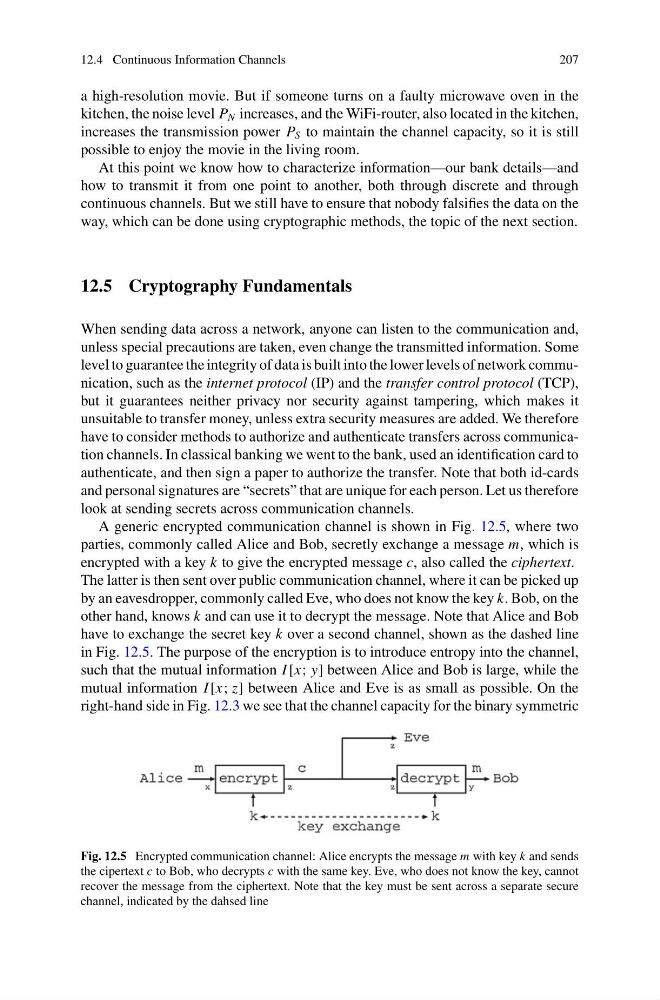
A generic encrypted communication channel is shown in Fig. 12.5, where two
parties, commonly called Alice and Bob, secretly exchange a message m, which is
encrypted with a key k to give the encrypted message c, also called the ciphertext.
The latter is then sent over public communication channel, where it can be picked up
by an eavesdropper, commonly called Eve, who does not know the key k. Bob, on the
other hand, knows k and can use it to decrypt the message. Note that Alice and Bob
have to exchange the secret key k over a second channel, shown as the dashed line
in Fig. 12.5. The purpose of the encryption is to introduce entropy into the channel,
such that the mutual information I [x; y] between Alice and Bob is large, while the
mutual information I [x; z] between Alice and Eve is as small as possible. On the
right-hand side in Fig. 12.3 we see that the channel capacity for the binary symmetric
Fig. 12.5 Encrypted communication channel: Alice encrypts the message m with key k and sends
the cipertext c to Bob, who decrypts c with the same key. Eve, who does not know the key, cannot
recover the message from the ciphertext. Note that the key must be sent across a separate secure
channel, indicated by the dahsed line
207
a high-resolution movie. But if someone turns on a faulty microwave oven in the
kitchen, the noise level P N increases, and the WiFi-router, also located in the kitchen,
increases the transmission power P S to maintain the channel capacity, so it is still
possible to enjoy the movie in the living room.
At this point we know how to characterize information—our bank details—and
how to transmit it from one point to another, both through discrete and through
continuous channels. But we still have to ensure that nobody falsifies the data on the
way, which can be done using cryptographic methods, the topic of the next section.
12.5 Cryptography Fundamentals
When sending data across a network, anyone can listen to the communication and,
unless special precautions are taken, even change the transmitted information. Some
level to guarantee the integrity of data is built into the lower levels of network communication, such as the internet protocol (IP) and the transfer control protocol (TCP),
but it guarantees neither privacy nor security against tampering, which makes it
unsuitable to transfer money, unless extra security measures are added. We therefore
have to consider methods to authorize and authenticate transfers across communication channels. In classical banking we went to the bank, used an identification card to
authenticate, and then sign a paper to authorize the transfer. Note that both id-cards
and personal signatures are “secrets” that are unique for each person. Let us therefore
look at sending secrets across communication channels.
A generic encrypted communication channel is shown in Fig. 12.5, where two
parties, commonly called Alice and Bob, secretly exchange a message m, which is
encrypted with a key k to give the encrypted message c, also called the ciphertext.
The latter is then sent over public communication channel, where it can be picked up
by an eavesdropper, commonly called Eve, who does not know the key k. Bob, on the
other hand, knows k and can use it to decrypt the message. Note that Alice and Bob
have to exchange the secret key k over a second channel, shown as the dashed line
in Fig. 12.5. The purpose of the encryption is to introduce entropy into the channel,
such that the mutual information I [x; y] between Alice and Bob is large, while the
mutual information I [x; z] between Alice and Eve is as small as possible. On the
right-hand side in Fig. 12.3 we see that the channel capacity for the binary symmetric
Fig. 12.5 Encrypted communication channel: Alice encrypts the message m with key k and sends
the cipertext c to Bob, who decrypts c with the same key. Eve, who does not know the key, cannot
recover the message from the ciphertext. Note that the key must be sent across a separate secure
channel, indicated by the dahsed line