

198
12 Cryptocurrencies
12.2 Relation to the Thermodynamic Entropy
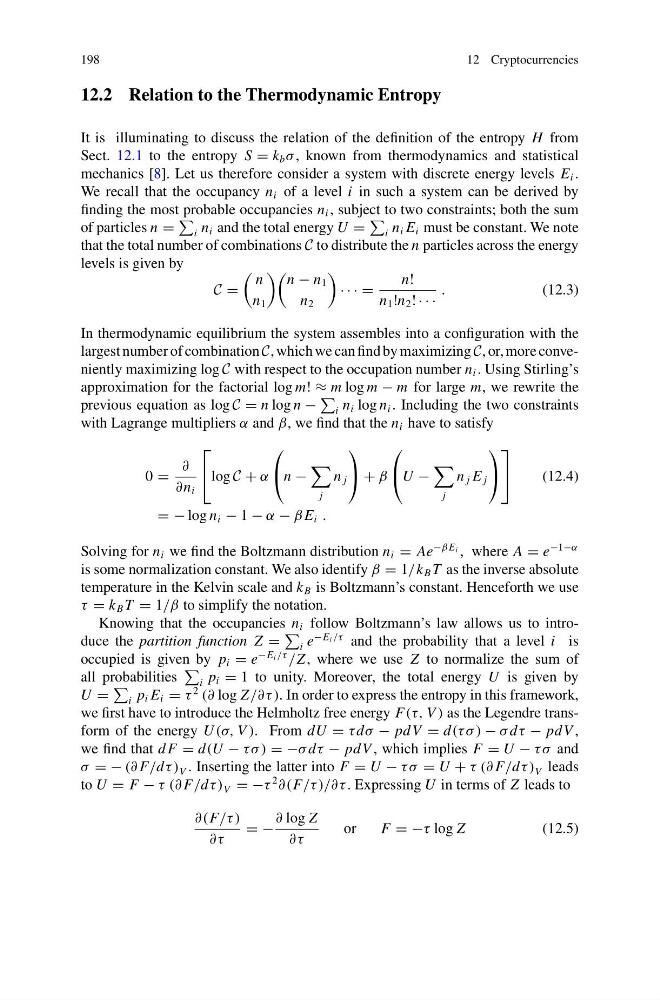
It is illuminating to discuss the relation of the definition of the entropy H from
Sect. 12.1 to the entropy S = k b σ , known from thermodynamics and statistical
mechanics [8]. Let us therefore consider a system with discrete energy levels E i .
We recall that the occupancy n i of a level i in such a system can be derived by
finding the most probable occupancies n i , subject to two constraints; both the sum
of particles n =
i n i and the total energy U =
i n i E i must be constant. We note
that the total number of combinations C to distribute the n particles across the energy
levels is given by
C =
n
n 1
n − n 1
n 2
· · · =
n!
n 1 !n 2 ! · · ·
.
(12.3)
In thermodynamic equilibrium the system assembles into a configuration with the
largest number of combination C, which we can find by maximizing C, or, more conveniently maximizing log C with respect to the occupation number n i . Using Stirling’s
approximation for the factorial log m! ≈ m log m − m for large m, we rewrite the
previous equation as log C = n log n −
i n i log n i . Including the two constraints
with Lagrange multipliers α and β, we find that the n i have to satisfy
0 =
∂
∂n i
⎡
⎣ log C + α
⎛
⎝ n −
j
n j
⎞
⎠ + β
⎛
⎝ U −
j
n j E j
⎞
⎠
⎤
⎦
(12.4)
= − log n i − 1 − α − β E i .
Solving for n i we find the Boltzmann distribution n i = Ae
−β E i , where A = e
−1−α
is some normalization constant. We also identify β = 1/k B T as the inverse absolute
temperature in the Kelvin scale and k B is Boltzmann’s constant. Henceforth we use
τ = k B T = 1/β to simplify the notation.
Knowing that the occupancies n i follow Boltzmann’s law allows us to introduce the partition function Z =
i e
−E i /τ and the probability that a level i is
occupied is given by p i = e
−E i /τ
/Z , where we use Z to normalize the sum of
all probabilities
i p i = 1 to unity. Moreover, the total energy U is given by
U =
i p i E i = τ
2
(∂ log Z /∂τ ). In order to express the entropy in this framework,
we first have to introduce the Helmholtz free energy F(τ, V ) as the Legendre transform of the energy U (σ, V ). From dU = τ dσ − pdV = d(τ σ ) − σ dτ − pdV ,
we find that d F = d(U − τ σ ) = −σ dτ − pdV , which implies F = U − τ σ and
σ = − (∂ F/dτ ) V . Inserting the latter into F = U − τ σ = U + τ (∂ F/dτ ) V leads
to U = F − τ (∂ F/dτ ) V = −τ
2
∂(F/τ )/∂τ . Expressing U in terms of Z leads to
∂(F/τ )
∂τ
= −
∂ log Z
∂τ
or
F = −τ log Z
(12.5)
12 Cryptocurrencies
12.2 Relation to the Thermodynamic Entropy
It is illuminating to discuss the relation of the definition of the entropy H from
Sect. 12.1 to the entropy S = k b σ , known from thermodynamics and statistical
mechanics [8]. Let us therefore consider a system with discrete energy levels E i .
We recall that the occupancy n i of a level i in such a system can be derived by
finding the most probable occupancies n i , subject to two constraints; both the sum
of particles n =
i n i and the total energy U =
i n i E i must be constant. We note
that the total number of combinations C to distribute the n particles across the energy
levels is given by
C =
n
n 1
n − n 1
n 2
· · · =
n!
n 1 !n 2 ! · · ·
.
(12.3)
In thermodynamic equilibrium the system assembles into a configuration with the
largest number of combination C, which we can find by maximizing C, or, more conveniently maximizing log C with respect to the occupation number n i . Using Stirling’s
approximation for the factorial log m! ≈ m log m − m for large m, we rewrite the
previous equation as log C = n log n −
i n i log n i . Including the two constraints
with Lagrange multipliers α and β, we find that the n i have to satisfy
0 =
∂
∂n i
⎡
⎣ log C + α
⎛
⎝ n −
j
n j
⎞
⎠ + β
⎛
⎝ U −
j
n j E j
⎞
⎠
⎤
⎦
(12.4)
= − log n i − 1 − α − β E i .
Solving for n i we find the Boltzmann distribution n i = Ae
−β E i , where A = e
−1−α
is some normalization constant. We also identify β = 1/k B T as the inverse absolute
temperature in the Kelvin scale and k B is Boltzmann’s constant. Henceforth we use
τ = k B T = 1/β to simplify the notation.
Knowing that the occupancies n i follow Boltzmann’s law allows us to introduce the partition function Z =
i e
−E i /τ and the probability that a level i is
occupied is given by p i = e
−E i /τ
/Z , where we use Z to normalize the sum of
all probabilities
i p i = 1 to unity. Moreover, the total energy U is given by
U =
i p i E i = τ
2
(∂ log Z /∂τ ). In order to express the entropy in this framework,
we first have to introduce the Helmholtz free energy F(τ, V ) as the Legendre transform of the energy U (σ, V ). From dU = τ dσ − pdV = d(τ σ ) − σ dτ − pdV ,
we find that d F = d(U − τ σ ) = −σ dτ − pdV , which implies F = U − τ σ and
σ = − (∂ F/dτ ) V . Inserting the latter into F = U − τ σ = U + τ (∂ F/dτ ) V leads
to U = F − τ (∂ F/dτ ) V = −τ
2
∂(F/τ )/∂τ . Expressing U in terms of Z leads to
∂(F/τ )
∂τ
= −
∂ log Z
∂τ
or
F = −τ log Z
(12.5)