

150
10 Quantum Finance and Path Integrals
c(x, t) = =x|c(t) =
dx
x|e
−τ H BS |x
x
|g
=
dx
p BS (x, τ ; x
)g(x
) ,
(10.16)
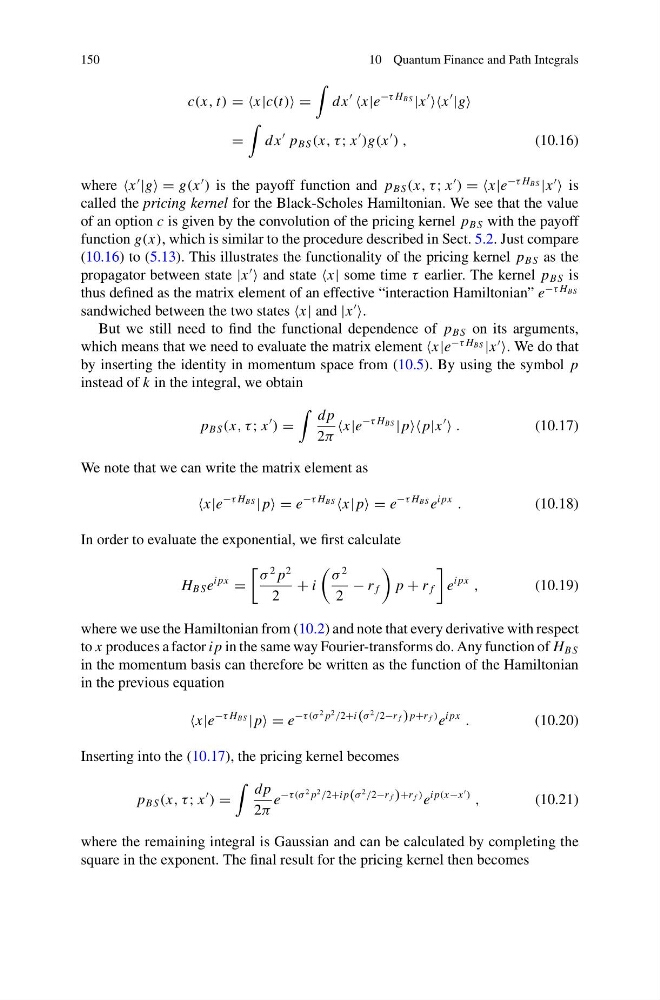
where x
|g = g(x
) is the payoff function and p BS (x, τ ; x
) = =x|e
−τ H BS |x
is
called the pricing kernel for the Black-Scholes Hamiltonian. We see that the value
of an option c is given by the convolution of the pricing kernel p BS with the payoff
function g(x), which is similar to the procedure described in Sect. 5.2. Just compare
(10.16) to (5.13). This illustrates the functionality of the pricing kernel p BS as the
propagator between state |x
and state x| some time τ earlier. The kernel p BS is
thus defined as the matrix element of an effective “interaction Hamiltonian” e
−τ H BS
sandwiched between the two states x| and |x
.
But we still need to find the functional dependence of p BS on its arguments,
which means that we need to evaluate the matrix element x|e
−τ H BS |x
. We do that
by inserting the identity in momentum space from (10.5). By using the symbol p
instead of k in the integral, we obtain
p BS (x, τ ; x
) =
dp
2π
x|e
−τ H BS | p p|x
.
(10.17)
We note that we can write the matrix element as
x|e
−τ H BS | p = e
−τ H BS x| p = e
−τ H BS e
i px
.
(10.18)
In order to evaluate the exponential, we first calculate
H BS e
i px
=
σ
2 p
2
2
+ i
σ
2
2
− r f
p + r f
e
i px
,
(10.19)
where we use the Hamiltonian from (10.2) and note that every derivative with respect
to x produces a factor i p in the same way Fourier-transforms do. Any function of H BS
in the momentum basis can therefore be written as the function of the Hamiltonian
in the previous equation
x|e
−τ H BS | p = e
−τ (σ
2 p
2 /2+i(σ
2 /2−r f )p+r f ) e
i px
.
(10.20)
Inserting into the (10.17), the pricing kernel becomes
p BS (x, τ ; x
) =
dp
2π
e
−τ (σ
2 p
2 /2+i p(σ
2 /2−r f )+r f ) e
i p(x−x
)
,
(10.21)
where the remaining integral is Gaussian and can be calculated by completing the
square in the exponent. The final result for the pricing kernel then becomes
10 Quantum Finance and Path Integrals
c(x, t) = =x|c(t) =
dx
x|e
−τ H BS |x
x
|g
=
dx
p BS (x, τ ; x
)g(x
) ,
(10.16)
where x
|g = g(x
) is the payoff function and p BS (x, τ ; x
) = =x|e
−τ H BS |x
is
called the pricing kernel for the Black-Scholes Hamiltonian. We see that the value
of an option c is given by the convolution of the pricing kernel p BS with the payoff
function g(x), which is similar to the procedure described in Sect. 5.2. Just compare
(10.16) to (5.13). This illustrates the functionality of the pricing kernel p BS as the
propagator between state |x
and state x| some time τ earlier. The kernel p BS is
thus defined as the matrix element of an effective “interaction Hamiltonian” e
−τ H BS
sandwiched between the two states x| and |x
.
But we still need to find the functional dependence of p BS on its arguments,
which means that we need to evaluate the matrix element x|e
−τ H BS |x
. We do that
by inserting the identity in momentum space from (10.5). By using the symbol p
instead of k in the integral, we obtain
p BS (x, τ ; x
) =
dp
2π
x|e
−τ H BS | p p|x
.
(10.17)
We note that we can write the matrix element as
x|e
−τ H BS | p = e
−τ H BS x| p = e
−τ H BS e
i px
.
(10.18)
In order to evaluate the exponential, we first calculate
H BS e
i px
=
σ
2 p
2
2
+ i
σ
2
2
− r f
p + r f
e
i px
,
(10.19)
where we use the Hamiltonian from (10.2) and note that every derivative with respect
to x produces a factor i p in the same way Fourier-transforms do. Any function of H BS
in the momentum basis can therefore be written as the function of the Hamiltonian
in the previous equation
x|e
−τ H BS | p = e
−τ (σ
2 p
2 /2+i(σ
2 /2−r f )p+r f ) e
i px
.
(10.20)
Inserting into the (10.17), the pricing kernel becomes
p BS (x, τ ; x
) =
dp
2π
e
−τ (σ
2 p
2 /2+i p(σ
2 /2−r f )+r f ) e
i p(x−x
)
,
(10.21)
where the remaining integral is Gaussian and can be calculated by completing the
square in the exponent. The final result for the pricing kernel then becomes