

148
10 Quantum Finance and Path Integrals
Here we added the last equality by introducing the energy operator ˆ
H , the Hamiltonian. As a matter of fact, we can even use Hamiltonians including potential energies.
They are derived from their classical counterparts H (q, p) = p
2
/2m + V (q) by
replacing q and p by their quantum-mechanical operator equivalents.
An important property of the Hamiltonian is that it moves the wave function
forward in time. This can be seen by discretizing the time derivative on the lefthand side of the Schrödinger equation (x, t + dt) − (x, t) = −i ˆ
Hdt(x, t)/,
which leads to
(x, t + dt) = (x, t) −
i ˆ
H
(x, t)dt =
1 −
i ˆ
Hdt
(x, t) .
(10.10)
This is only valid for a small time step dt. For larger time steps t = ndt, subdivided
into n infinitesimal time steps, we have to repeatedly apply the small time step n times
(x, t + t) =
1 −
i ˆ
H t
n
n
(x, t) = e
−i ˆ
H t/
(x, t)
(10.11)
where we used lim n→∞ (1 − x/n)
n
= e
−x and ruthlessly ignored questions of timeordering and convergence. Note, however, that the Hamiltonian ˆ
H generates the
motion in time. It pushes the wave functions towards the future and this is the property
that we will exploit when using quantum mechanical methods to describe finance.
10.2 Black-Scholes Hamiltonian
There are two particular points where the application of quantum concepts in finance
differs from the treatment in physics. First, the wave functions in quantum mechanics
are complex-valued and the physical relevant quantities—the probabilities—are the
squared moduli of the wave function, whereas in finance the “wave functions” are
real-valued and describe, for example, option prices. This is also apparent from the
missing complex unit i in the Black-Scholes “Schrödinger equation” in (10.1).
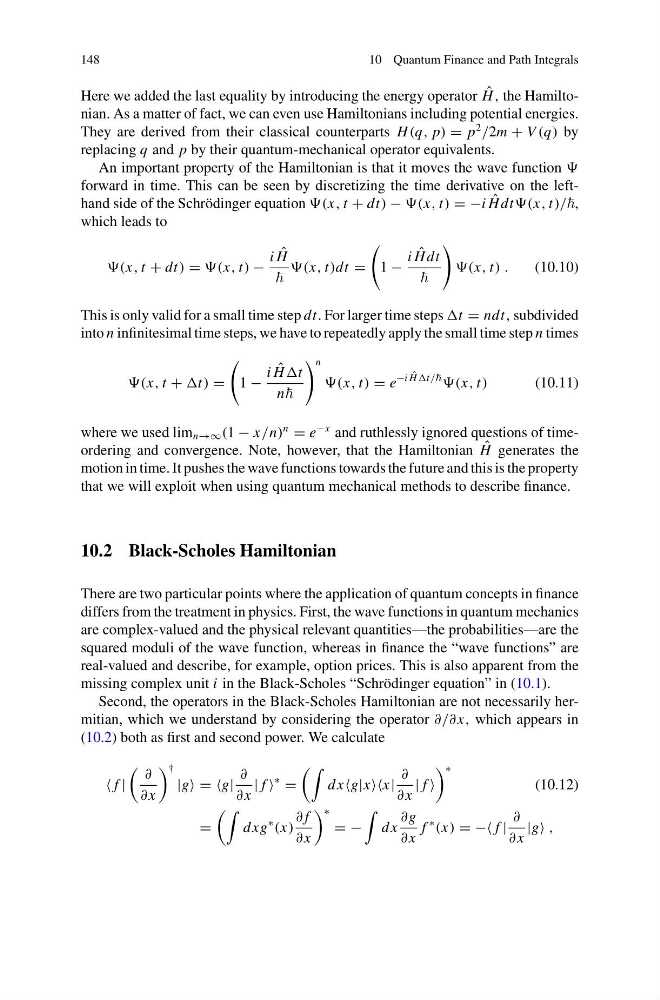
Second, the operators in the Black-Scholes Hamiltonian are not necessarily hermitian, which we understand by considering the operator ∂/∂ x, which appears in
(10.2) both as first and second power. We calculate
f |
∂
∂ x
†
|g = =g|
∂
∂ x
| f
∗
=
dxg|xx|
∂
∂ x
| f
∗
(10.12)
=
dxg
∗
(x)
∂ f
∂ x
∗
= −
dx
∂g
∂ x
f
∗
(x) = −− f |
∂
∂ x
|g ,
10 Quantum Finance and Path Integrals
Here we added the last equality by introducing the energy operator ˆ
H , the Hamiltonian. As a matter of fact, we can even use Hamiltonians including potential energies.
They are derived from their classical counterparts H (q, p) = p
2
/2m + V (q) by
replacing q and p by their quantum-mechanical operator equivalents.
An important property of the Hamiltonian is that it moves the wave function
forward in time. This can be seen by discretizing the time derivative on the lefthand side of the Schrödinger equation (x, t + dt) − (x, t) = −i ˆ
Hdt(x, t)/,
which leads to
(x, t + dt) = (x, t) −
i ˆ
H
(x, t)dt =
1 −
i ˆ
Hdt
(x, t) .
(10.10)
This is only valid for a small time step dt. For larger time steps t = ndt, subdivided
into n infinitesimal time steps, we have to repeatedly apply the small time step n times
(x, t + t) =
1 −
i ˆ
H t
n
n
(x, t) = e
−i ˆ
H t/
(x, t)
(10.11)
where we used lim n→∞ (1 − x/n)
n
= e
−x and ruthlessly ignored questions of timeordering and convergence. Note, however, that the Hamiltonian ˆ
H generates the
motion in time. It pushes the wave functions towards the future and this is the property
that we will exploit when using quantum mechanical methods to describe finance.
10.2 Black-Scholes Hamiltonian
There are two particular points where the application of quantum concepts in finance
differs from the treatment in physics. First, the wave functions in quantum mechanics
are complex-valued and the physical relevant quantities—the probabilities—are the
squared moduli of the wave function, whereas in finance the “wave functions” are
real-valued and describe, for example, option prices. This is also apparent from the
missing complex unit i in the Black-Scholes “Schrödinger equation” in (10.1).
Second, the operators in the Black-Scholes Hamiltonian are not necessarily hermitian, which we understand by considering the operator ∂/∂ x, which appears in
(10.2) both as first and second power. We calculate
f |
∂
∂ x
†
|g = =g|
∂
∂ x
| f
∗
=
dxg|xx|
∂
∂ x
| f
∗
(10.12)
=
dxg
∗
(x)
∂ f
∂ x
∗
= −
dx
∂g
∂ x
f
∗
(x) = −− f |
∂
∂ x
|g ,