

114
9 Bubbles, Crashes, Fat Tails and Lévy-Stable Distributions
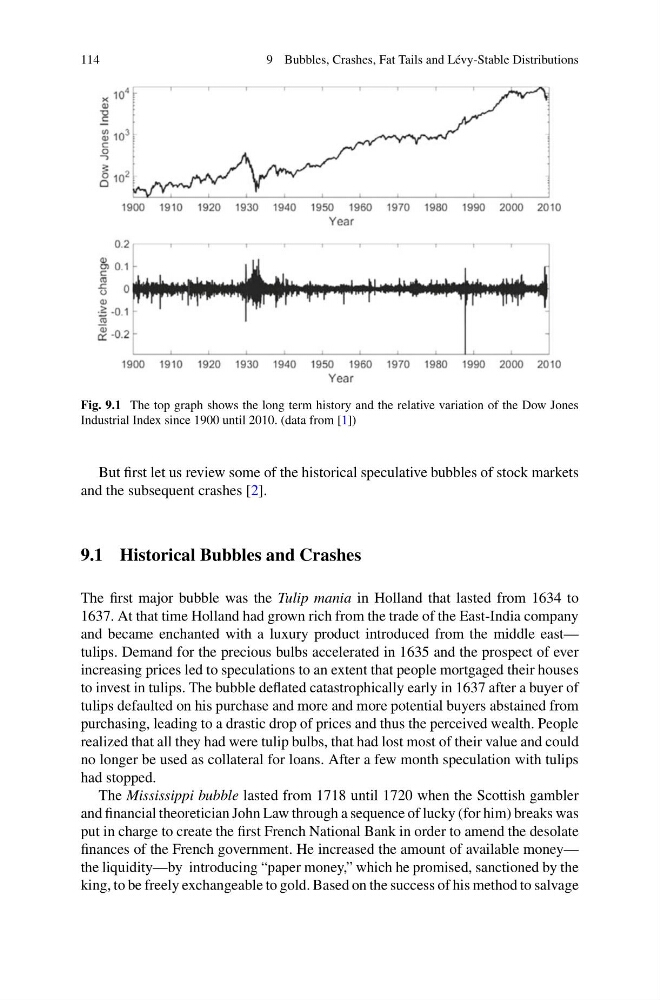
Fig. 9.1 The top graph shows the long term history and the relative variation of the Dow Jones
Industrial Index since 1900 until 2010. (data from [1])
But first let us review some of the historical speculative bubbles of stock markets
and the subsequent crashes [2].
9.1 Historical Bubbles and Crashes
The first major bubble was the Tulip mania in Holland that lasted from 1634 to
1637. At that time Holland had grown rich from the trade of the East-India company
and became enchanted with a luxury product introduced from the middle east—
tulips. Demand for the precious bulbs accelerated in 1635 and the prospect of ever
increasing prices led to speculations to an extent that people mortgaged their houses
to invest in tulips. The bubble deflated catastrophically early in 1637 after a buyer of
tulips defaulted on his purchase and more and more potential buyers abstained from
purchasing, leading to a drastic drop of prices and thus the perceived wealth. People
realized that all they had were tulip bulbs, that had lost most of their value and could
no longer be used as collateral for loans. After a few month speculation with tulips
had stopped.
The Mississippi bubble lasted from 1718 until 1720 when the Scottish gambler
and financial theoretician John Law through a sequence of lucky (for him) breaks was
put in charge to create the first French National Bank in order to amend the desolate
finances of the French government. He increased the amount of available money—
the liquidity—by introducing “paper money,” which he promised, sanctioned by the
king, to be freely exchangeable to gold. Based on the success of his method to salvage
9 Bubbles, Crashes, Fat Tails and Lévy-Stable Distributions
Fig. 9.1 The top graph shows the long term history and the relative variation of the Dow Jones
Industrial Index since 1900 until 2010. (data from [1])
But first let us review some of the historical speculative bubbles of stock markets
and the subsequent crashes [2].
9.1 Historical Bubbles and Crashes
The first major bubble was the Tulip mania in Holland that lasted from 1634 to
1637. At that time Holland had grown rich from the trade of the East-India company
and became enchanted with a luxury product introduced from the middle east—
tulips. Demand for the precious bulbs accelerated in 1635 and the prospect of ever
increasing prices led to speculations to an extent that people mortgaged their houses
to invest in tulips. The bubble deflated catastrophically early in 1637 after a buyer of
tulips defaulted on his purchase and more and more potential buyers abstained from
purchasing, leading to a drastic drop of prices and thus the perceived wealth. People
realized that all they had were tulip bulbs, that had lost most of their value and could
no longer be used as collateral for loans. After a few month speculation with tulips
had stopped.
The Mississippi bubble lasted from 1718 until 1720 when the Scottish gambler
and financial theoretician John Law through a sequence of lucky (for him) breaks was
put in charge to create the first French National Bank in order to amend the desolate
finances of the French government. He increased the amount of available money—
the liquidity—by introducing “paper money,” which he promised, sanctioned by the
king, to be freely exchangeable to gold. Based on the success of his method to salvage