

110
8 Time Series
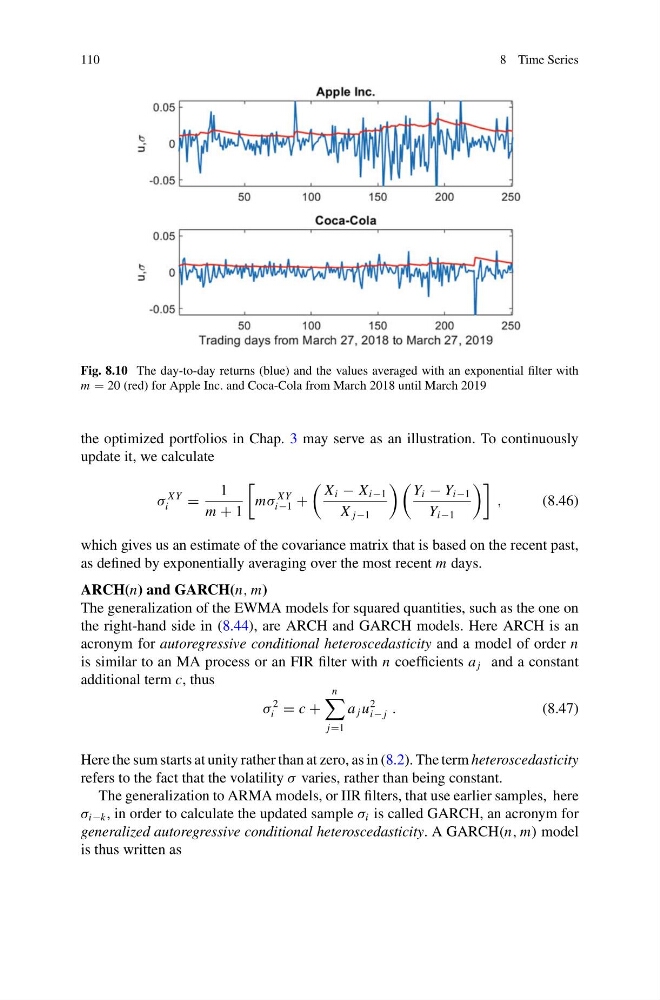
Fig. 8.10 The day-to-day returns (blue) and the values averaged with an exponential filter with
m = 20 (red) for Apple Inc. and Coca-Cola from March 2018 until March 2019
the optimized portfolios in Chap. 3 may serve as an illustration. To continuously
update it, we calculate
σ
XY
i
=
1
m + 1
mσ
XY
i−1 +
X i − X i−1
X j−1
Y i − Y i−1
Y i−1
,
(8.46)
which gives us an estimate of the covariance matrix that is based on the recent past,
as defined by exponentially averaging over the most recent m days.
ARCH(n) and GARCH(n, m)
The generalization of the EWMA models for squared quantities, such as the one on
the right-hand side in (8.44), are ARCH and GARCH models. Here ARCH is an
acronym for autoregressive conditional heteroscedasticity and a model of order n
is similar to an MA process or an FIR filter with n coefficients a j and a constant
additional term c, thus
σ
2
i = c +
n
j=1
a j u
2
i− j .
(8.47)
Here the sum starts at unity rather than at zero, as in (8.2). The term heteroscedasticity
refers to the fact that the volatility σ varies, rather than being constant.
The generalization to ARMA models, or IIR filters, that use earlier samples, here
σ i−k , in order to calculate the updated sample σ i is called GARCH, an acronym for
generalized autoregressive conditional heteroscedasticity. A GARCH(n, m) model
is thus written as
8 Time Series
Fig. 8.10 The day-to-day returns (blue) and the values averaged with an exponential filter with
m = 20 (red) for Apple Inc. and Coca-Cola from March 2018 until March 2019
the optimized portfolios in Chap. 3 may serve as an illustration. To continuously
update it, we calculate
σ
XY
i
=
1
m + 1
mσ
XY
i−1 +
X i − X i−1
X j−1
Y i − Y i−1
Y i−1
,
(8.46)
which gives us an estimate of the covariance matrix that is based on the recent past,
as defined by exponentially averaging over the most recent m days.
ARCH(n) and GARCH(n, m)
The generalization of the EWMA models for squared quantities, such as the one on
the right-hand side in (8.44), are ARCH and GARCH models. Here ARCH is an
acronym for autoregressive conditional heteroscedasticity and a model of order n
is similar to an MA process or an FIR filter with n coefficients a j and a constant
additional term c, thus
σ
2
i = c +
n
j=1
a j u
2
i− j .
(8.47)
Here the sum starts at unity rather than at zero, as in (8.2). The term heteroscedasticity
refers to the fact that the volatility σ varies, rather than being constant.
The generalization to ARMA models, or IIR filters, that use earlier samples, here
σ i−k , in order to calculate the updated sample σ i is called GARCH, an acronym for
generalized autoregressive conditional heteroscedasticity. A GARCH(n, m) model
is thus written as