

2.3 Memristive Devices and Systems
57
Example 2.18 (Potassium and Sodium Ions Channels in the Hodgkin–Huxley
Model) The renowned Hodgkin–Huxley neuron model (HH model) provides a
description of neurophysiology and action potential propagation in the squid giant
axon membrane. The squid was chosen by Hodgkin and Huxley because it has
axons of almost one millimeter in diameter and the Hodgkin–Huxley equation was
derived strictly by empirical methods.
The electric behavior of the Hodgkin–Huxley axon membrane is described by
the net ion flow through a great number of ion channels. The Hodgkin–Huxley axon
circuit model (see [23]) takes into account the electric current flowing through the
cell membrane during activation due to four current components: (1) current i Na (t)
carried by sodium ions; (2) current i K (t) carried by potassium ions; (3) current i L (t)
carried by other ions (designated leakage current, mainly due to chloride ions); (4)
capacitive current. As discussed in [1], the Hodgkin–Huxley axon circuit model may
be replaced by the memristor-based Hodgkin–Huxley axon circuit model because:
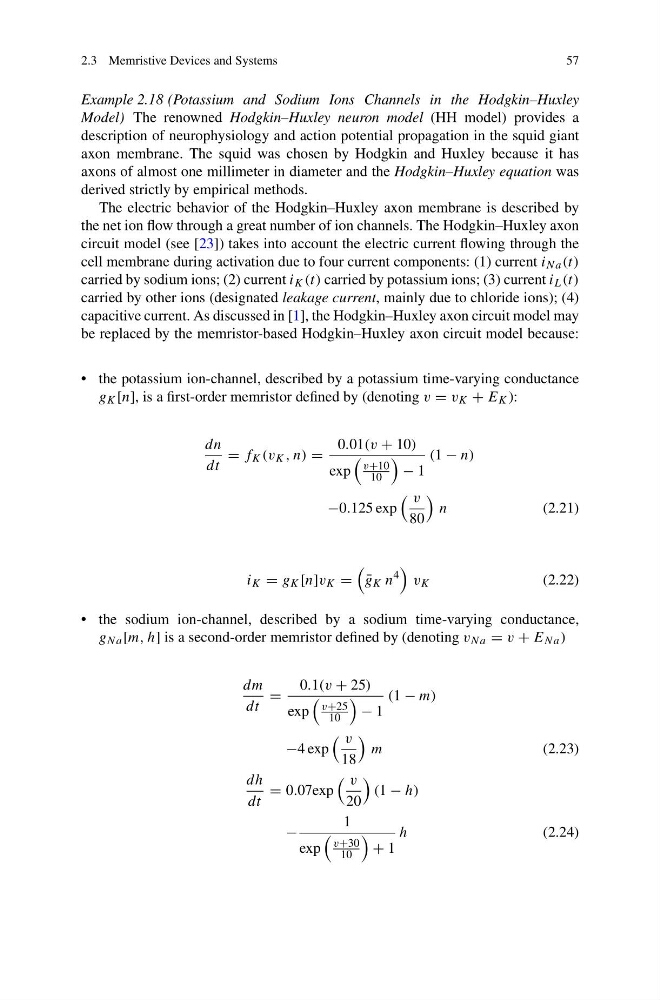
• the potassium ion-channel, described by a potassium time-varying conductance
g K [n], is a first-order memristor defined by (denoting v = v K + E K ):
dn
dt
= f K (v K , n) =
0.01(v + 10)
exp
v+10
10
− 1
(1 − n)
−0.125 exp
v
80
n
(2.21)
i K = g K [n]v K =
¯
g K n
4
v K
(2.22)
• the sodium ion-channel, described by a sodium time-varying conductance,
g Na [m, h] is a second-order memristor defined by (denoting v Na = v + E Na )
dm
dt
=
0.1(v + 25)
exp
v+25
10
− 1
(1 − m)
−4 exp
v
18
m
(2.23)
dh
dt
= 0.07exp
v
20
(1 − h)
−
1
exp
v+30
10
+ 1
h
(2.24)
57
Example 2.18 (Potassium and Sodium Ions Channels in the Hodgkin–Huxley
Model) The renowned Hodgkin–Huxley neuron model (HH model) provides a
description of neurophysiology and action potential propagation in the squid giant
axon membrane. The squid was chosen by Hodgkin and Huxley because it has
axons of almost one millimeter in diameter and the Hodgkin–Huxley equation was
derived strictly by empirical methods.
The electric behavior of the Hodgkin–Huxley axon membrane is described by
the net ion flow through a great number of ion channels. The Hodgkin–Huxley axon
circuit model (see [23]) takes into account the electric current flowing through the
cell membrane during activation due to four current components: (1) current i Na (t)
carried by sodium ions; (2) current i K (t) carried by potassium ions; (3) current i L (t)
carried by other ions (designated leakage current, mainly due to chloride ions); (4)
capacitive current. As discussed in [1], the Hodgkin–Huxley axon circuit model may
be replaced by the memristor-based Hodgkin–Huxley axon circuit model because:
• the potassium ion-channel, described by a potassium time-varying conductance
g K [n], is a first-order memristor defined by (denoting v = v K + E K ):
dn
dt
= f K (v K , n) =
0.01(v + 10)
exp
v+10
10
− 1
(1 − n)
−0.125 exp
v
80
n
(2.21)
i K = g K [n]v K =
¯
g K n
4
v K
(2.22)
• the sodium ion-channel, described by a sodium time-varying conductance,
g Na [m, h] is a second-order memristor defined by (denoting v Na = v + E Na )
dm
dt
=
0.1(v + 25)
exp
v+25
10
− 1
(1 − m)
−4 exp
v
18
m
(2.23)
dh
dt
= 0.07exp
v
20
(1 − h)
−
1
exp
v+30
10
+ 1
h
(2.24)