

2.3 Memristive Devices and Systems
49
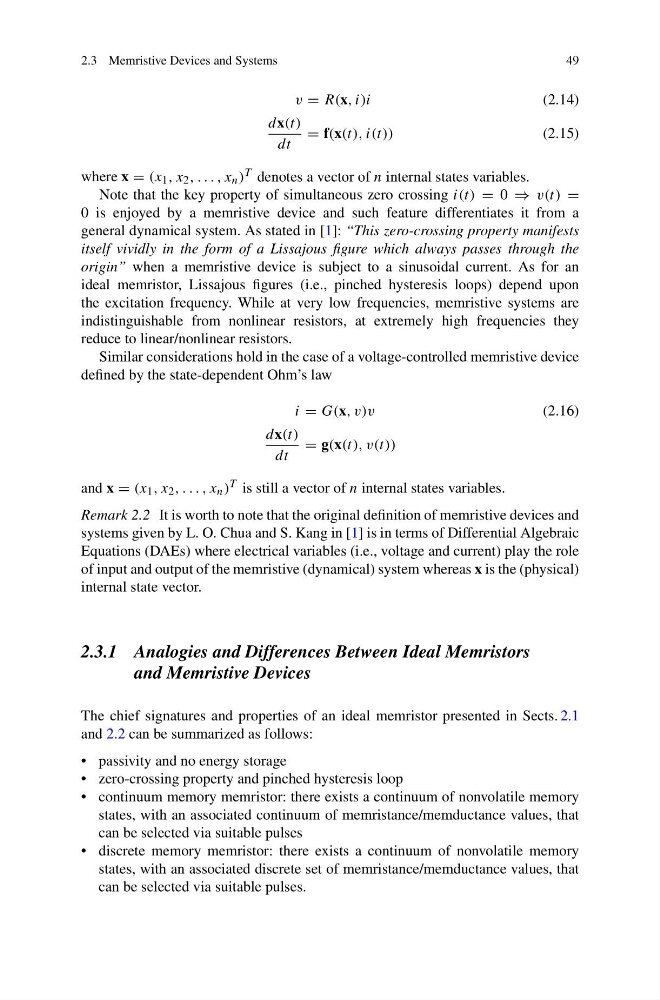
v = R(x, i)i
(2.14)
dx(t)
dt
= f(x(t), i(t))
(2.15)
where x = (x 1 , x 2 , . . . , x n ) T denotes a vector of n internal states variables.
Note that the key property of simultaneous zero crossing i(t) = 0 ⇒ v(t) =
0 is enjoyed by a memristive device and such feature differentiates it from a
general dynamical system. As stated in [1]: “This zero-crossing property manifests
itself vividly in the form of a Lissajous figure which always passes through the
origin” when a memristive device is subject to a sinusoidal current. As for an
ideal memristor, Lissajous figures (i.e., pinched hysteresis loops) depend upon
the excitation frequency. While at very low frequencies, memristive systems are
indistinguishable from nonlinear resistors, at extremely high frequencies they
reduce to linear/nonlinear resistors.
Similar considerations hold in the case of a voltage-controlled memristive device
defined by the state-dependent Ohm’s law
i = G(x, v)v
(2.16)
dx(t)
dt
= g(x(t), v(t))
and x = (x 1 , x 2 , . . . , x n ) T is still a vector of n internal states variables.
Remark 2.2 It is worth to note that the original definition of memristive devices and
systems given by L. O. Chua and S. Kang in [1] is in terms of Differential Algebraic
Equations (DAEs) where electrical variables (i.e., voltage and current) play the role
of input and output of the memristive (dynamical) system whereas x is the (physical)
internal state vector.
2.3.1 Analogies and Differences Between Ideal Memristors
and Memristive Devices
The chief signatures and properties of an ideal memristor presented in Sects. 2.1
and 2.2 can be summarized as follows:
• passivity and no energy storage
• zero-crossing property and pinched hysteresis loop
• continuum memory memristor: there exists a continuum of nonvolatile memory
states, with an associated continuum of memristance/memductance values, that
can be selected via suitable pulses
• discrete memory memristor: there exists a continuum of nonvolatile memory
states, with an associated discrete set of memristance/memductance values, that
can be selected via suitable pulses.
49
v = R(x, i)i
(2.14)
dx(t)
dt
= f(x(t), i(t))
(2.15)
where x = (x 1 , x 2 , . . . , x n ) T denotes a vector of n internal states variables.
Note that the key property of simultaneous zero crossing i(t) = 0 ⇒ v(t) =
0 is enjoyed by a memristive device and such feature differentiates it from a
general dynamical system. As stated in [1]: “This zero-crossing property manifests
itself vividly in the form of a Lissajous figure which always passes through the
origin” when a memristive device is subject to a sinusoidal current. As for an
ideal memristor, Lissajous figures (i.e., pinched hysteresis loops) depend upon
the excitation frequency. While at very low frequencies, memristive systems are
indistinguishable from nonlinear resistors, at extremely high frequencies they
reduce to linear/nonlinear resistors.
Similar considerations hold in the case of a voltage-controlled memristive device
defined by the state-dependent Ohm’s law
i = G(x, v)v
(2.16)
dx(t)
dt
= g(x(t), v(t))
and x = (x 1 , x 2 , . . . , x n ) T is still a vector of n internal states variables.
Remark 2.2 It is worth to note that the original definition of memristive devices and
systems given by L. O. Chua and S. Kang in [1] is in terms of Differential Algebraic
Equations (DAEs) where electrical variables (i.e., voltage and current) play the role
of input and output of the memristive (dynamical) system whereas x is the (physical)
internal state vector.
2.3.1 Analogies and Differences Between Ideal Memristors
and Memristive Devices
The chief signatures and properties of an ideal memristor presented in Sects. 2.1
and 2.2 can be summarized as follows:
• passivity and no energy storage
• zero-crossing property and pinched hysteresis loop
• continuum memory memristor: there exists a continuum of nonvolatile memory
states, with an associated continuum of memristance/memductance values, that
can be selected via suitable pulses
• discrete memory memristor: there exists a continuum of nonvolatile memory
states, with an associated discrete set of memristance/memductance values, that
can be selected via suitable pulses.