

46
2 Fundamental Properties of Mem-Elements
Example 2.11 (Programming a Continuum Memory Ideal Memristor) Let us consider again the (passive) flux-controlled memristor of the previous Example 2.10
with memductance ˆ
q (ϕ) = ϕ 2 and subject to an external voltage source v s as
shown in Fig. 2.17a. Assume that the initial flux is ϕ(t 0 ) = 0, hence the initial
charge q(t 0 ) = ˆ
q(ϕ(t 0 )) = 0. It follows that the nonvolatile memory associated
with the memductance at t 0 is ˆ
q (ϕ(t 0 )) = 0 until an external input is applied.
Then, apply a sequence of N + 1 voltage pulses (cf. Fig. 2.17c) with amplitudes
E k and durations Δ k at the instant t k with k = 0, 1, 2, . . . , N. In other words, the
ideal memristor ˆ
q(ϕ) =
1
3 ϕ 3 is subject to a sequence of nonuniform pulses defined
by a voltage source v s (t) = E k , t ∈ [t k , t k + Δ k ] and v s (t) = 0, t ∈ (t k + Δ, t k+1 ).
By using Eq. (2.13) in the Example 2.9, each voltage pulse increases the flux ϕ
by ϕ P k = E k Δ k , i.e., being ϕ(t 0 ) = 0
ϕ(t k + Δ k ) =
k
r=0
E r Δ r , (k = 0, 1, 2, . . . , N).
On the other hand, the flux ϕ(t) remains constant for all t ∈ [t k + Δ k , t k+1 ] (because
v s (t) = 0) so that the memristor exhibits a nonvolatile memductance
ˆ
q
(ϕ(t k + Δ k )) = ϕ
2 (t k + Δ k ) = ϕ
2 (t k+1 ), ∀t ∈ (t k + Δ k , t k+1 ).
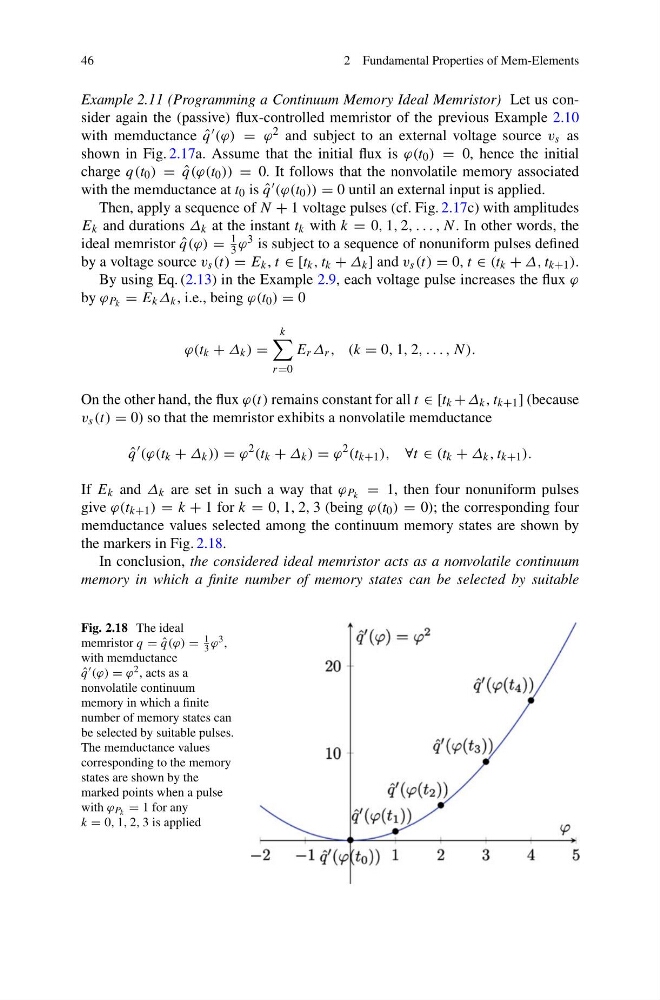
If E k and Δ k are set in such a way that ϕ P k = 1, then four nonuniform pulses
give ϕ(t k+1 ) = k + 1 for k = 0, 1, 2, 3 (being ϕ(t 0 ) = 0); the corresponding four
memductance values selected among the continuum memory states are shown by
the markers in Fig. 2.18.
In conclusion, the considered ideal memristor acts as a nonvolatile continuum
memory in which a finite number of memory states can be selected by suitable
Fig. 2.18 The ideal
memristor q = ˆ
q(ϕ) =
1
3 ϕ 3 ,
with memductance
ˆ
q (ϕ) = ϕ 2 , acts as a
nonvolatile continuum
memory in which a finite
number of memory states can
be selected by suitable pulses.
The memductance values
corresponding to the memory
states are shown by the
marked points when a pulse
with ϕ P k = 1 for any
k = 0, 1, 2, 3 is applied
2 Fundamental Properties of Mem-Elements
Example 2.11 (Programming a Continuum Memory Ideal Memristor) Let us consider again the (passive) flux-controlled memristor of the previous Example 2.10
with memductance ˆ
q (ϕ) = ϕ 2 and subject to an external voltage source v s as
shown in Fig. 2.17a. Assume that the initial flux is ϕ(t 0 ) = 0, hence the initial
charge q(t 0 ) = ˆ
q(ϕ(t 0 )) = 0. It follows that the nonvolatile memory associated
with the memductance at t 0 is ˆ
q (ϕ(t 0 )) = 0 until an external input is applied.
Then, apply a sequence of N + 1 voltage pulses (cf. Fig. 2.17c) with amplitudes
E k and durations Δ k at the instant t k with k = 0, 1, 2, . . . , N. In other words, the
ideal memristor ˆ
q(ϕ) =
1
3 ϕ 3 is subject to a sequence of nonuniform pulses defined
by a voltage source v s (t) = E k , t ∈ [t k , t k + Δ k ] and v s (t) = 0, t ∈ (t k + Δ, t k+1 ).
By using Eq. (2.13) in the Example 2.9, each voltage pulse increases the flux ϕ
by ϕ P k = E k Δ k , i.e., being ϕ(t 0 ) = 0
ϕ(t k + Δ k ) =
k
r=0
E r Δ r , (k = 0, 1, 2, . . . , N).
On the other hand, the flux ϕ(t) remains constant for all t ∈ [t k + Δ k , t k+1 ] (because
v s (t) = 0) so that the memristor exhibits a nonvolatile memductance
ˆ
q
(ϕ(t k + Δ k )) = ϕ
2 (t k + Δ k ) = ϕ
2 (t k+1 ), ∀t ∈ (t k + Δ k , t k+1 ).
If E k and Δ k are set in such a way that ϕ P k = 1, then four nonuniform pulses
give ϕ(t k+1 ) = k + 1 for k = 0, 1, 2, 3 (being ϕ(t 0 ) = 0); the corresponding four
memductance values selected among the continuum memory states are shown by
the markers in Fig. 2.18.
In conclusion, the considered ideal memristor acts as a nonvolatile continuum
memory in which a finite number of memory states can be selected by suitable
Fig. 2.18 The ideal
memristor q = ˆ
q(ϕ) =
1
3 ϕ 3 ,
with memductance
ˆ
q (ϕ) = ϕ 2 , acts as a
nonvolatile continuum
memory in which a finite
number of memory states can
be selected by suitable pulses.
The memductance values
corresponding to the memory
states are shown by the
marked points when a pulse
with ϕ P k = 1 for any
k = 0, 1, 2, 3 is applied