

30
2 Fundamental Properties of Mem-Elements
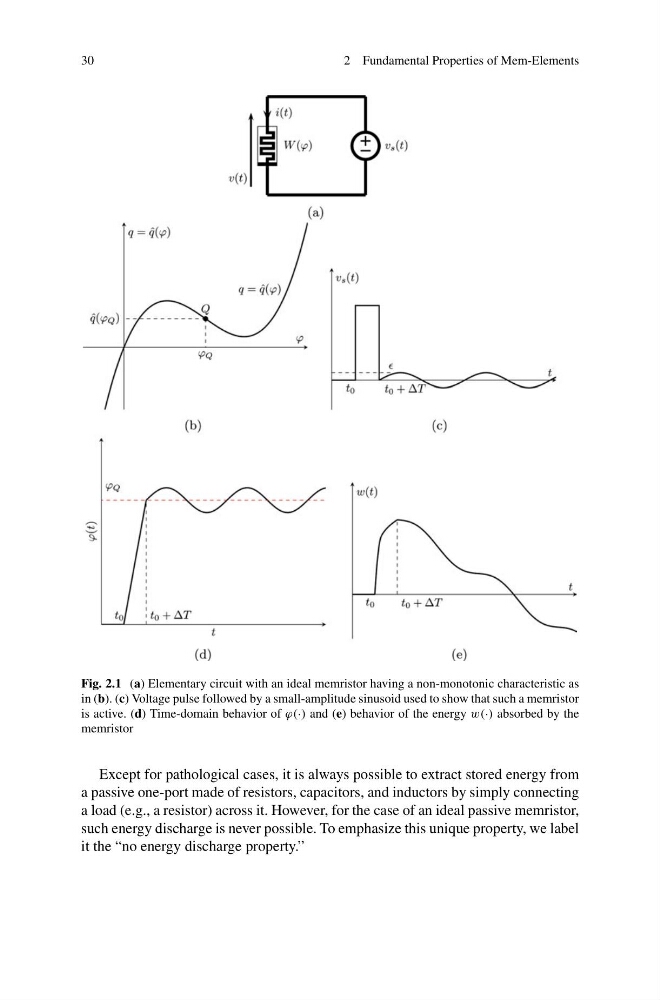
Fig. 2.1 (a) Elementary circuit with an ideal memristor having a non-monotonic characteristic as
in (b). (c) Voltage pulse followed by a small-amplitude sinusoid used to show that such a memristor
is active. (d) Time-domain behavior of ϕ(·) and (e) behavior of the energy w(·) absorbed by the
memristor
Except for pathological cases, it is always possible to extract stored energy from
a passive one-port made of resistors, capacitors, and inductors by simply connecting
a load (e.g., a resistor) across it. However, for the case of an ideal passive memristor,
such energy discharge is never possible. To emphasize this unique property, we label
it the “no energy discharge property.”
2 Fundamental Properties of Mem-Elements
Fig. 2.1 (a) Elementary circuit with an ideal memristor having a non-monotonic characteristic as
in (b). (c) Voltage pulse followed by a small-amplitude sinusoid used to show that such a memristor
is active. (d) Time-domain behavior of ϕ(·) and (e) behavior of the energy w(·) absorbed by the
memristor
Except for pathological cases, it is always possible to extract stored energy from
a passive one-port made of resistors, capacitors, and inductors by simply connecting
a load (e.g., a resistor) across it. However, for the case of an ideal passive memristor,
such energy discharge is never possible. To emphasize this unique property, we label
it the “no energy discharge property.”