

12
1 Device Modeling and Circuit Elements
+
−
v
i
v
i
)
b
(
)
a
(
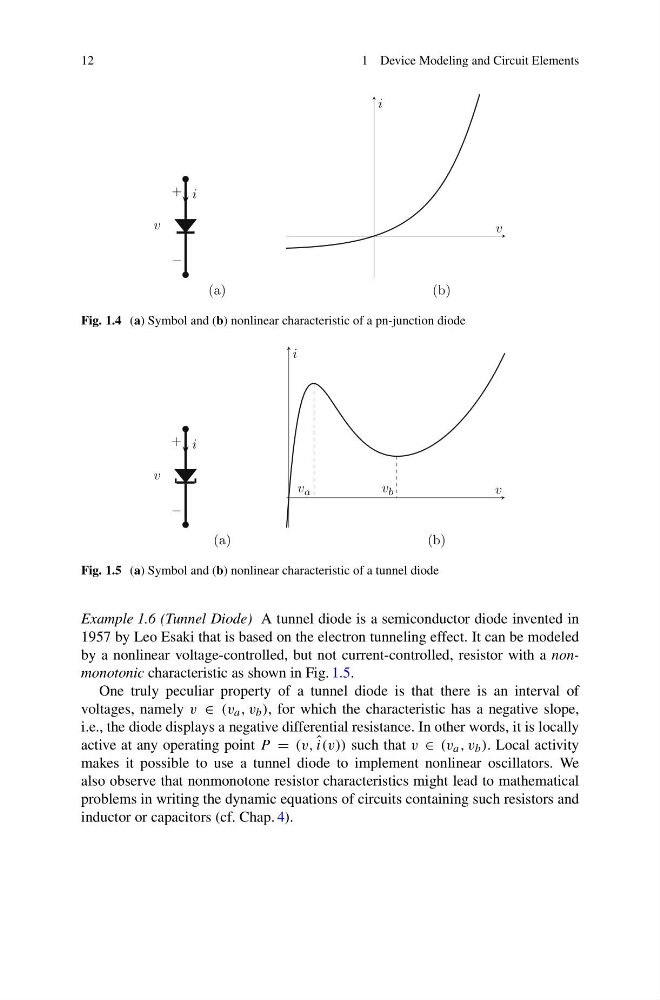
Fig. 1.4 (a) Symbol and (b) nonlinear characteristic of a pn-junction diode
+
−
v
i
v a
v b
v
i
)
b
(
)
a
(
Fig. 1.5 (a) Symbol and (b) nonlinear characteristic of a tunnel diode
Example 1.6 (Tunnel Diode) A tunnel diode is a semiconductor diode invented in
1957 by Leo Esaki that is based on the electron tunneling effect. It can be modeled
by a nonlinear voltage-controlled, but not current-controlled, resistor with a nonmonotonic characteristic as shown in Fig. 1.5.
One truly peculiar property of a tunnel diode is that there is an interval of
voltages, namely v ∈ (v a , v b ), for which the characteristic has a negative slope,
i.e., the diode displays a negative differential resistance. In other words, it is locally
active at any operating point P = (v, ˆ
i(v)) such that v ∈ (v a , v b ). Local activity
makes it possible to use a tunnel diode to implement nonlinear oscillators. We
also observe that nonmonotone resistor characteristics might lead to mathematical
problems in writing the dynamic equations of circuits containing such resistors and
inductor or capacitors (cf. Chap. 4).
1 Device Modeling and Circuit Elements
+
−
v
i
v
i
)
b
(
)
a
(
Fig. 1.4 (a) Symbol and (b) nonlinear characteristic of a pn-junction diode
+
−
v
i
v a
v b
v
i
)
b
(
)
a
(
Fig. 1.5 (a) Symbol and (b) nonlinear characteristic of a tunnel diode
Example 1.6 (Tunnel Diode) A tunnel diode is a semiconductor diode invented in
1957 by Leo Esaki that is based on the electron tunneling effect. It can be modeled
by a nonlinear voltage-controlled, but not current-controlled, resistor with a nonmonotonic characteristic as shown in Fig. 1.5.
One truly peculiar property of a tunnel diode is that there is an interval of
voltages, namely v ∈ (v a , v b ), for which the characteristic has a negative slope,
i.e., the diode displays a negative differential resistance. In other words, it is locally
active at any operating point P = (v, ˆ
i(v)) such that v ∈ (v a , v b ). Local activity
makes it possible to use a tunnel diode to implement nonlinear oscillators. We
also observe that nonmonotone resistor characteristics might lead to mathematical
problems in writing the dynamic equations of circuits containing such resistors and
inductor or capacitors (cf. Chap. 4).