

384
10 Extended Memristor Devices
10.3 An L − C Circuit with an Extended Memristor
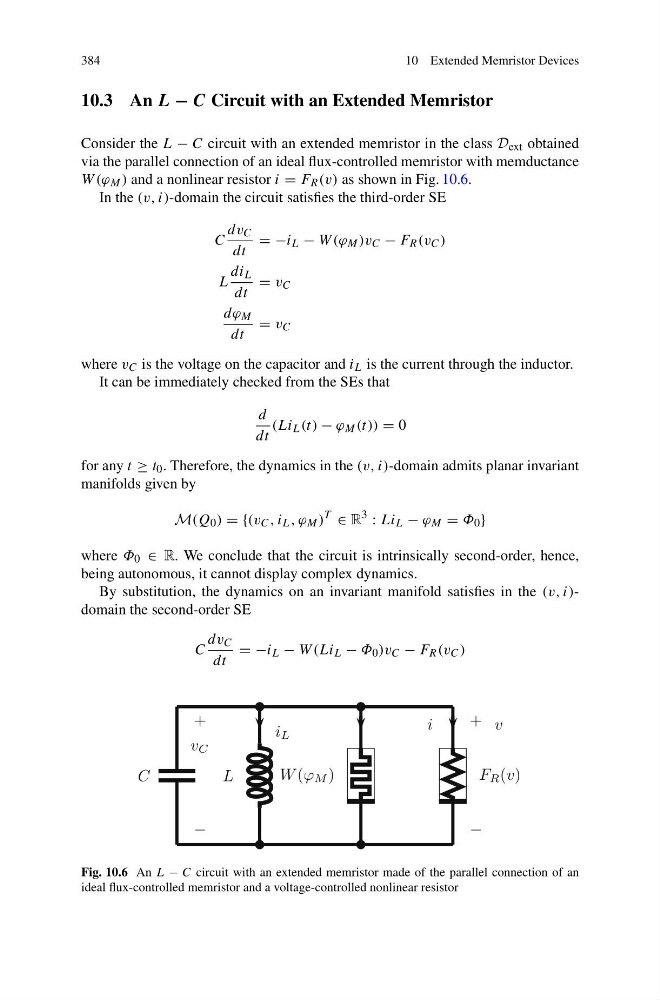
Consider the L − C circuit with an extended memristor in the class D ext obtained
via the parallel connection of an ideal flux-controlled memristor with memductance
W (ϕ M ) and a nonlinear resistor i = F R (v) as shown in Fig. 10.6.
In the (v, i)-domain the circuit satisfies the third-order SE
C
dv C
dt
= −i L − W (ϕ M )v C − F R (v C )
L
di L
dt
= v C
dϕ M
dt
= v C
where v C is the voltage on the capacitor and i L is the current through the inductor.
It can be immediately checked from the SEs that
d
dt
(Li L (t) − ϕ M (t)) = 0
for any t ≥ t 0 . Therefore, the dynamics in the (v, i)-domain admits planar invariant
manifolds given by
M(Q 0 ) = {(v C , i L , ϕ M )
T
∈ R
3
: Li L − ϕ M = Φ 0 }
where Φ 0 ∈ R. We conclude that the circuit is intrinsically second-order, hence,
being autonomous, it cannot display complex dynamics.
By substitution, the dynamics on an invariant manifold satisfies in the (v, i)domain the second-order SE
C
dv C
dt
= −i L − W (Li L − Φ 0 )v C − F R (v C )
C
L
W (ϕ M )
F R (v)
−
+
v C
i L
i
−
+ v
Fig. 10.6 An L − C circuit with an extended memristor made of the parallel connection of an
ideal flux-controlled memristor and a voltage-controlled nonlinear resistor
10 Extended Memristor Devices
10.3 An L − C Circuit with an Extended Memristor
Consider the L − C circuit with an extended memristor in the class D ext obtained
via the parallel connection of an ideal flux-controlled memristor with memductance
W (ϕ M ) and a nonlinear resistor i = F R (v) as shown in Fig. 10.6.
In the (v, i)-domain the circuit satisfies the third-order SE
C
dv C
dt
= −i L − W (ϕ M )v C − F R (v C )
L
di L
dt
= v C
dϕ M
dt
= v C
where v C is the voltage on the capacitor and i L is the current through the inductor.
It can be immediately checked from the SEs that
d
dt
(Li L (t) − ϕ M (t)) = 0
for any t ≥ t 0 . Therefore, the dynamics in the (v, i)-domain admits planar invariant
manifolds given by
M(Q 0 ) = {(v C , i L , ϕ M )
T
∈ R
3
: Li L − ϕ M = Φ 0 }
where Φ 0 ∈ R. We conclude that the circuit is intrinsically second-order, hence,
being autonomous, it cannot display complex dynamics.
By substitution, the dynamics on an invariant manifold satisfies in the (v, i)domain the second-order SE
C
dv C
dt
= −i L − W (Li L − Φ 0 )v C − F R (v C )
C
L
W (ϕ M )
F R (v)
−
+
v C
i L
i
−
+ v
Fig. 10.6 An L − C circuit with an extended memristor made of the parallel connection of an
ideal flux-controlled memristor and a voltage-controlled nonlinear resistor