

376
10 Extended Memristor Devices
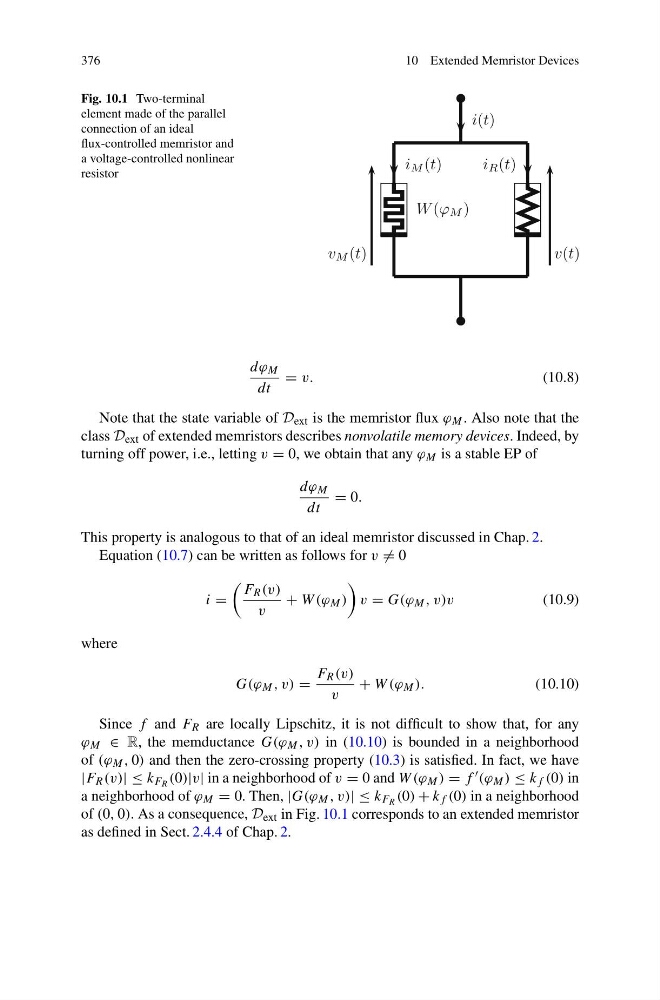
Fig. 10.1 Two-terminal
element made of the parallel
connection of an ideal
flux-controlled memristor and
a voltage-controlled nonlinear
resistor
dϕ M
dt
= v.
(10.8)
Note that the state variable of D ext is the memristor flux ϕ M . Also note that the
class D ext of extended memristors describes nonvolatile memory devices. Indeed, by
turning off power, i.e., letting v = 0, we obtain that any ϕ M is a stable EP of
dϕ M
dt
= 0.
This property is analogous to that of an ideal memristor discussed in Chap. 2.
Equation (10.7) can be written as follows for v = 0
i =
F R (v)
v
+ W (ϕ M )
v = G(ϕ M , v)v
(10.9)
where
G(ϕ M , v) =
F R (v)
v
+ W (ϕ M ).
(10.10)
Since f and F R are locally Lipschitz, it is not difficult to show that, for any
ϕ M ∈ R, the memductance G(ϕ M , v) in (10.10) is bounded in a neighborhood
of (ϕ M , 0) and then the zero-crossing property (10.3) is satisfied. In fact, we have
|F R (v)| ≤ k F R (0)|v| in a neighborhood of v = 0 and W (ϕ M ) = f (ϕ M ) ≤ k f (0) in
a neighborhood of ϕ M = 0. Then, |G(ϕ M , v)| ≤ k F R (0) + k f (0) in a neighborhood
of (0, 0). As a consequence, D ext in Fig. 10.1 corresponds to an extended memristor
as defined in Sect. 2.4.4 of Chap. 2.
10 Extended Memristor Devices
Fig. 10.1 Two-terminal
element made of the parallel
connection of an ideal
flux-controlled memristor and
a voltage-controlled nonlinear
resistor
dϕ M
dt
= v.
(10.8)
Note that the state variable of D ext is the memristor flux ϕ M . Also note that the
class D ext of extended memristors describes nonvolatile memory devices. Indeed, by
turning off power, i.e., letting v = 0, we obtain that any ϕ M is a stable EP of
dϕ M
dt
= 0.
This property is analogous to that of an ideal memristor discussed in Chap. 2.
Equation (10.7) can be written as follows for v = 0
i =
F R (v)
v
+ W (ϕ M )
v = G(ϕ M , v)v
(10.9)
where
G(ϕ M , v) =
F R (v)
v
+ W (ϕ M ).
(10.10)
Since f and F R are locally Lipschitz, it is not difficult to show that, for any
ϕ M ∈ R, the memductance G(ϕ M , v) in (10.10) is bounded in a neighborhood
of (ϕ M , 0) and then the zero-crossing property (10.3) is satisfied. In fact, we have
|F R (v)| ≤ k F R (0)|v| in a neighborhood of v = 0 and W (ϕ M ) = f (ϕ M ) ≤ k f (0) in
a neighborhood of ϕ M = 0. Then, |G(ϕ M , v)| ≤ k F R (0) + k f (0) in a neighborhood
of (0, 0). As a consequence, D ext in Fig. 10.1 corresponds to an extended memristor
as defined in Sect. 2.4.4 of Chap. 2.