

350
9 Memristor Cellular Neural Networks Computing in the Flux-charge Domain
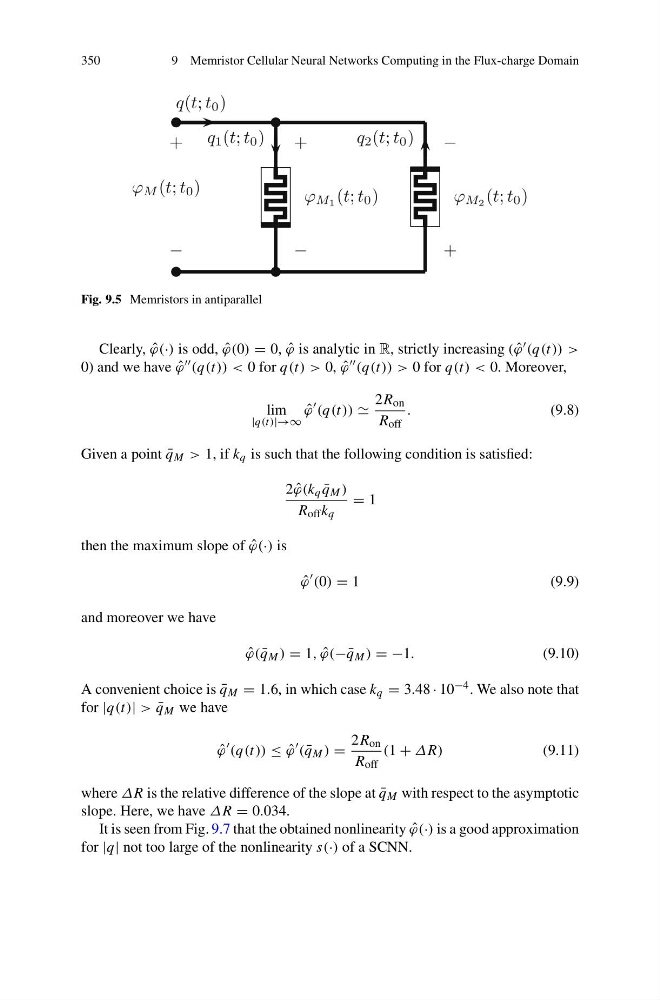
Fig. 9.5 Memristors in antiparallel
Clearly, ˆ
ϕ(·) is odd, ˆ
ϕ(0) = 0, ˆ
ϕ is analytic in R, strictly increasing ( ˆ
ϕ (q(t)) >
0) and we have ˆ
ϕ (q(t)) < 0 for q(t) > 0, ˆ
ϕ (q(t)) > 0 for q(t) < 0. Moreover,
lim
|q(t)|→∞
ˆ
ϕ
(q(t))
2R on
R off
.
(9.8)
Given a point ¯
q M > 1, if k q is such that the following condition is satisfied:
2 ˆ
ϕ(k q ¯
q M )
R off k q
= 1
then the maximum slope of ˆ
ϕ(·) is
ˆ
ϕ
(0) = 1
(9.9)
and moreover we have
ˆ
ϕ( ¯
q M ) = 1, ˆ
ϕ(− ¯
q M ) = −1.
(9.10)
A convenient choice is ¯
q M = 1.6, in which case k q = 3.48 · 10 −4 . We also note that
for |q(t)| > ¯
q M we have
ˆ
ϕ
(q(t)) ≤ ˆ
ϕ
( ¯
q M ) =
2R on
R off
(1 + ΔR)
(9.11)
where ΔR is the relative difference of the slope at ¯
q M with respect to the asymptotic
slope. Here, we have ΔR = 0.034.
It is seen from Fig. 9.7 that the obtained nonlinearity ˆ
ϕ(·) is a good approximation
for |q| not too large of the nonlinearity s(·) of a SCNN.
9 Memristor Cellular Neural Networks Computing in the Flux-charge Domain
Fig. 9.5 Memristors in antiparallel
Clearly, ˆ
ϕ(·) is odd, ˆ
ϕ(0) = 0, ˆ
ϕ is analytic in R, strictly increasing ( ˆ
ϕ (q(t)) >
0) and we have ˆ
ϕ (q(t)) < 0 for q(t) > 0, ˆ
ϕ (q(t)) > 0 for q(t) < 0. Moreover,
lim
|q(t)|→∞
ˆ
ϕ
(q(t))
2R on
R off
.
(9.8)
Given a point ¯
q M > 1, if k q is such that the following condition is satisfied:
2 ˆ
ϕ(k q ¯
q M )
R off k q
= 1
then the maximum slope of ˆ
ϕ(·) is
ˆ
ϕ
(0) = 1
(9.9)
and moreover we have
ˆ
ϕ( ¯
q M ) = 1, ˆ
ϕ(− ¯
q M ) = −1.
(9.10)
A convenient choice is ¯
q M = 1.6, in which case k q = 3.48 · 10 −4 . We also note that
for |q(t)| > ¯
q M we have
ˆ
ϕ
(q(t)) ≤ ˆ
ϕ
( ¯
q M ) =
2R on
R off
(1 + ΔR)
(9.11)
where ΔR is the relative difference of the slope at ¯
q M with respect to the asymptotic
slope. Here, we have ΔR = 0.034.
It is seen from Fig. 9.7 that the obtained nonlinearity ˆ
ϕ(·) is a good approximation
for |q| not too large of the nonlinearity s(·) of a SCNN.