

340
8 Complex Dynamics and Synchronization Phenomena in Arrays of Memristor. . .
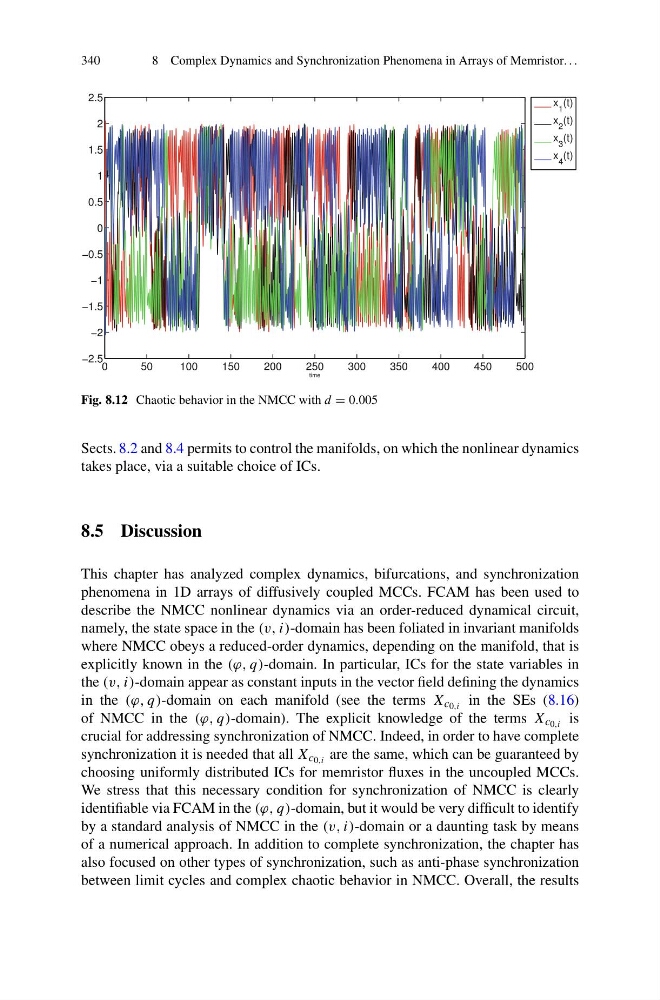
Fig. 8.12 Chaotic behavior in the NMCC with d = 0.005
Sects. 8.2 and 8.4 permits to control the manifolds, on which the nonlinear dynamics
takes place, via a suitable choice of ICs.
8.5 Discussion
This chapter has analyzed complex dynamics, bifurcations, and synchronization
phenomena in 1D arrays of diffusively coupled MCCs. FCAM has been used to
describe the NMCC nonlinear dynamics via an order-reduced dynamical circuit,
namely, the state space in the (v, i)-domain has been foliated in invariant manifolds
where NMCC obeys a reduced-order dynamics, depending on the manifold, that is
explicitly known in the (ϕ, q)-domain. In particular, ICs for the state variables in
the (v, i)-domain appear as constant inputs in the vector field defining the dynamics
in the (ϕ, q)-domain on each manifold (see the terms X c 0,i in the SEs (8.16)
of NMCC in the (ϕ, q)-domain). The explicit knowledge of the terms X c 0,i is
crucial for addressing synchronization of NMCC. Indeed, in order to have complete
synchronization it is needed that all X c 0,i are the same, which can be guaranteed by
choosing uniformly distributed ICs for memristor fluxes in the uncoupled MCCs.
We stress that this necessary condition for synchronization of NMCC is clearly
identifiable via FCAM in the (ϕ, q)-domain, but it would be very difficult to identify
by a standard analysis of NMCC in the (v, i)-domain or a daunting task by means
of a numerical approach. In addition to complete synchronization, the chapter has
also focused on other types of synchronization, such as anti-phase synchronization
between limit cycles and complex chaotic behavior in NMCC. Overall, the results
8 Complex Dynamics and Synchronization Phenomena in Arrays of Memristor. . .
Fig. 8.12 Chaotic behavior in the NMCC with d = 0.005
Sects. 8.2 and 8.4 permits to control the manifolds, on which the nonlinear dynamics
takes place, via a suitable choice of ICs.
8.5 Discussion
This chapter has analyzed complex dynamics, bifurcations, and synchronization
phenomena in 1D arrays of diffusively coupled MCCs. FCAM has been used to
describe the NMCC nonlinear dynamics via an order-reduced dynamical circuit,
namely, the state space in the (v, i)-domain has been foliated in invariant manifolds
where NMCC obeys a reduced-order dynamics, depending on the manifold, that is
explicitly known in the (ϕ, q)-domain. In particular, ICs for the state variables in
the (v, i)-domain appear as constant inputs in the vector field defining the dynamics
in the (ϕ, q)-domain on each manifold (see the terms X c 0,i in the SEs (8.16)
of NMCC in the (ϕ, q)-domain). The explicit knowledge of the terms X c 0,i is
crucial for addressing synchronization of NMCC. Indeed, in order to have complete
synchronization it is needed that all X c 0,i are the same, which can be guaranteed by
choosing uniformly distributed ICs for memristor fluxes in the uncoupled MCCs.
We stress that this necessary condition for synchronization of NMCC is clearly
identifiable via FCAM in the (ϕ, q)-domain, but it would be very difficult to identify
by a standard analysis of NMCC in the (v, i)-domain or a daunting task by means
of a numerical approach. In addition to complete synchronization, the chapter has
also focused on other types of synchronization, such as anti-phase synchronization
between limit cycles and complex chaotic behavior in NMCC. Overall, the results