

8.4 Synchronization Phenomena in the NMCC
333
de ij (t)
dt
=
⎛
⎝
X c 0,i − X c 0,j
0
0
⎞
⎠
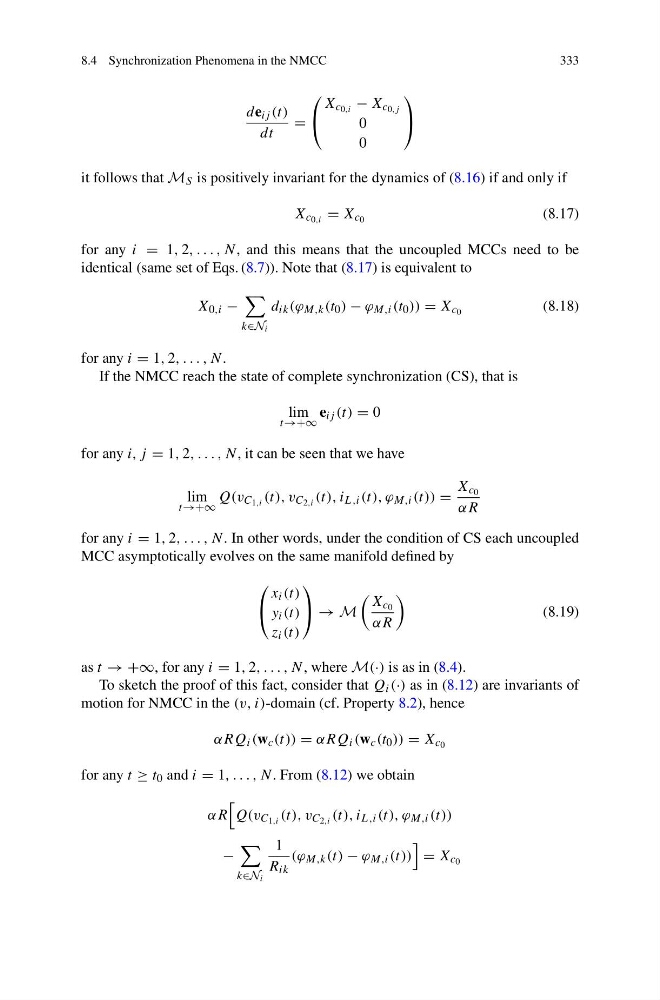
it follows that M S is positively invariant for the dynamics of (8.16) if and only if
X c 0,i = X c 0
(8.17)
for any i = 1, 2, . . . , N, and this means that the uncoupled MCCs need to be
identical (same set of Eqs. (8.7)). Note that (8.17) is equivalent to
X 0,i −
k∈N i
d ik (ϕ M,k (t 0 ) − ϕ M,i (t 0 )) = X c 0
(8.18)
for any i = 1, 2, . . . , N.
If the NMCC reach the state of complete synchronization (CS), that is
lim
t→+∞
e ij (t) = 0
for any i, j = 1, 2, . . . , N, it can be seen that we have
lim
t→+∞
Q(v C 1,i (t), v C 2,i (t), i L,i (t), ϕ M,i (t)) =
X c 0
αR
for any i = 1, 2, . . . , N. In other words, under the condition of CS each uncoupled
MCC asymptotically evolves on the same manifold defined by
⎛
⎝
x i (t)
y i (t)
z i (t)
⎞
⎠ → M
X c 0
αR
(8.19)
as t → +∞, for any i = 1, 2, . . . , N, where M(·) is as in (8.4).
To sketch the proof of this fact, consider that Q i (·) as in (8.12) are invariants of
motion for NMCC in the (v, i)-domain (cf. Property 8.2), hence
αRQ i (w c (t)) = αRQ i (w c (t 0 )) = X c 0
for any t ≥ t 0 and i = 1, . . . , N. From (8.12) we obtain
αR
Q(v C 1,i (t), v C 2,i (t), i L,i (t), ϕ M,i (t))
−
k∈N i
1
R ik
(ϕ M,k (t) − ϕ M,i (t))
= X c 0
333
de ij (t)
dt
=
⎛
⎝
X c 0,i − X c 0,j
0
0
⎞
⎠
it follows that M S is positively invariant for the dynamics of (8.16) if and only if
X c 0,i = X c 0
(8.17)
for any i = 1, 2, . . . , N, and this means that the uncoupled MCCs need to be
identical (same set of Eqs. (8.7)). Note that (8.17) is equivalent to
X 0,i −
k∈N i
d ik (ϕ M,k (t 0 ) − ϕ M,i (t 0 )) = X c 0
(8.18)
for any i = 1, 2, . . . , N.
If the NMCC reach the state of complete synchronization (CS), that is
lim
t→+∞
e ij (t) = 0
for any i, j = 1, 2, . . . , N, it can be seen that we have
lim
t→+∞
Q(v C 1,i (t), v C 2,i (t), i L,i (t), ϕ M,i (t)) =
X c 0
αR
for any i = 1, 2, . . . , N. In other words, under the condition of CS each uncoupled
MCC asymptotically evolves on the same manifold defined by
⎛
⎝
x i (t)
y i (t)
z i (t)
⎞
⎠ → M
X c 0
αR
(8.19)
as t → +∞, for any i = 1, 2, . . . , N, where M(·) is as in (8.4).
To sketch the proof of this fact, consider that Q i (·) as in (8.12) are invariants of
motion for NMCC in the (v, i)-domain (cf. Property 8.2), hence
αRQ i (w c (t)) = αRQ i (w c (t 0 )) = X c 0
for any t ≥ t 0 and i = 1, . . . , N. From (8.12) we obtain
αR
Q(v C 1,i (t), v C 2,i (t), i L,i (t), ϕ M,i (t))
−
k∈N i
1
R ik
(ϕ M,k (t) − ϕ M,i (t))
= X c 0