

4
1 Device Modeling and Circuit Elements
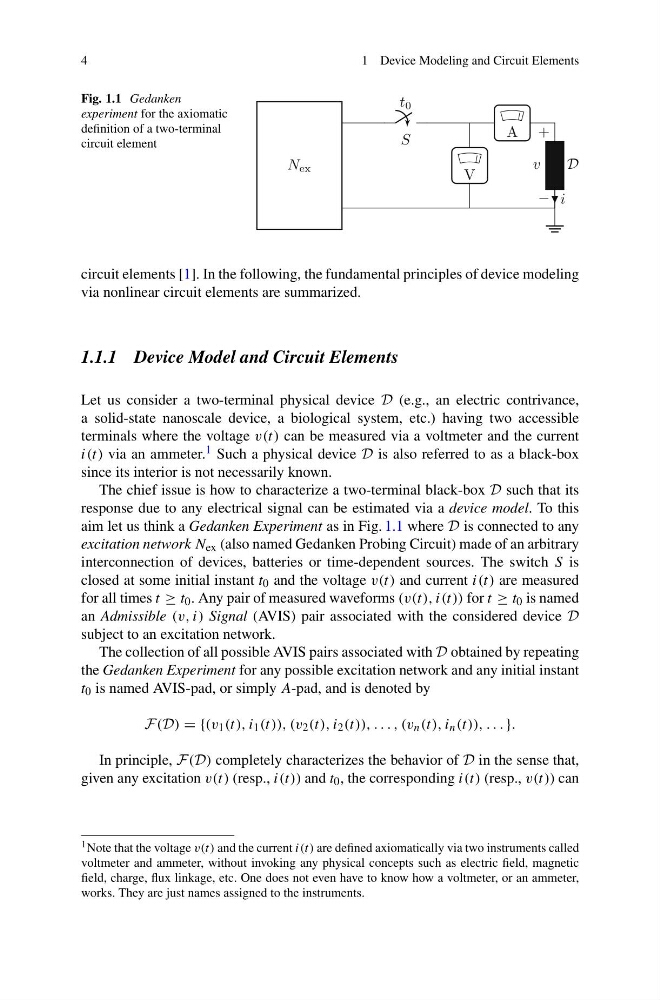
Fig. 1.1 Gedanken
experiment for the axiomatic
definition of a two-terminal
circuit element
A
D
+
−
v
i
V
S
t 0
N ex
circuit elements [1]. In the following, the fundamental principles of device modeling
via nonlinear circuit elements are summarized.
1.1.1 Device Model and Circuit Elements
Let us consider a two-terminal physical device D (e.g., an electric contrivance,
a solid-state nanoscale device, a biological system, etc.) having two accessible
terminals where the voltage v(t) can be measured via a voltmeter and the current
i(t) via an ammeter. 1 Such a physical device D is also referred to as a black-box
since its interior is not necessarily known.
The chief issue is how to characterize a two-terminal black-box D such that its
response due to any electrical signal can be estimated via a device model. To this
aim let us think a Gedanken Experiment as in Fig. 1.1 where D is connected to any
excitation network N ex (also named Gedanken Probing Circuit) made of an arbitrary
interconnection of devices, batteries or time-dependent sources. The switch S is
closed at some initial instant t 0 and the voltage v(t) and current i(t) are measured
for all times t ≥ t 0 . Any pair of measured waveforms (v(t), i(t)) for t ≥ t 0 is named
an Admissible (v, i) Signal (AVIS) pair associated with the considered device D
subject to an excitation network.
The collection of all possible AVIS pairs associated with D obtained by repeating
the Gedanken Experiment for any possible excitation network and any initial instant
t 0 is named AVIS-pad, or simply A-pad, and is denoted by
F(D) = {(v 1 (t), i 1 (t)), (v 2 (t), i 2 (t)), . . . , (v n (t), i n (t)), . . . }.
In principle, F(D) completely characterizes the behavior of D in the sense that,
given any excitation v(t) (resp., i(t)) and t 0 , the corresponding i(t) (resp., v(t)) can
1 Note that the voltage v(t) and the current i(t) are defined axiomatically via two instruments called
voltmeter and ammeter, without invoking any physical concepts such as electric field, magnetic
field, charge, flux linkage, etc. One does not even have to know how a voltmeter, or an ammeter,
works. They are just names assigned to the instruments.
1 Device Modeling and Circuit Elements
Fig. 1.1 Gedanken
experiment for the axiomatic
definition of a two-terminal
circuit element
A
D
+
−
v
i
V
S
t 0
N ex
circuit elements [1]. In the following, the fundamental principles of device modeling
via nonlinear circuit elements are summarized.
1.1.1 Device Model and Circuit Elements
Let us consider a two-terminal physical device D (e.g., an electric contrivance,
a solid-state nanoscale device, a biological system, etc.) having two accessible
terminals where the voltage v(t) can be measured via a voltmeter and the current
i(t) via an ammeter. 1 Such a physical device D is also referred to as a black-box
since its interior is not necessarily known.
The chief issue is how to characterize a two-terminal black-box D such that its
response due to any electrical signal can be estimated via a device model. To this
aim let us think a Gedanken Experiment as in Fig. 1.1 where D is connected to any
excitation network N ex (also named Gedanken Probing Circuit) made of an arbitrary
interconnection of devices, batteries or time-dependent sources. The switch S is
closed at some initial instant t 0 and the voltage v(t) and current i(t) are measured
for all times t ≥ t 0 . Any pair of measured waveforms (v(t), i(t)) for t ≥ t 0 is named
an Admissible (v, i) Signal (AVIS) pair associated with the considered device D
subject to an excitation network.
The collection of all possible AVIS pairs associated with D obtained by repeating
the Gedanken Experiment for any possible excitation network and any initial instant
t 0 is named AVIS-pad, or simply A-pad, and is denoted by
F(D) = {(v 1 (t), i 1 (t)), (v 2 (t), i 2 (t)), . . . , (v n (t), i n (t)), . . . }.
In principle, F(D) completely characterizes the behavior of D in the sense that,
given any excitation v(t) (resp., i(t)) and t 0 , the corresponding i(t) (resp., v(t)) can
1 Note that the voltage v(t) and the current i(t) are defined axiomatically via two instruments called
voltmeter and ammeter, without invoking any physical concepts such as electric field, magnetic
field, charge, flux linkage, etc. One does not even have to know how a voltmeter, or an ammeter,
works. They are just names assigned to the instruments.