

310
7 Pulse Programming of Memristor Circuits
˙
k(ϕ M (t), v C (t), i L (t)) = a(t)
hence via the current-source we can control the switching of solutions between
manifolds.
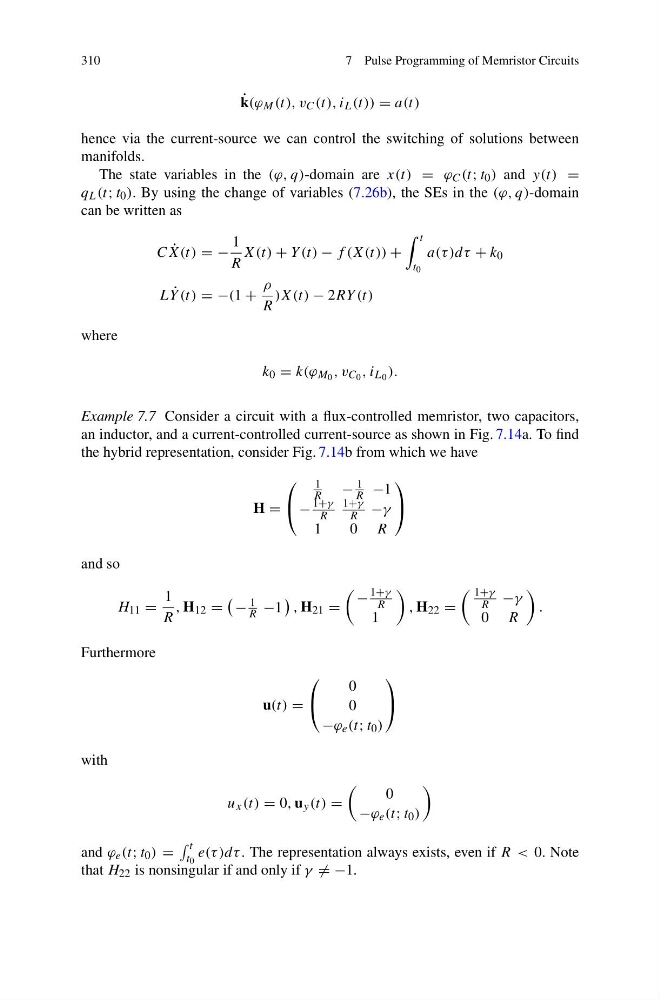
The state variables in the (ϕ, q)-domain are x(t) = ϕ C (t; t 0 ) and y(t) =
q L (t; t 0 ). By using the change of variables (7.26b), the SEs in the (ϕ, q)-domain
can be written as
C ˙
X(t) = −
1
R
X(t) + Y (t) − f (X(t)) +
t
t 0
a(τ )dτ + k 0
L ˙
Y (t) = −(1 +
ρ
R
)X(t) − 2RY (t)
where
k 0 = k(ϕ M 0 , v C 0 , i L 0 ).
Example 7.7 Consider a circuit with a flux-controlled memristor, two capacitors,
an inductor, and a current-controlled current-source as shown in Fig. 7.14a. To find
the hybrid representation, consider Fig. 7.14b from which we have
H =
⎛
⎝
1
R
−
1
R −1
−
1+γ
R
1+γ
R −γ
1
0 R
⎞
⎠
and so
H 11 =
1
R
, H 12 =
−
1
R −1
, H 21 =
−
1+γ
R
1
, H 22 =
1+γ
R −γ
0 R
.
Furthermore
u(t) =
⎛
⎝
0
0
−ϕ e (t; t 0 )
⎞
⎠
with
u x (t) = 0, u y (t) =
0
−ϕ e (t; t 0 )
and ϕ e (t; t 0 ) =
t
t 0
e(τ )dτ . The representation always exists, even if R < 0. Note
that H 22 is nonsingular if and only if γ = −1.
7 Pulse Programming of Memristor Circuits
˙
k(ϕ M (t), v C (t), i L (t)) = a(t)
hence via the current-source we can control the switching of solutions between
manifolds.
The state variables in the (ϕ, q)-domain are x(t) = ϕ C (t; t 0 ) and y(t) =
q L (t; t 0 ). By using the change of variables (7.26b), the SEs in the (ϕ, q)-domain
can be written as
C ˙
X(t) = −
1
R
X(t) + Y (t) − f (X(t)) +
t
t 0
a(τ )dτ + k 0
L ˙
Y (t) = −(1 +
ρ
R
)X(t) − 2RY (t)
where
k 0 = k(ϕ M 0 , v C 0 , i L 0 ).
Example 7.7 Consider a circuit with a flux-controlled memristor, two capacitors,
an inductor, and a current-controlled current-source as shown in Fig. 7.14a. To find
the hybrid representation, consider Fig. 7.14b from which we have
H =
⎛
⎝
1
R
−
1
R −1
−
1+γ
R
1+γ
R −γ
1
0 R
⎞
⎠
and so
H 11 =
1
R
, H 12 =
−
1
R −1
, H 21 =
−
1+γ
R
1
, H 22 =
1+γ
R −γ
0 R
.
Furthermore
u(t) =
⎛
⎝
0
0
−ϕ e (t; t 0 )
⎞
⎠
with
u x (t) = 0, u y (t) =
0
−ϕ e (t; t 0 )
and ϕ e (t; t 0 ) =
t
t 0
e(τ )dτ . The representation always exists, even if R < 0. Note
that H 22 is nonsingular if and only if γ = −1.