

302
7 Pulse Programming of Memristor Circuits
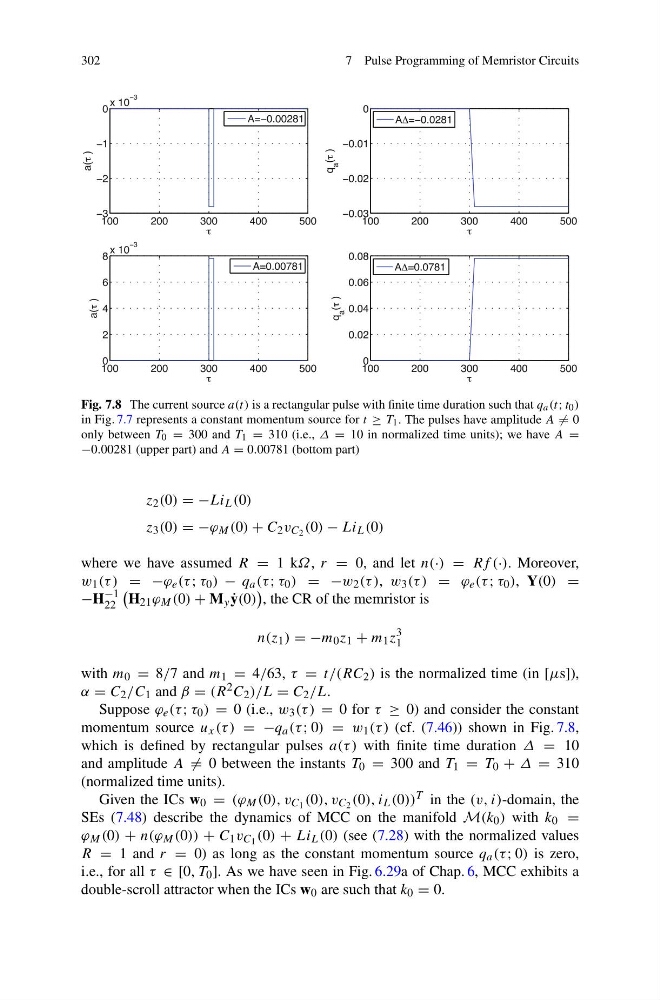
Fig. 7.8 The current source a(t) is a rectangular pulse with finite time duration such that q a (t; t 0 )
in Fig. 7.7 represents a constant momentum source for t ≥ T 1 . The pulses have amplitude A = 0
only between T 0 = 300 and T 1 = 310 (i.e., Δ = 10 in normalized time units); we have A =
−0.00281 (upper part) and A = 0.00781 (bottom part)
z 2 (0) = −Li L (0)
z 3 (0) = −ϕ M (0) + C 2 v C 2 (0) − Li L (0)
where we have assumed R = 1 kΩ, r = 0, and let n(·) = Rf (·). Moreover,
w 1 (τ ) = −ϕ e (τ ; τ 0 ) − q a (τ ; τ 0 ) = −w 2 (τ ), w 3 (τ ) = ϕ e (τ ; τ 0 ), Y(0) =
−H
−1
22
H 21 ϕ M (0) + M y ˙
y(0)
, the CR of the memristor is
n(z 1 ) = −m 0 z 1 + m 1 z
3
1
with m 0 = 8/7 and m 1 = 4/63, τ = t/(RC 2 ) is the normalized time (in [μs]),
α = C 2 /C 1 and β = (R 2 C 2 )/L = C 2 /L.
Suppose ϕ e (τ ; τ 0 ) = 0 (i.e., w 3 (τ ) = 0 for τ ≥ 0) and consider the constant
momentum source u x (τ ) = −q a (τ ; 0) = w 1 (τ ) (cf. (7.46)) shown in Fig. 7.8,
which is defined by rectangular pulses a(τ ) with finite time duration Δ = 10
and amplitude A = 0 between the instants T 0 = 300 and T 1 = T 0 + Δ = 310
(normalized time units).
Given the ICs w 0 = (ϕ M (0), v C 1 (0), v C 2 (0), i L (0)) T in the (v, i)-domain, the
SEs (7.48) describe the dynamics of MCC on the manifold M(k 0 ) with k 0 =
ϕ M (0) + n(ϕ M (0)) + C 1 v C 1 (0) + Li L (0) (see (7.28) with the normalized values
R = 1 and r = 0) as long as the constant momentum source q a (τ ; 0) is zero,
i.e., for all τ ∈ [0, T 0 ]. As we have seen in Fig. 6.29a of Chap. 6, MCC exhibits a
double-scroll attractor when the ICs w 0 are such that k 0 = 0.
7 Pulse Programming of Memristor Circuits
Fig. 7.8 The current source a(t) is a rectangular pulse with finite time duration such that q a (t; t 0 )
in Fig. 7.7 represents a constant momentum source for t ≥ T 1 . The pulses have amplitude A = 0
only between T 0 = 300 and T 1 = 310 (i.e., Δ = 10 in normalized time units); we have A =
−0.00281 (upper part) and A = 0.00781 (bottom part)
z 2 (0) = −Li L (0)
z 3 (0) = −ϕ M (0) + C 2 v C 2 (0) − Li L (0)
where we have assumed R = 1 kΩ, r = 0, and let n(·) = Rf (·). Moreover,
w 1 (τ ) = −ϕ e (τ ; τ 0 ) − q a (τ ; τ 0 ) = −w 2 (τ ), w 3 (τ ) = ϕ e (τ ; τ 0 ), Y(0) =
−H
−1
22
H 21 ϕ M (0) + M y ˙
y(0)
, the CR of the memristor is
n(z 1 ) = −m 0 z 1 + m 1 z
3
1
with m 0 = 8/7 and m 1 = 4/63, τ = t/(RC 2 ) is the normalized time (in [μs]),
α = C 2 /C 1 and β = (R 2 C 2 )/L = C 2 /L.
Suppose ϕ e (τ ; τ 0 ) = 0 (i.e., w 3 (τ ) = 0 for τ ≥ 0) and consider the constant
momentum source u x (τ ) = −q a (τ ; 0) = w 1 (τ ) (cf. (7.46)) shown in Fig. 7.8,
which is defined by rectangular pulses a(τ ) with finite time duration Δ = 10
and amplitude A = 0 between the instants T 0 = 300 and T 1 = T 0 + Δ = 310
(normalized time units).
Given the ICs w 0 = (ϕ M (0), v C 1 (0), v C 2 (0), i L (0)) T in the (v, i)-domain, the
SEs (7.48) describe the dynamics of MCC on the manifold M(k 0 ) with k 0 =
ϕ M (0) + n(ϕ M (0)) + C 1 v C 1 (0) + Li L (0) (see (7.28) with the normalized values
R = 1 and r = 0) as long as the constant momentum source q a (τ ; 0) is zero,
i.e., for all τ ∈ [0, T 0 ]. As we have seen in Fig. 6.29a of Chap. 6, MCC exhibits a
double-scroll attractor when the ICs w 0 are such that k 0 = 0.