

7.6 Programming Memristor Circuits with Pulses and Time-Varying Inputs
297
˙
k(t; t 0 , w 0 ) = 0
for any w 0 ∈ R n and t ≥ t 0 , i.e., K(x M , ˙
x, ˙
y) in (7.29) is an invariant of motion for
N in the (v, i)-domain.
The following fundamental property summarizes the dynamics on manifolds of
memristor circuits with no external sources.
Property 7.3 Let us consider an autonomous memristor circuit N with no external
sources satisfying (A1)–(A4). Then, for any w 0 ∈ R (n M +n C +n L ) we have
w(t; t 0 , w 0 ) ∈ M(k 0 ), ∀t ≥ t 0
where k 0 is given in (7.28).
Moreover, the reduced-order dynamics on M(k 0 ) for any t ≥ t 0 is described in
the (ϕ, q)-domain by the SEs (7.27).
Finally, for any k ∈ R n M , manifold M(k) defined in (7.30) is positively invariant
for the dynamics of N in the (v, i)-domain.
7.6.2 Memristor Circuits Subject to Pulses
Let us consider non-autonomous memristor circuits N = N D
N R satisfying
(A1)–(A4) and subject to sources with constant momentum in the (ϕ, q)-domain
for t ≥ t 1 . We have
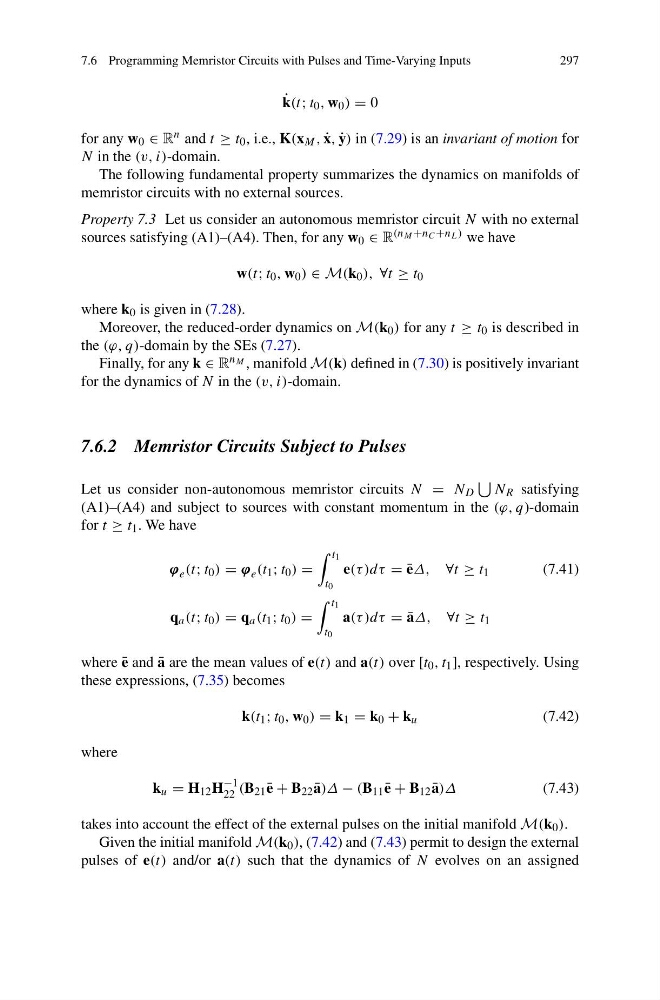
ϕ e (t; t 0 ) = ϕ e (t 1 ; t 0 ) =
t 1
t 0
e(τ )dτ = ¯
eΔ, ∀t ≥ t 1
(7.41)
q a (t; t 0 ) = q a (t 1 ; t 0 ) =
t 1
t 0
a(τ )dτ = ¯
aΔ, ∀t ≥ t 1
where ¯
e and ¯
a are the mean values of e(t) and a(t) over [t 0 , t 1 ], respectively. Using
these expressions, (7.35) becomes
k(t 1 ; t 0 , w 0 ) = k 1 = k 0 + k u
(7.42)
where
k u = H 12 H
−1
22 (B 21 ¯
e + B 22 ¯
a)Δ − (B 11 ¯
e + B 12 ¯
a)Δ
(7.43)
takes into account the effect of the external pulses on the initial manifold M(k 0 ).
Given the initial manifold M(k 0 ), (7.42) and (7.43) permit to design the external
pulses of e(t) and/or a(t) such that the dynamics of N evolves on an assigned
297
˙
k(t; t 0 , w 0 ) = 0
for any w 0 ∈ R n and t ≥ t 0 , i.e., K(x M , ˙
x, ˙
y) in (7.29) is an invariant of motion for
N in the (v, i)-domain.
The following fundamental property summarizes the dynamics on manifolds of
memristor circuits with no external sources.
Property 7.3 Let us consider an autonomous memristor circuit N with no external
sources satisfying (A1)–(A4). Then, for any w 0 ∈ R (n M +n C +n L ) we have
w(t; t 0 , w 0 ) ∈ M(k 0 ), ∀t ≥ t 0
where k 0 is given in (7.28).
Moreover, the reduced-order dynamics on M(k 0 ) for any t ≥ t 0 is described in
the (ϕ, q)-domain by the SEs (7.27).
Finally, for any k ∈ R n M , manifold M(k) defined in (7.30) is positively invariant
for the dynamics of N in the (v, i)-domain.
7.6.2 Memristor Circuits Subject to Pulses
Let us consider non-autonomous memristor circuits N = N D
N R satisfying
(A1)–(A4) and subject to sources with constant momentum in the (ϕ, q)-domain
for t ≥ t 1 . We have
ϕ e (t; t 0 ) = ϕ e (t 1 ; t 0 ) =
t 1
t 0
e(τ )dτ = ¯
eΔ, ∀t ≥ t 1
(7.41)
q a (t; t 0 ) = q a (t 1 ; t 0 ) =
t 1
t 0
a(τ )dτ = ¯
aΔ, ∀t ≥ t 1
where ¯
e and ¯
a are the mean values of e(t) and a(t) over [t 0 , t 1 ], respectively. Using
these expressions, (7.35) becomes
k(t 1 ; t 0 , w 0 ) = k 1 = k 0 + k u
(7.42)
where
k u = H 12 H
−1
22 (B 21 ¯
e + B 22 ¯
a)Δ − (B 11 ¯
e + B 12 ¯
a)Δ
(7.43)
takes into account the effect of the external pulses on the initial manifold M(k 0 ).
Given the initial manifold M(k 0 ), (7.42) and (7.43) permit to design the external
pulses of e(t) and/or a(t) such that the dynamics of N evolves on an assigned