

7.5 Analysis of Manifolds
291
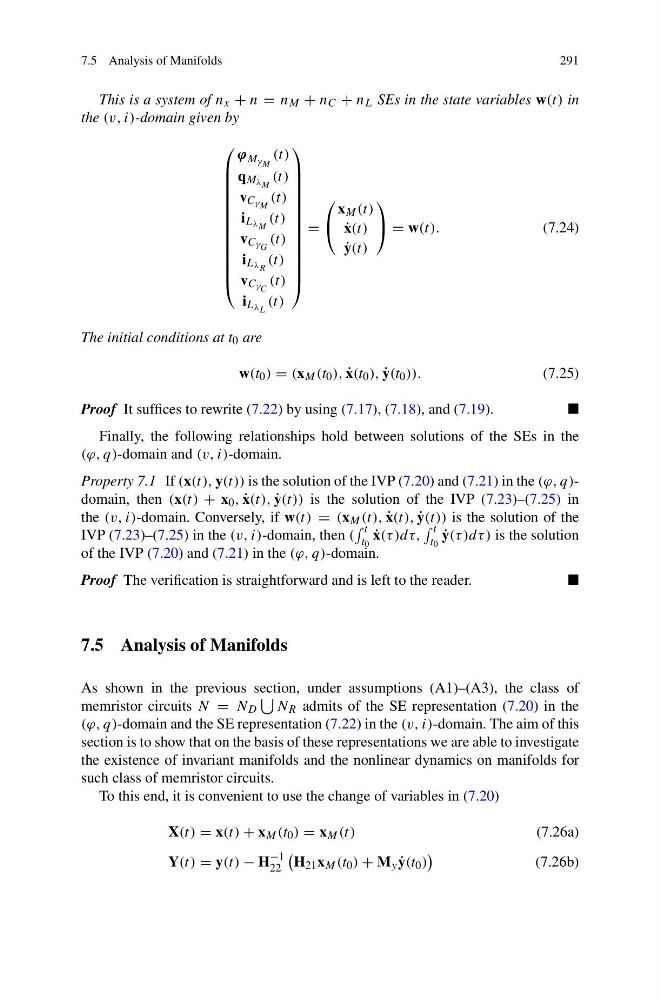
This is a system of n x + n = n M + n C + n L SEs in the state variables w(t) in
the (v, i)-domain given by
⎛
⎜
⎜
⎜
⎜
⎜
⎜
⎜
⎜
⎜
⎜
⎜
⎜
⎝
ϕ M γ M
(t)
q M λ M (t)
v C γ M (t)
i L λ M (t)
v C γ G (t)
i L λ R (t)
v C γ C (t)
i L λ L (t)
⎞
⎟
⎟
⎟
⎟
⎟
⎟
⎟
⎟
⎟
⎟
⎟
⎟
⎠
=
⎛
⎝
x M (t)
˙
x(t)
˙
y(t)
⎞
⎠ = w(t).
(7.24)
The initial conditions at t 0 are
w(t 0 ) = (x M (t 0 ), ˙
x(t 0 ), ˙
y(t 0 )).
(7.25)
Proof It suffices to rewrite (7.22) by using (7.17), (7.18), and (7.19).
Finally, the following relationships hold between solutions of the SEs in the
(ϕ, q)-domain and (v, i)-domain.
Property 7.1 If (x(t), y(t)) is the solution of the IVP (7.20) and (7.21) in the (ϕ, q)domain, then (x(t) + x 0 , ˙
x(t), ˙
y(t)) is the solution of the IVP (7.23)–(7.25) in
the (v, i)-domain. Conversely, if w(t) = (x M (t), ˙
x(t), ˙
y(t)) is the solution of the
IVP (7.23)–(7.25) in the (v, i)-domain, then (
t
t 0
˙
x(τ )dτ,
t
t 0
˙
y(τ )dτ ) is the solution
of the IVP (7.20) and (7.21) in the (ϕ, q)-domain.
Proof The verification is straightforward and is left to the reader.
7.5 Analysis of Manifolds
As shown in the previous section, under assumptions (A1)–(A3), the class of
memristor circuits N = N D
N R admits of the SE representation (7.20) in the
(ϕ, q)-domain and the SE representation (7.22) in the (v, i)-domain. The aim of this
section is to show that on the basis of these representations we are able to investigate
the existence of invariant manifolds and the nonlinear dynamics on manifolds for
such class of memristor circuits.
To this end, it is convenient to use the change of variables in (7.20)
X(t) = x(t) + x M (t 0 ) = x M (t)
(7.26a)
Y(t) = y(t) − H
−1
22
H 21 x M (t 0 ) + M y ˙
y(t 0 )
(7.26b)
291
This is a system of n x + n = n M + n C + n L SEs in the state variables w(t) in
the (v, i)-domain given by
⎛
⎜
⎜
⎜
⎜
⎜
⎜
⎜
⎜
⎜
⎜
⎜
⎜
⎝
ϕ M γ M
(t)
q M λ M (t)
v C γ M (t)
i L λ M (t)
v C γ G (t)
i L λ R (t)
v C γ C (t)
i L λ L (t)
⎞
⎟
⎟
⎟
⎟
⎟
⎟
⎟
⎟
⎟
⎟
⎟
⎟
⎠
=
⎛
⎝
x M (t)
˙
x(t)
˙
y(t)
⎞
⎠ = w(t).
(7.24)
The initial conditions at t 0 are
w(t 0 ) = (x M (t 0 ), ˙
x(t 0 ), ˙
y(t 0 )).
(7.25)
Proof It suffices to rewrite (7.22) by using (7.17), (7.18), and (7.19).
Finally, the following relationships hold between solutions of the SEs in the
(ϕ, q)-domain and (v, i)-domain.
Property 7.1 If (x(t), y(t)) is the solution of the IVP (7.20) and (7.21) in the (ϕ, q)domain, then (x(t) + x 0 , ˙
x(t), ˙
y(t)) is the solution of the IVP (7.23)–(7.25) in
the (v, i)-domain. Conversely, if w(t) = (x M (t), ˙
x(t), ˙
y(t)) is the solution of the
IVP (7.23)–(7.25) in the (v, i)-domain, then (
t
t 0
˙
x(τ )dτ,
t
t 0
˙
y(τ )dτ ) is the solution
of the IVP (7.20) and (7.21) in the (ϕ, q)-domain.
Proof The verification is straightforward and is left to the reader.
7.5 Analysis of Manifolds
As shown in the previous section, under assumptions (A1)–(A3), the class of
memristor circuits N = N D
N R admits of the SE representation (7.20) in the
(ϕ, q)-domain and the SE representation (7.22) in the (v, i)-domain. The aim of this
section is to show that on the basis of these representations we are able to investigate
the existence of invariant manifolds and the nonlinear dynamics on manifolds for
such class of memristor circuits.
To this end, it is convenient to use the change of variables in (7.20)
X(t) = x(t) + x M (t 0 ) = x M (t)
(7.26a)
Y(t) = y(t) − H
−1
22
H 21 x M (t 0 ) + M y ˙
y(t 0 )
(7.26b)