

278
7 Pulse Programming of Memristor Circuits
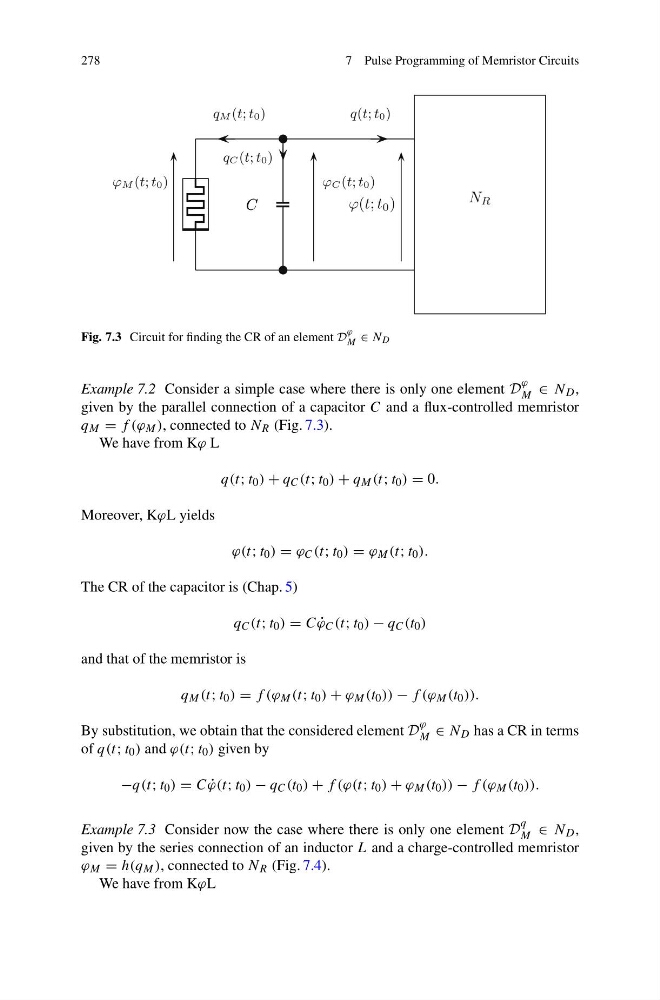
Fig. 7.3 Circuit for finding the CR of an element D
ϕ
M ∈ N D
Example 7.2 Consider a simple case where there is only one element D
ϕ
M ∈ N D ,
given by the parallel connection of a capacitor C and a flux-controlled memristor
q M = f (ϕ M ), connected to N R (Fig. 7.3).
We have from Kϕ L
q(t; t 0 ) + q C (t; t 0 ) + q M (t; t 0 ) = 0.
Moreover, KϕL yields
ϕ(t; t 0 ) = ϕ C (t; t 0 ) = ϕ M (t; t 0 ).
The CR of the capacitor is (Chap. 5)
q C (t; t 0 ) = C ˙
ϕ C (t; t 0 ) − q C (t 0 )
and that of the memristor is
q M (t; t 0 ) = f (ϕ M (t; t 0 ) + ϕ M (t 0 )) − f (ϕ M (t 0 )).
By substitution, we obtain that the considered element D
ϕ
M ∈ N D has a CR in terms
of q(t; t 0 ) and ϕ(t; t 0 ) given by
−q(t; t 0 ) = C ˙
ϕ(t; t 0 ) − q C (t 0 ) + f (ϕ(t; t 0 ) + ϕ M (t 0 )) − f (ϕ M (t 0 )).
Example 7.3 Consider now the case where there is only one element D
q
M ∈ N D ,
given by the series connection of an inductor L and a charge-controlled memristor
ϕ M = h(q M ), connected to N R (Fig. 7.4).
We have from KϕL
7 Pulse Programming of Memristor Circuits
Fig. 7.3 Circuit for finding the CR of an element D
ϕ
M ∈ N D
Example 7.2 Consider a simple case where there is only one element D
ϕ
M ∈ N D ,
given by the parallel connection of a capacitor C and a flux-controlled memristor
q M = f (ϕ M ), connected to N R (Fig. 7.3).
We have from Kϕ L
q(t; t 0 ) + q C (t; t 0 ) + q M (t; t 0 ) = 0.
Moreover, KϕL yields
ϕ(t; t 0 ) = ϕ C (t; t 0 ) = ϕ M (t; t 0 ).
The CR of the capacitor is (Chap. 5)
q C (t; t 0 ) = C ˙
ϕ C (t; t 0 ) − q C (t 0 )
and that of the memristor is
q M (t; t 0 ) = f (ϕ M (t; t 0 ) + ϕ M (t 0 )) − f (ϕ M (t 0 )).
By substitution, we obtain that the considered element D
ϕ
M ∈ N D has a CR in terms
of q(t; t 0 ) and ϕ(t; t 0 ) given by
−q(t; t 0 ) = C ˙
ϕ(t; t 0 ) − q C (t 0 ) + f (ϕ(t; t 0 ) + ϕ M (t 0 )) − f (ϕ M (t 0 )).
Example 7.3 Consider now the case where there is only one element D
q
M ∈ N D ,
given by the series connection of an inductor L and a charge-controlled memristor
ϕ M = h(q M ), connected to N R (Fig. 7.4).
We have from KϕL