

266
6 Memristor Circuits: Invariant Manifolds, Coexisting Attractors, Extreme. . .
∂ z f
y (0, 0) = 1 = 0
hence conditions (11) and (12) in [6] guaranteeing the existence of a bifurcation
without parameter at the EP y e = 0 are satisfied.
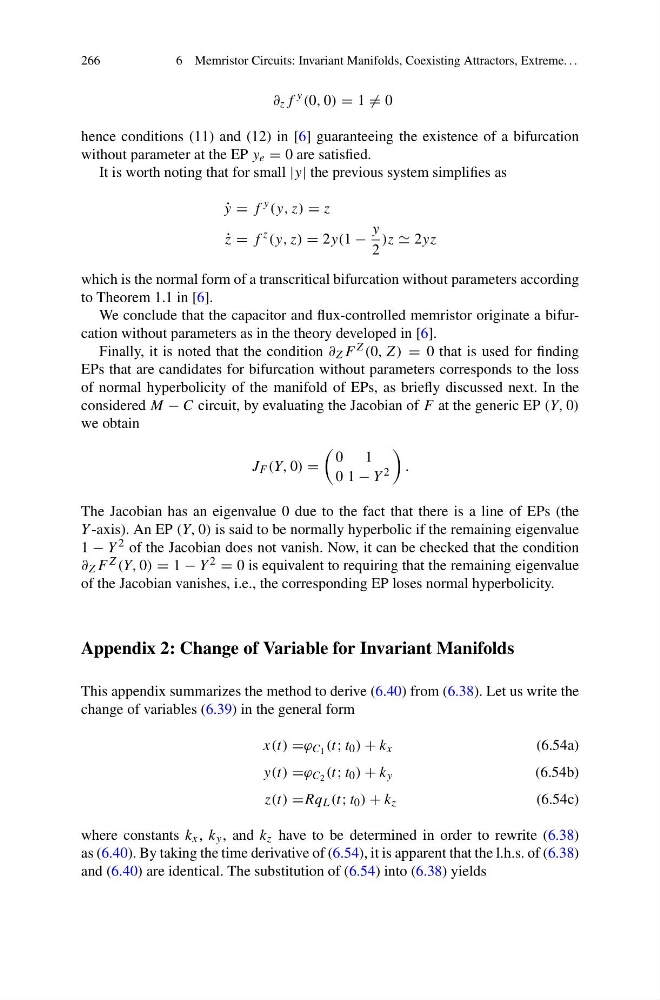
It is worth noting that for small |y| the previous system simplifies as
˙
y = f
y (y, z) = z
˙
z = f
z (y, z) = 2y(1 −
y
2
)z 2yz
which is the normal form of a transcritical bifurcation without parameters according
to Theorem 1.1 in [6].
We conclude that the capacitor and flux-controlled memristor originate a bifurcation without parameters as in the theory developed in [6].
Finally, it is noted that the condition ∂ Z F Z (0, Z) = 0 that is used for finding
EPs that are candidates for bifurcation without parameters corresponds to the loss
of normal hyperbolicity of the manifold of EPs, as briefly discussed next. In the
considered M − C circuit, by evaluating the Jacobian of F at the generic EP (Y, 0)
we obtain
J F (Y, 0) =
0 1
0 1 − Y 2
.
The Jacobian has an eigenvalue 0 due to the fact that there is a line of EPs (the
Y -axis). An EP (Y, 0) is said to be normally hyperbolic if the remaining eigenvalue
1 − Y 2 of the Jacobian does not vanish. Now, it can be checked that the condition
∂ Z F Z (Y, 0) = 1 − Y 2 = 0 is equivalent to requiring that the remaining eigenvalue
of the Jacobian vanishes, i.e., the corresponding EP loses normal hyperbolicity.
Appendix 2: Change of Variable for Invariant Manifolds
This appendix summarizes the method to derive (6.40) from (6.38). Let us write the
change of variables (6.39) in the general form
x(t) =ϕ C 1 (t; t 0 ) + k x
(6.54a)
y(t) =ϕ C 2 (t; t 0 ) + k y
(6.54b)
z(t) =Rq L (t; t 0 ) + k z
(6.54c)
where constants k x , k y , and k z have to be determined in order to rewrite (6.38)
as (6.40). By taking the time derivative of (6.54), it is apparent that the l.h.s. of (6.38)
and (6.40) are identical. The substitution of (6.54) into (6.38) yields
6 Memristor Circuits: Invariant Manifolds, Coexisting Attractors, Extreme. . .
∂ z f
y (0, 0) = 1 = 0
hence conditions (11) and (12) in [6] guaranteeing the existence of a bifurcation
without parameter at the EP y e = 0 are satisfied.
It is worth noting that for small |y| the previous system simplifies as
˙
y = f
y (y, z) = z
˙
z = f
z (y, z) = 2y(1 −
y
2
)z 2yz
which is the normal form of a transcritical bifurcation without parameters according
to Theorem 1.1 in [6].
We conclude that the capacitor and flux-controlled memristor originate a bifurcation without parameters as in the theory developed in [6].
Finally, it is noted that the condition ∂ Z F Z (0, Z) = 0 that is used for finding
EPs that are candidates for bifurcation without parameters corresponds to the loss
of normal hyperbolicity of the manifold of EPs, as briefly discussed next. In the
considered M − C circuit, by evaluating the Jacobian of F at the generic EP (Y, 0)
we obtain
J F (Y, 0) =
0 1
0 1 − Y 2
.
The Jacobian has an eigenvalue 0 due to the fact that there is a line of EPs (the
Y -axis). An EP (Y, 0) is said to be normally hyperbolic if the remaining eigenvalue
1 − Y 2 of the Jacobian does not vanish. Now, it can be checked that the condition
∂ Z F Z (Y, 0) = 1 − Y 2 = 0 is equivalent to requiring that the remaining eigenvalue
of the Jacobian vanishes, i.e., the corresponding EP loses normal hyperbolicity.
Appendix 2: Change of Variable for Invariant Manifolds
This appendix summarizes the method to derive (6.40) from (6.38). Let us write the
change of variables (6.39) in the general form
x(t) =ϕ C 1 (t; t 0 ) + k x
(6.54a)
y(t) =ϕ C 2 (t; t 0 ) + k y
(6.54b)
z(t) =Rq L (t; t 0 ) + k z
(6.54c)
where constants k x , k y , and k z have to be determined in order to rewrite (6.38)
as (6.40). By taking the time derivative of (6.54), it is apparent that the l.h.s. of (6.38)
and (6.40) are identical. The substitution of (6.54) into (6.38) yields