

242
6 Memristor Circuits: Invariant Manifolds, Coexisting Attractors, Extreme. . .
x
y
a
3b
Y 0
h(Y 0 )
−
a
3b
P 1
P 2
P
◦
◦
×
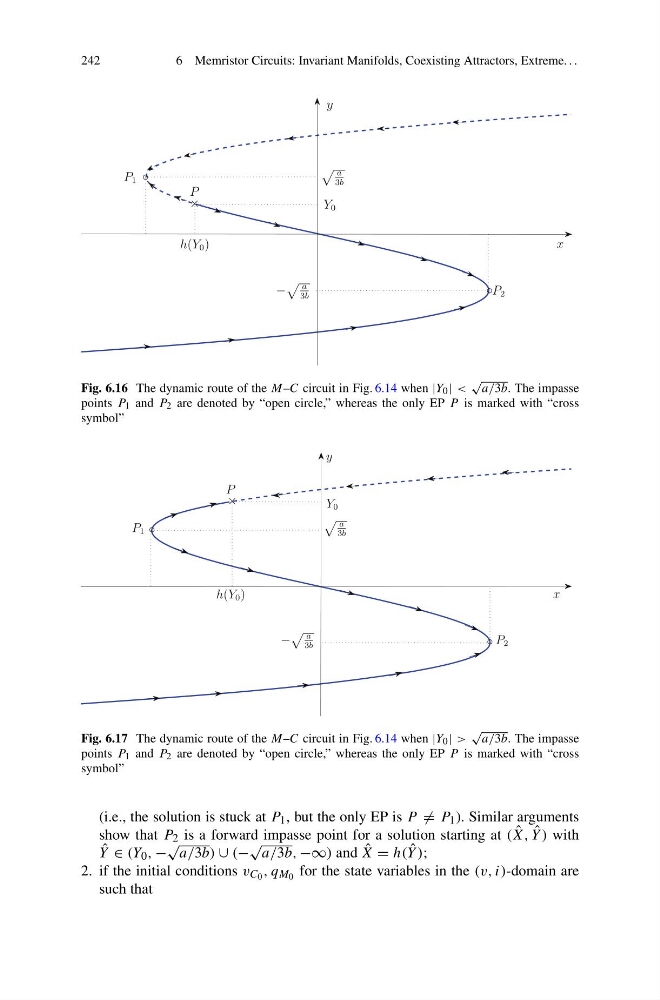
Fig. 6.16 The dynamic route of the M–C circuit in Fig. 6.14 when |Y 0 | <
√
a/3b. The impasse
points P 1 and P 2 are denoted by “open circle,” whereas the only EP P is marked with “cross
symbol”
3
x
y
a
3b
Y 0
h(Y 0 )
−
a
3b
P 1
P 2
P
◦
◦
×
Fig. 6.17 The dynamic route of the M–C circuit in Fig. 6.14 when |Y 0 | >
√
a/3b. The impasse
points P 1 and P 2 are denoted by “open circle,” whereas the only EP P is marked with “cross
symbol”
(i.e., the solution is stuck at P 1 , but the only EP is P = P 1 ). Similar arguments
show that P 2 is a forward impasse point for a solution starting at ( ˆ
X, ˆ
Y ) with
ˆ
Y ∈ (Y 0 , −
√
a/3b) ∪ (−
√
a/3b, −∞) and ˆ
X = h( ˆ
Y );
2. if the initial conditions v C 0 , q M 0 for the state variables in the (v, i)-domain are
such that
6 Memristor Circuits: Invariant Manifolds, Coexisting Attractors, Extreme. . .
x
y
a
3b
Y 0
h(Y 0 )
−
a
3b
P 1
P 2
P
◦
◦
×
Fig. 6.16 The dynamic route of the M–C circuit in Fig. 6.14 when |Y 0 | <
√
a/3b. The impasse
points P 1 and P 2 are denoted by “open circle,” whereas the only EP P is marked with “cross
symbol”
3
x
y
a
3b
Y 0
h(Y 0 )
−
a
3b
P 1
P 2
P
◦
◦
×
Fig. 6.17 The dynamic route of the M–C circuit in Fig. 6.14 when |Y 0 | >
√
a/3b. The impasse
points P 1 and P 2 are denoted by “open circle,” whereas the only EP P is marked with “cross
symbol”
(i.e., the solution is stuck at P 1 , but the only EP is P = P 1 ). Similar arguments
show that P 2 is a forward impasse point for a solution starting at ( ˆ
X, ˆ
Y ) with
ˆ
Y ∈ (Y 0 , −
√
a/3b) ∪ (−
√
a/3b, −∞) and ˆ
X = h( ˆ
Y );
2. if the initial conditions v C 0 , q M 0 for the state variables in the (v, i)-domain are
such that