

240
6 Memristor Circuits: Invariant Manifolds, Coexisting Attractors, Extreme. . .
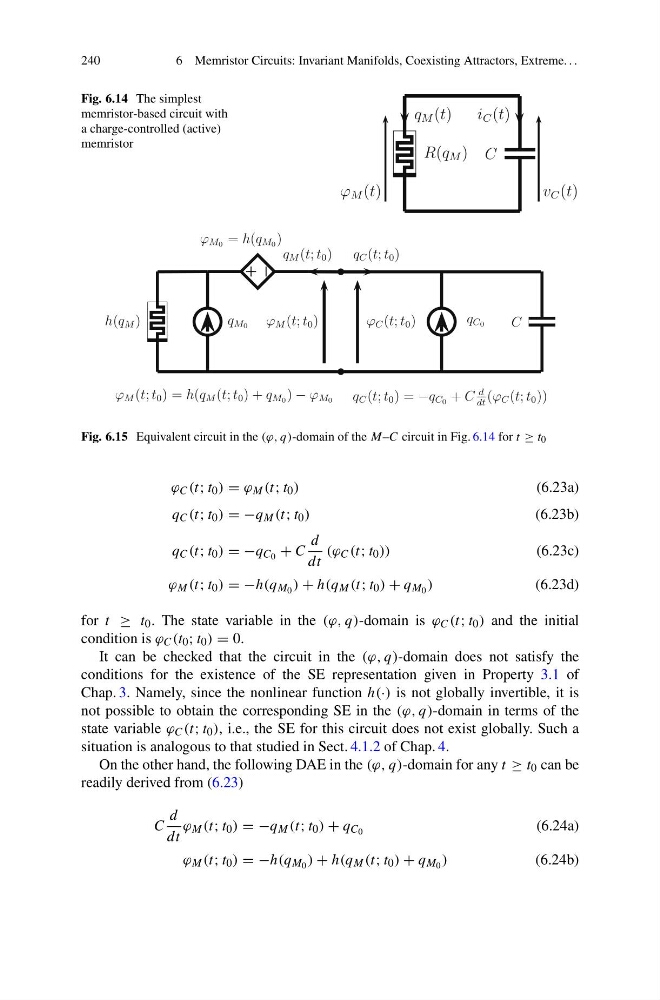
Fig. 6.14 The simplest
memristor-based circuit with
a charge-controlled (active)
memristor
R(q M ) C
i C (t)
q M (t)
v C (t)
ϕ M (t)
q M0
ϕ M0 = h(q M0 )
h(q M )
q M (t; t 0 )
ϕ M (t; t 0 )
q C0
C
q C (t; t 0 )
ϕ C (t; t 0 )
ϕ M (t; t 0 ) = h(q M (t; t 0 ) + q M0 ) − ϕ M0 q C (t; t 0 ) = −q C0 + C
d
dt
(ϕ C (t; t 0 ))
Fig. 6.15 Equivalent circuit in the (ϕ, q)-domain of the M–C circuit in Fig. 6.14 for t ≥ t 0
ϕ C (t; t 0 ) = ϕ M (t; t 0 )
(6.23a)
q C (t; t 0 ) = −q M (t; t 0 )
(6.23b)
q C (t; t 0 ) = −q C 0 + C
d
dt
(ϕ C (t; t 0 ))
(6.23c)
ϕ M (t; t 0 ) = −h(q M 0 ) + h(q M (t; t 0 ) + q M 0 )
(6.23d)
for t ≥ t 0 . The state variable in the (ϕ, q)-domain is ϕ C (t; t 0 ) and the initial
condition is ϕ C (t 0 ; t 0 ) = 0.
It can be checked that the circuit in the (ϕ, q)-domain does not satisfy the
conditions for the existence of the SE representation given in Property 3.1 of
Chap. 3. Namely, since the nonlinear function h(·) is not globally invertible, it is
not possible to obtain the corresponding SE in the (ϕ, q)-domain in terms of the
state variable ϕ C (t; t 0 ), i.e., the SE for this circuit does not exist globally. Such a
situation is analogous to that studied in Sect. 4.1.2 of Chap. 4.
On the other hand, the following DAE in the (ϕ, q)-domain for any t ≥ t 0 can be
readily derived from (6.23)
C
d
dt
ϕ M (t; t 0 ) = −q M (t; t 0 ) + q C 0
(6.24a)
ϕ M (t; t 0 ) = −h(q M 0 ) + h(q M (t; t 0 ) + q M 0 )
(6.24b)
6 Memristor Circuits: Invariant Manifolds, Coexisting Attractors, Extreme. . .
Fig. 6.14 The simplest
memristor-based circuit with
a charge-controlled (active)
memristor
R(q M ) C
i C (t)
q M (t)
v C (t)
ϕ M (t)
q M0
ϕ M0 = h(q M0 )
h(q M )
q M (t; t 0 )
ϕ M (t; t 0 )
q C0
C
q C (t; t 0 )
ϕ C (t; t 0 )
ϕ M (t; t 0 ) = h(q M (t; t 0 ) + q M0 ) − ϕ M0 q C (t; t 0 ) = −q C0 + C
d
dt
(ϕ C (t; t 0 ))
Fig. 6.15 Equivalent circuit in the (ϕ, q)-domain of the M–C circuit in Fig. 6.14 for t ≥ t 0
ϕ C (t; t 0 ) = ϕ M (t; t 0 )
(6.23a)
q C (t; t 0 ) = −q M (t; t 0 )
(6.23b)
q C (t; t 0 ) = −q C 0 + C
d
dt
(ϕ C (t; t 0 ))
(6.23c)
ϕ M (t; t 0 ) = −h(q M 0 ) + h(q M (t; t 0 ) + q M 0 )
(6.23d)
for t ≥ t 0 . The state variable in the (ϕ, q)-domain is ϕ C (t; t 0 ) and the initial
condition is ϕ C (t 0 ; t 0 ) = 0.
It can be checked that the circuit in the (ϕ, q)-domain does not satisfy the
conditions for the existence of the SE representation given in Property 3.1 of
Chap. 3. Namely, since the nonlinear function h(·) is not globally invertible, it is
not possible to obtain the corresponding SE in the (ϕ, q)-domain in terms of the
state variable ϕ C (t; t 0 ), i.e., the SE for this circuit does not exist globally. Such a
situation is analogous to that studied in Sect. 4.1.2 of Chap. 4.
On the other hand, the following DAE in the (ϕ, q)-domain for any t ≥ t 0 can be
readily derived from (6.23)
C
d
dt
ϕ M (t; t 0 ) = −q M (t; t 0 ) + q C 0
(6.24a)
ϕ M (t; t 0 ) = −h(q M 0 ) + h(q M (t; t 0 ) + q M 0 )
(6.24b)