

238
6 Memristor Circuits: Invariant Manifolds, Coexisting Attractors, Extreme. . .
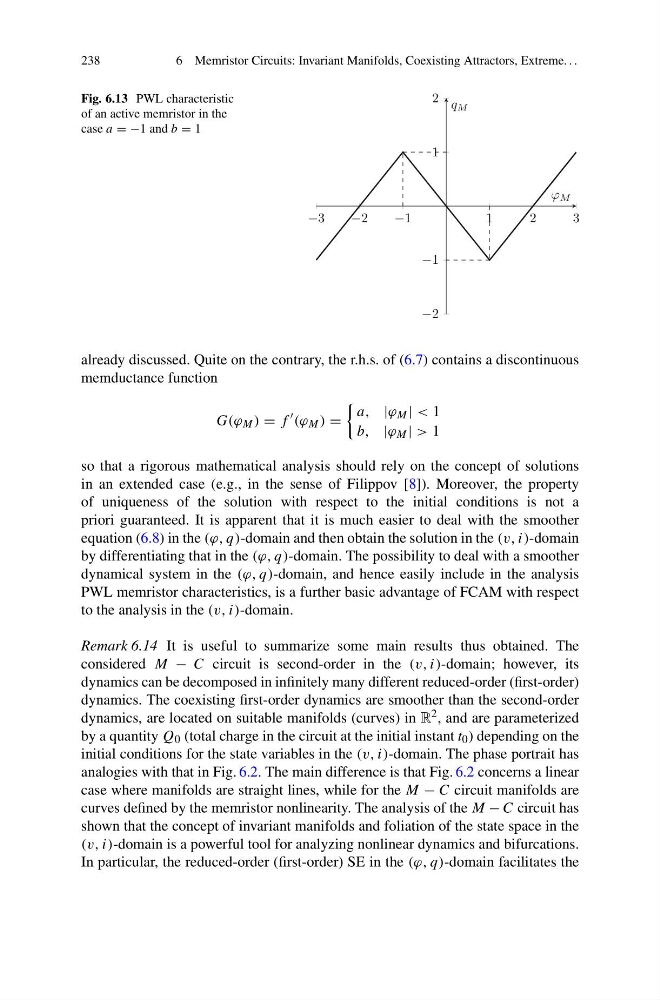
Fig. 6.13 PWL characteristic
of an active memristor in the
case a = −1 and b = 1
−3
−2
−1
1
2
3
−2
−1
1
2
ϕ M
q M
already discussed. Quite on the contrary, the r.h.s. of (6.7) contains a discontinuous
memductance function
G(ϕ M ) = f
(ϕ M ) =
a, |ϕ M | < 1
b, |ϕ M | > 1
so that a rigorous mathematical analysis should rely on the concept of solutions
in an extended case (e.g., in the sense of Filippov [8]). Moreover, the property
of uniqueness of the solution with respect to the initial conditions is not a
priori guaranteed. It is apparent that it is much easier to deal with the smoother
equation (6.8) in the (ϕ, q)-domain and then obtain the solution in the (v, i)-domain
by differentiating that in the (ϕ, q)-domain. The possibility to deal with a smoother
dynamical system in the (ϕ, q)-domain, and hence easily include in the analysis
PWL memristor characteristics, is a further basic advantage of FCAM with respect
to the analysis in the (v, i)-domain.
Remark 6.14 It is useful to summarize some main results thus obtained. The
considered M − C circuit is second-order in the (v, i)-domain; however, its
dynamics can be decomposed in infinitely many different reduced-order (first-order)
dynamics. The coexisting first-order dynamics are smoother than the second-order
dynamics, are located on suitable manifolds (curves) in R 2 , and are parameterized
by a quantity Q 0 (total charge in the circuit at the initial instant t 0 ) depending on the
initial conditions for the state variables in the (v, i)-domain. The phase portrait has
analogies with that in Fig. 6.2. The main difference is that Fig. 6.2 concerns a linear
case where manifolds are straight lines, while for the M − C circuit manifolds are
curves defined by the memristor nonlinearity. The analysis of the M − C circuit has
shown that the concept of invariant manifolds and foliation of the state space in the
(v, i)-domain is a powerful tool for analyzing nonlinear dynamics and bifurcations.
In particular, the reduced-order (first-order) SE in the (ϕ, q)-domain facilitates the
6 Memristor Circuits: Invariant Manifolds, Coexisting Attractors, Extreme. . .
Fig. 6.13 PWL characteristic
of an active memristor in the
case a = −1 and b = 1
−3
−2
−1
1
2
3
−2
−1
1
2
ϕ M
q M
already discussed. Quite on the contrary, the r.h.s. of (6.7) contains a discontinuous
memductance function
G(ϕ M ) = f
(ϕ M ) =
a, |ϕ M | < 1
b, |ϕ M | > 1
so that a rigorous mathematical analysis should rely on the concept of solutions
in an extended case (e.g., in the sense of Filippov [8]). Moreover, the property
of uniqueness of the solution with respect to the initial conditions is not a
priori guaranteed. It is apparent that it is much easier to deal with the smoother
equation (6.8) in the (ϕ, q)-domain and then obtain the solution in the (v, i)-domain
by differentiating that in the (ϕ, q)-domain. The possibility to deal with a smoother
dynamical system in the (ϕ, q)-domain, and hence easily include in the analysis
PWL memristor characteristics, is a further basic advantage of FCAM with respect
to the analysis in the (v, i)-domain.
Remark 6.14 It is useful to summarize some main results thus obtained. The
considered M − C circuit is second-order in the (v, i)-domain; however, its
dynamics can be decomposed in infinitely many different reduced-order (first-order)
dynamics. The coexisting first-order dynamics are smoother than the second-order
dynamics, are located on suitable manifolds (curves) in R 2 , and are parameterized
by a quantity Q 0 (total charge in the circuit at the initial instant t 0 ) depending on the
initial conditions for the state variables in the (v, i)-domain. The phase portrait has
analogies with that in Fig. 6.2. The main difference is that Fig. 6.2 concerns a linear
case where manifolds are straight lines, while for the M − C circuit manifolds are
curves defined by the memristor nonlinearity. The analysis of the M − C circuit has
shown that the concept of invariant manifolds and foliation of the state space in the
(v, i)-domain is a powerful tool for analyzing nonlinear dynamics and bifurcations.
In particular, the reduced-order (first-order) SE in the (ϕ, q)-domain facilitates the