

196
5 Flux-Charge Analysis Method of Memristor Circuits
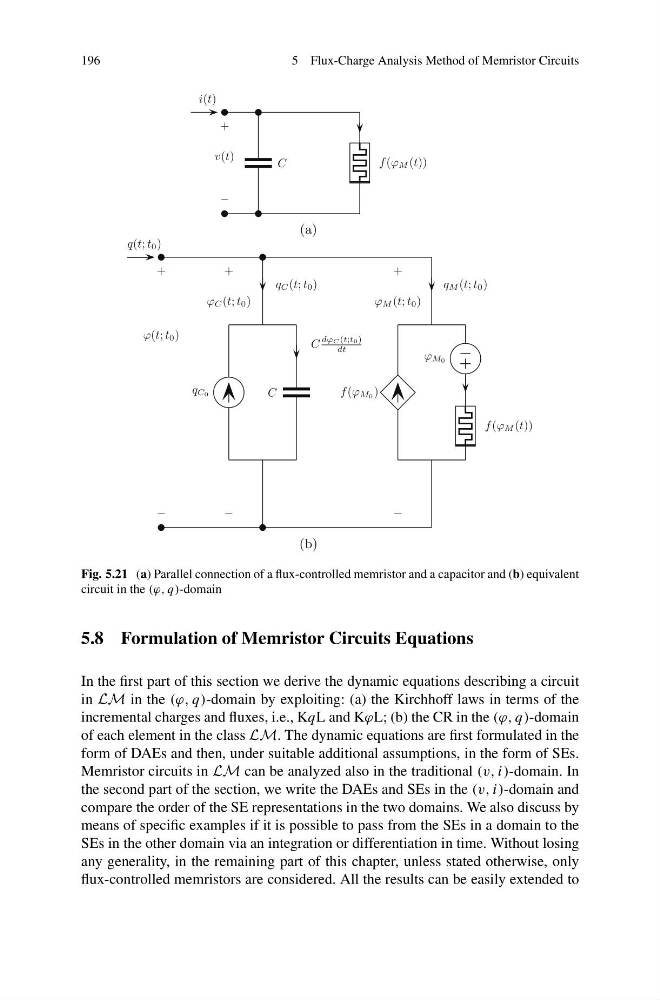
Fig. 5.21 (a) Parallel connection of a flux-controlled memristor and a capacitor and (b) equivalent
circuit in the (ϕ, q)-domain
5.8 Formulation of Memristor Circuits Equations
In the first part of this section we derive the dynamic equations describing a circuit
in LM in the (ϕ, q)-domain by exploiting: (a) the Kirchhoff laws in terms of the
incremental charges and fluxes, i.e., KqL and KϕL; (b) the CR in the (ϕ, q)-domain
of each element in the class LM. The dynamic equations are first formulated in the
form of DAEs and then, under suitable additional assumptions, in the form of SEs.
Memristor circuits in LM can be analyzed also in the traditional (v, i)-domain. In
the second part of the section, we write the DAEs and SEs in the (v, i)-domain and
compare the order of the SE representations in the two domains. We also discuss by
means of specific examples if it is possible to pass from the SEs in a domain to the
SEs in the other domain via an integration or differentiation in time. Without losing
any generality, in the remaining part of this chapter, unless stated otherwise, only
flux-controlled memristors are considered. All the results can be easily extended to
5 Flux-Charge Analysis Method of Memristor Circuits
Fig. 5.21 (a) Parallel connection of a flux-controlled memristor and a capacitor and (b) equivalent
circuit in the (ϕ, q)-domain
5.8 Formulation of Memristor Circuits Equations
In the first part of this section we derive the dynamic equations describing a circuit
in LM in the (ϕ, q)-domain by exploiting: (a) the Kirchhoff laws in terms of the
incremental charges and fluxes, i.e., KqL and KϕL; (b) the CR in the (ϕ, q)-domain
of each element in the class LM. The dynamic equations are first formulated in the
form of DAEs and then, under suitable additional assumptions, in the form of SEs.
Memristor circuits in LM can be analyzed also in the traditional (v, i)-domain. In
the second part of the section, we write the DAEs and SEs in the (v, i)-domain and
compare the order of the SE representations in the two domains. We also discuss by
means of specific examples if it is possible to pass from the SEs in a domain to the
SEs in the other domain via an integration or differentiation in time. Without losing
any generality, in the remaining part of this chapter, unless stated otherwise, only
flux-controlled memristors are considered. All the results can be easily extended to