

178
5 Flux-Charge Analysis Method of Memristor Circuits
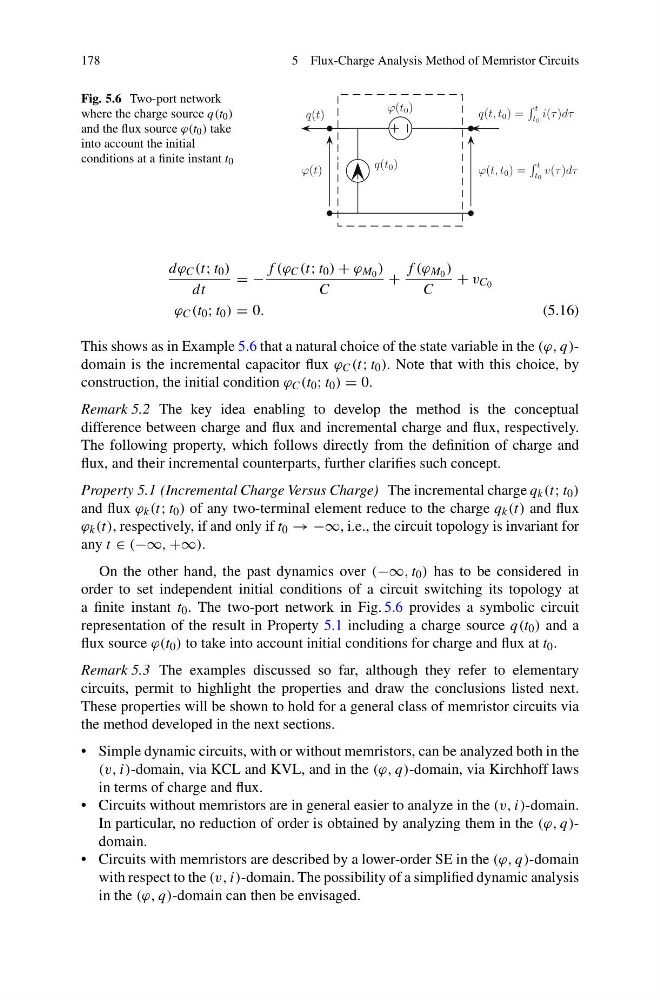
Fig. 5.6 Two-port network
where the charge source q(t 0 )
and the flux source ϕ(t 0 ) take
into account the initial
conditions at a finite instant t 0
dϕ C (t; t 0 )
dt
= −
f (ϕ C (t; t 0 ) + ϕ M 0 )
C
+
f (ϕ M 0 )
C
+ v C 0
ϕ C (t 0 ; t 0 ) = 0.
(5.16)
This shows as in Example 5.6 that a natural choice of the state variable in the (ϕ, q)domain is the incremental capacitor flux ϕ C (t; t 0 ). Note that with this choice, by
construction, the initial condition ϕ C (t 0 ; t 0 ) = 0.
Remark 5.2 The key idea enabling to develop the method is the conceptual
difference between charge and flux and incremental charge and flux, respectively.
The following property, which follows directly from the definition of charge and
flux, and their incremental counterparts, further clarifies such concept.
Property 5.1 (Incremental Charge Versus Charge) The incremental charge q k (t; t 0 )
and flux ϕ k (t; t 0 ) of any two-terminal element reduce to the charge q k (t) and flux
ϕ k (t), respectively, if and only if t 0 → −∞, i.e., the circuit topology is invariant for
any t ∈ (−∞, +∞).
On the other hand, the past dynamics over (−∞, t 0 ) has to be considered in
order to set independent initial conditions of a circuit switching its topology at
a finite instant t 0 . The two-port network in Fig. 5.6 provides a symbolic circuit
representation of the result in Property 5.1 including a charge source q(t 0 ) and a
flux source ϕ(t 0 ) to take into account initial conditions for charge and flux at t 0 .
Remark 5.3 The examples discussed so far, although they refer to elementary
circuits, permit to highlight the properties and draw the conclusions listed next.
These properties will be shown to hold for a general class of memristor circuits via
the method developed in the next sections.
• Simple dynamic circuits, with or without memristors, can be analyzed both in the
(v, i)-domain, via KCL and KVL, and in the (ϕ, q)-domain, via Kirchhoff laws
in terms of charge and flux.
• Circuits without memristors are in general easier to analyze in the (v, i)-domain.
In particular, no reduction of order is obtained by analyzing them in the (ϕ, q)domain.
• Circuits with memristors are described by a lower-order SE in the (ϕ, q)-domain
with respect to the (v, i)-domain. The possibility of a simplified dynamic analysis
in the (ϕ, q)-domain can then be envisaged.
5 Flux-Charge Analysis Method of Memristor Circuits
Fig. 5.6 Two-port network
where the charge source q(t 0 )
and the flux source ϕ(t 0 ) take
into account the initial
conditions at a finite instant t 0
dϕ C (t; t 0 )
dt
= −
f (ϕ C (t; t 0 ) + ϕ M 0 )
C
+
f (ϕ M 0 )
C
+ v C 0
ϕ C (t 0 ; t 0 ) = 0.
(5.16)
This shows as in Example 5.6 that a natural choice of the state variable in the (ϕ, q)domain is the incremental capacitor flux ϕ C (t; t 0 ). Note that with this choice, by
construction, the initial condition ϕ C (t 0 ; t 0 ) = 0.
Remark 5.2 The key idea enabling to develop the method is the conceptual
difference between charge and flux and incremental charge and flux, respectively.
The following property, which follows directly from the definition of charge and
flux, and their incremental counterparts, further clarifies such concept.
Property 5.1 (Incremental Charge Versus Charge) The incremental charge q k (t; t 0 )
and flux ϕ k (t; t 0 ) of any two-terminal element reduce to the charge q k (t) and flux
ϕ k (t), respectively, if and only if t 0 → −∞, i.e., the circuit topology is invariant for
any t ∈ (−∞, +∞).
On the other hand, the past dynamics over (−∞, t 0 ) has to be considered in
order to set independent initial conditions of a circuit switching its topology at
a finite instant t 0 . The two-port network in Fig. 5.6 provides a symbolic circuit
representation of the result in Property 5.1 including a charge source q(t 0 ) and a
flux source ϕ(t 0 ) to take into account initial conditions for charge and flux at t 0 .
Remark 5.3 The examples discussed so far, although they refer to elementary
circuits, permit to highlight the properties and draw the conclusions listed next.
These properties will be shown to hold for a general class of memristor circuits via
the method developed in the next sections.
• Simple dynamic circuits, with or without memristors, can be analyzed both in the
(v, i)-domain, via KCL and KVL, and in the (ϕ, q)-domain, via Kirchhoff laws
in terms of charge and flux.
• Circuits without memristors are in general easier to analyze in the (v, i)-domain.
In particular, no reduction of order is obtained by analyzing them in the (ϕ, q)domain.
• Circuits with memristors are described by a lower-order SE in the (ϕ, q)-domain
with respect to the (v, i)-domain. The possibility of a simplified dynamic analysis
in the (ϕ, q)-domain can then be envisaged.