

130
3 RLC Networks Equations and Analysis Methods
and h b are linear functions of their arguments and in the first formulation the SEs
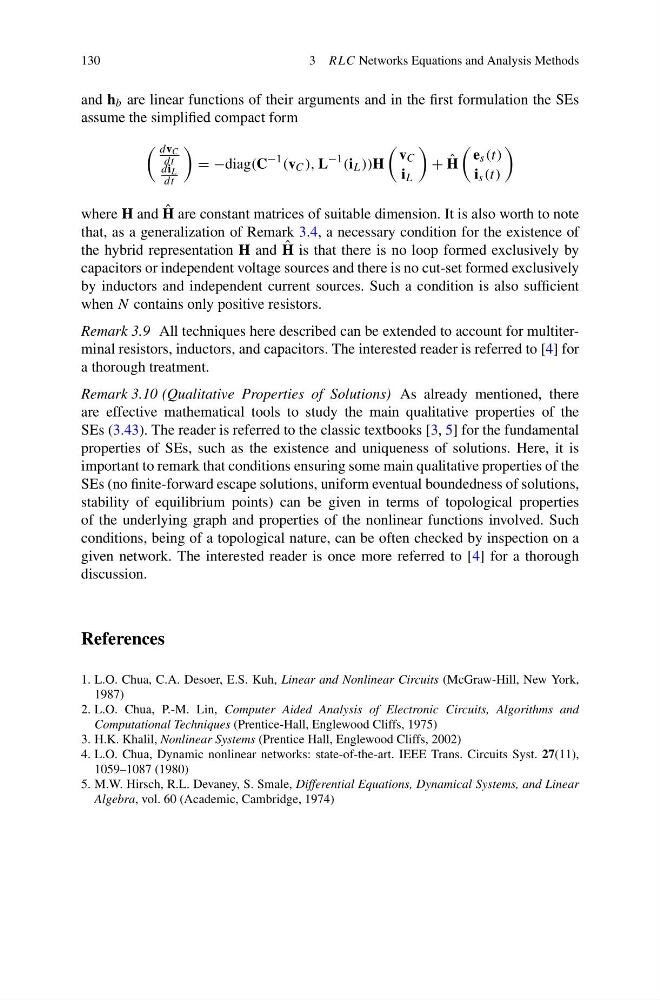
assume the simplified compact form
dv C
dt
di L
dt
= −diag(C
−1 (v C ), L
−1 (i L ))H
v C
i L
+ ˆ
H
e s (t)
i s (t)
where H and ˆ
H are constant matrices of suitable dimension. It is also worth to note
that, as a generalization of Remark 3.4, a necessary condition for the existence of
the hybrid representation H and ˆ
H is that there is no loop formed exclusively by
capacitors or independent voltage sources and there is no cut-set formed exclusively
by inductors and independent current sources. Such a condition is also sufficient
when N contains only positive resistors.
Remark 3.9 All techniques here described can be extended to account for multiterminal resistors, inductors, and capacitors. The interested reader is referred to [4] for
a thorough treatment.
Remark 3.10 (Qualitative Properties of Solutions) As already mentioned, there
are effective mathematical tools to study the main qualitative properties of the
SEs (3.43). The reader is referred to the classic textbooks [3, 5] for the fundamental
properties of SEs, such as the existence and uniqueness of solutions. Here, it is
important to remark that conditions ensuring some main qualitative properties of the
SEs (no finite-forward escape solutions, uniform eventual boundedness of solutions,
stability of equilibrium points) can be given in terms of topological properties
of the underlying graph and properties of the nonlinear functions involved. Such
conditions, being of a topological nature, can be often checked by inspection on a
given network. The interested reader is once more referred to [4] for a thorough
discussion.
References
1. L.O. Chua, C.A. Desoer, E.S. Kuh, Linear and Nonlinear Circuits (McGraw-Hill, New York,
1987)
2. L.O. Chua, P.-M. Lin, Computer Aided Analysis of Electronic Circuits, Algorithms and
Computational Techniques (Prentice-Hall, Englewood Cliffs, 1975)
3. H.K. Khalil, Nonlinear Systems (Prentice Hall, Englewood Cliffs, 2002)
4. L.O. Chua, Dynamic nonlinear networks: state-of-the-art. IEEE Trans. Circuits Syst. 27(11),
1059–1087 (1980)
5. M.W. Hirsch, R.L. Devaney, S. Smale, Differential Equations, Dynamical Systems, and Linear
Algebra, vol. 60 (Academic, Cambridge, 1974)
3 RLC Networks Equations and Analysis Methods
and h b are linear functions of their arguments and in the first formulation the SEs
assume the simplified compact form
dv C
dt
di L
dt
= −diag(C
−1 (v C ), L
−1 (i L ))H
v C
i L
+ ˆ
H
e s (t)
i s (t)
where H and ˆ
H are constant matrices of suitable dimension. It is also worth to note
that, as a generalization of Remark 3.4, a necessary condition for the existence of
the hybrid representation H and ˆ
H is that there is no loop formed exclusively by
capacitors or independent voltage sources and there is no cut-set formed exclusively
by inductors and independent current sources. Such a condition is also sufficient
when N contains only positive resistors.
Remark 3.9 All techniques here described can be extended to account for multiterminal resistors, inductors, and capacitors. The interested reader is referred to [4] for
a thorough treatment.
Remark 3.10 (Qualitative Properties of Solutions) As already mentioned, there
are effective mathematical tools to study the main qualitative properties of the
SEs (3.43). The reader is referred to the classic textbooks [3, 5] for the fundamental
properties of SEs, such as the existence and uniqueness of solutions. Here, it is
important to remark that conditions ensuring some main qualitative properties of the
SEs (no finite-forward escape solutions, uniform eventual boundedness of solutions,
stability of equilibrium points) can be given in terms of topological properties
of the underlying graph and properties of the nonlinear functions involved. Such
conditions, being of a topological nature, can be often checked by inspection on a
given network. The interested reader is once more referred to [4] for a thorough
discussion.
References
1. L.O. Chua, C.A. Desoer, E.S. Kuh, Linear and Nonlinear Circuits (McGraw-Hill, New York,
1987)
2. L.O. Chua, P.-M. Lin, Computer Aided Analysis of Electronic Circuits, Algorithms and
Computational Techniques (Prentice-Hall, Englewood Cliffs, 1975)
3. H.K. Khalil, Nonlinear Systems (Prentice Hall, Englewood Cliffs, 2002)
4. L.O. Chua, Dynamic nonlinear networks: state-of-the-art. IEEE Trans. Circuits Syst. 27(11),
1059–1087 (1980)
5. M.W. Hirsch, R.L. Devaney, S. Smale, Differential Equations, Dynamical Systems, and Linear
Algebra, vol. 60 (Academic, Cambridge, 1974)