

102
3 RLC Networks Equations and Analysis Methods
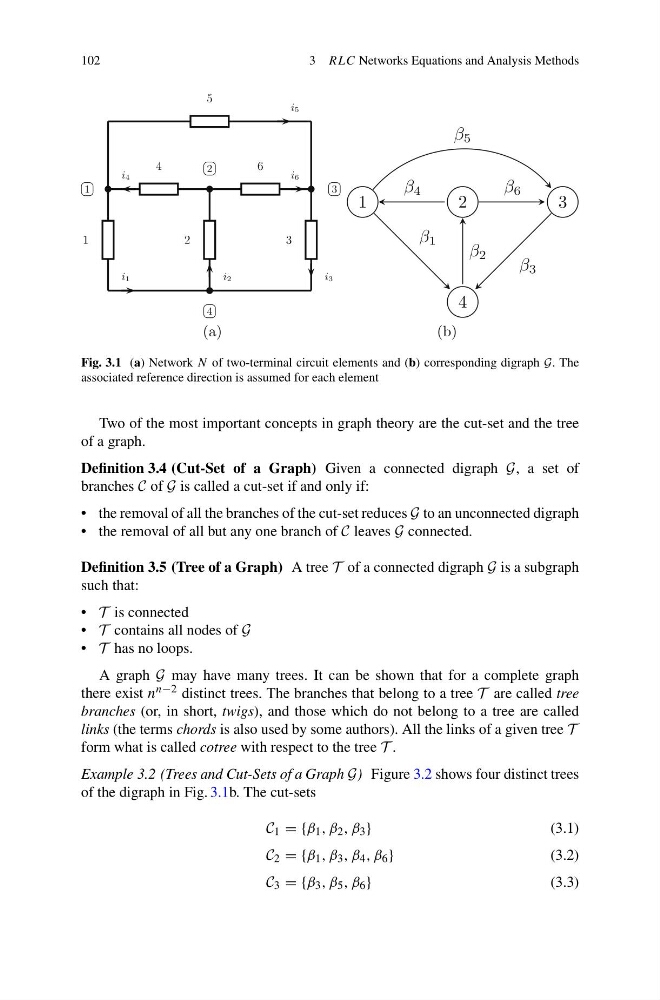
Fig. 3.1 (a) Network N of two-terminal circuit elements and (b) corresponding digraph G. The
associated reference direction is assumed for each element
Two of the most important concepts in graph theory are the cut-set and the tree
of a graph.
Definition 3.4 (Cut-Set of a Graph) Given a connected digraph G, a set of
branches C of G is called a cut-set if and only if:
• the removal of all the branches of the cut-set reduces G to an unconnected digraph
• the removal of all but any one branch of C leaves G connected.
Definition 3.5 (Tree of a Graph) A tree T of a connected digraph G is a subgraph
such that:
• T is connected
• T contains all nodes of G
• T has no loops.
A graph G may have many trees. It can be shown that for a complete graph
there exist n n−2 distinct trees. The branches that belong to a tree T are called tree
branches (or, in short, twigs), and those which do not belong to a tree are called
links (the terms chords is also used by some authors). All the links of a given tree T
form what is called cotree with respect to the tree T .
Example 3.2 (Trees and Cut-Sets of a Graph G) Figure 3.2 shows four distinct trees
of the digraph in Fig. 3.1b. The cut-sets
C 1 = {β 1 , β 2 , β 3 }
(3.1)
C 2 = {β 1 , β 3 , β 4 , β 6 }
(3.2)
C 3 = {β 3 , β 5 , β 6 }
(3.3)
3 RLC Networks Equations and Analysis Methods
Fig. 3.1 (a) Network N of two-terminal circuit elements and (b) corresponding digraph G. The
associated reference direction is assumed for each element
Two of the most important concepts in graph theory are the cut-set and the tree
of a graph.
Definition 3.4 (Cut-Set of a Graph) Given a connected digraph G, a set of
branches C of G is called a cut-set if and only if:
• the removal of all the branches of the cut-set reduces G to an unconnected digraph
• the removal of all but any one branch of C leaves G connected.
Definition 3.5 (Tree of a Graph) A tree T of a connected digraph G is a subgraph
such that:
• T is connected
• T contains all nodes of G
• T has no loops.
A graph G may have many trees. It can be shown that for a complete graph
there exist n n−2 distinct trees. The branches that belong to a tree T are called tree
branches (or, in short, twigs), and those which do not belong to a tree are called
links (the terms chords is also used by some authors). All the links of a given tree T
form what is called cotree with respect to the tree T .
Example 3.2 (Trees and Cut-Sets of a Graph G) Figure 3.2 shows four distinct trees
of the digraph in Fig. 3.1b. The cut-sets
C 1 = {β 1 , β 2 , β 3 }
(3.1)
C 2 = {β 1 , β 3 , β 4 , β 6 }
(3.2)
C 3 = {β 3 , β 5 , β 6 }
(3.3)