

New Paradigms for the Urban Regeneration Project …
65
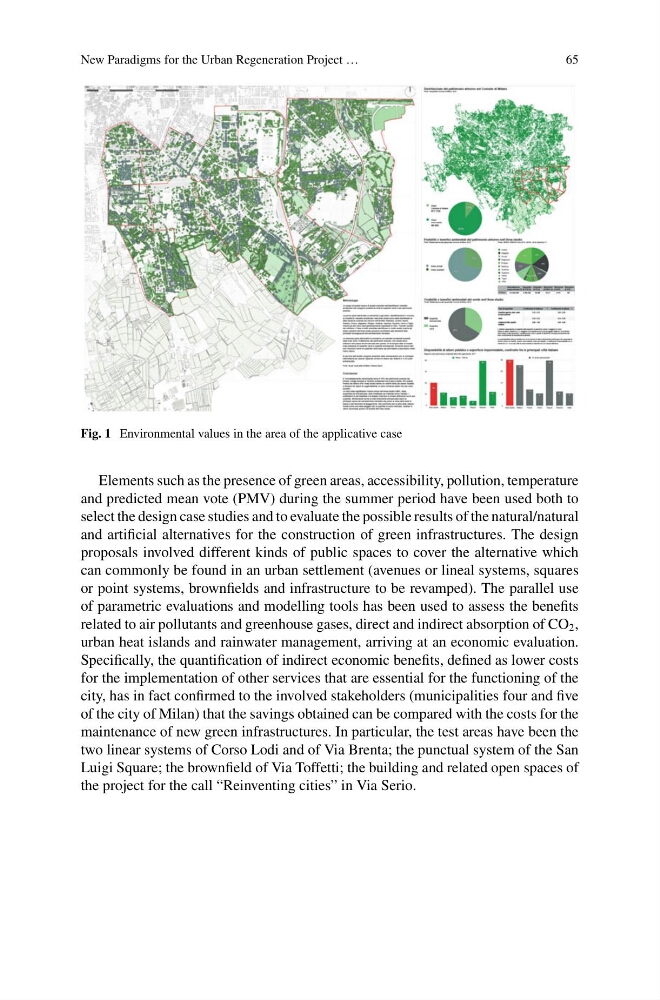
Fig. 1 Environmental values in the area of the applicative case
Elements such as the presence of green areas, accessibility, pollution, temperature
and predicted mean vote (PMV) during the summer period have been used both to
select the design case studies and to evaluate the possible results of the natural/natural
and artificial alternatives for the construction of green infrastructures. The design
proposals involved different kinds of public spaces to cover the alternative which
can commonly be found in an urban settlement (avenues or lineal systems, squares
or point systems, brownfields and infrastructure to be revamped). The parallel use
of parametric evaluations and modelling tools has been used to assess the benefits
related to air pollutants and greenhouse gases, direct and indirect absorption of CO 2 ,
urban heat islands and rainwater management, arriving at an economic evaluation.
Specifically, the quantification of indirect economic benefits, defined as lower costs
for the implementation of other services that are essential for the functioning of the
city, has in fact confirmed to the involved stakeholders (municipalities four and five
of the city of Milan) that the savings obtained can be compared with the costs for the
maintenance of new green infrastructures. In particular, the test areas have been the
two linear systems of Corso Lodi and of Via Brenta; the punctual system of the San
Luigi Square; the brownfield of Via Toffetti; the building and related open spaces of
the project for the call “Reinventing cities” in Via Serio.
65
Fig. 1 Environmental values in the area of the applicative case
Elements such as the presence of green areas, accessibility, pollution, temperature
and predicted mean vote (PMV) during the summer period have been used both to
select the design case studies and to evaluate the possible results of the natural/natural
and artificial alternatives for the construction of green infrastructures. The design
proposals involved different kinds of public spaces to cover the alternative which
can commonly be found in an urban settlement (avenues or lineal systems, squares
or point systems, brownfields and infrastructure to be revamped). The parallel use
of parametric evaluations and modelling tools has been used to assess the benefits
related to air pollutants and greenhouse gases, direct and indirect absorption of CO 2 ,
urban heat islands and rainwater management, arriving at an economic evaluation.
Specifically, the quantification of indirect economic benefits, defined as lower costs
for the implementation of other services that are essential for the functioning of the
city, has in fact confirmed to the involved stakeholders (municipalities four and five
of the city of Milan) that the savings obtained can be compared with the costs for the
maintenance of new green infrastructures. In particular, the test areas have been the
two linear systems of Corso Lodi and of Via Brenta; the punctual system of the San
Luigi Square; the brownfield of Via Toffetti; the building and related open spaces of
the project for the call “Reinventing cities” in Via Serio.