

Urbanization and Subjective Well-Being
23
by negative externalities, such as land rent and cost of living, pollution and congestion, unregulated urban expansion. The effects of urbanization are significantly
different for different kinds of cities, according to the place in the urban hierarchy
they occupy (Christaller 1933). For instance, the set of externalities generated on the
resident population by metropolitan areas is entirely different from those available
in medium-size cities.
An innovative approach to the analysis of the association between urbanization
and SWB should therefore conceptualize the measurement of city size, with a clear
reference to the rank of cities and, as a consequence, with a clear interpretation in
terms of agglomeration economies/diseconomies generated by each kind of urban
environment.
As mentioned in the introduction, the common approach to the topic makes use of
survey data where a sample of respondents is asked to define his/her level of overall
life satisfaction, choosing among different options.
1 This empirical measurement
of SWB is expected to be a function of some individual characteristics (such as
age, gender, education, income) and regional features (per capita GDP, demographic
structure, etc.), among which the most interesting variable is represented by the
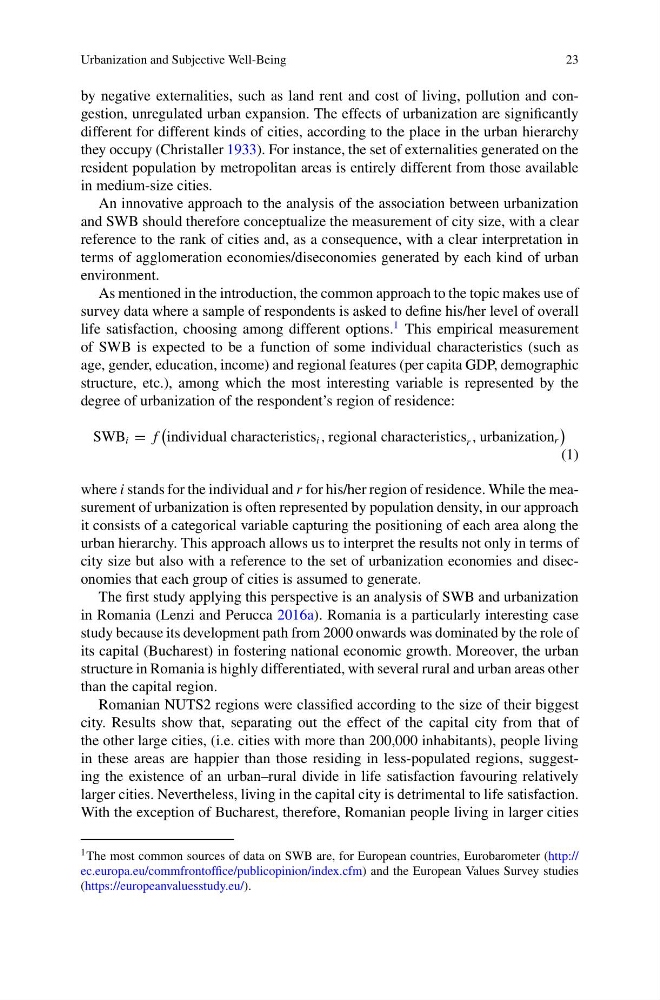
degree of urbanization of the respondent’s region of residence:
SWB i = f
individual characteristics i , regional characteristics r , urbanization r
(1)
where i stands for the individual and r for his/her region of residence. While the measurement of urbanization is often represented by population density, in our approach
it consists of a categorical variable capturing the positioning of each area along the
urban hierarchy. This approach allows us to interpret the results not only in terms of
city size but also with a reference to the set of urbanization economies and diseconomies that each group of cities is assumed to generate.
The first study applying this perspective is an analysis of SWB and urbanization
in Romania (Lenzi and Perucca 2016a). Romania is a particularly interesting case
study because its development path from 2000 onwards was dominated by the role of
its capital (Bucharest) in fostering national economic growth. Moreover, the urban
structure in Romania is highly differentiated, with several rural and urban areas other
than the capital region.
Romanian NUTS2 regions were classified according to the size of their biggest
city. Results show that, separating out the effect of the capital city from that of
the other large cities, (i.e. cities with more than 200,000 inhabitants), people living
in these areas are happier than those residing in less-populated regions, suggesting the existence of an urban–rural divide in life satisfaction favouring relatively
larger cities. Nevertheless, living in the capital city is detrimental to life satisfaction.
With the exception of Bucharest, therefore, Romanian people living in larger cities
1 The most common sources of data on SWB are, for European countries, Eurobarometer (http://
ec.europa.eu/commfrontoffice/publicopinion/index.cfm) and the European Values Survey studies
(https://europeanvaluesstudy.eu/).
23
by negative externalities, such as land rent and cost of living, pollution and congestion, unregulated urban expansion. The effects of urbanization are significantly
different for different kinds of cities, according to the place in the urban hierarchy
they occupy (Christaller 1933). For instance, the set of externalities generated on the
resident population by metropolitan areas is entirely different from those available
in medium-size cities.
An innovative approach to the analysis of the association between urbanization
and SWB should therefore conceptualize the measurement of city size, with a clear
reference to the rank of cities and, as a consequence, with a clear interpretation in
terms of agglomeration economies/diseconomies generated by each kind of urban
environment.
As mentioned in the introduction, the common approach to the topic makes use of
survey data where a sample of respondents is asked to define his/her level of overall
life satisfaction, choosing among different options.
1 This empirical measurement
of SWB is expected to be a function of some individual characteristics (such as
age, gender, education, income) and regional features (per capita GDP, demographic
structure, etc.), among which the most interesting variable is represented by the
degree of urbanization of the respondent’s region of residence:
SWB i = f
individual characteristics i , regional characteristics r , urbanization r
(1)
where i stands for the individual and r for his/her region of residence. While the measurement of urbanization is often represented by population density, in our approach
it consists of a categorical variable capturing the positioning of each area along the
urban hierarchy. This approach allows us to interpret the results not only in terms of
city size but also with a reference to the set of urbanization economies and diseconomies that each group of cities is assumed to generate.
The first study applying this perspective is an analysis of SWB and urbanization
in Romania (Lenzi and Perucca 2016a). Romania is a particularly interesting case
study because its development path from 2000 onwards was dominated by the role of
its capital (Bucharest) in fostering national economic growth. Moreover, the urban
structure in Romania is highly differentiated, with several rural and urban areas other
than the capital region.
Romanian NUTS2 regions were classified according to the size of their biggest
city. Results show that, separating out the effect of the capital city from that of
the other large cities, (i.e. cities with more than 200,000 inhabitants), people living
in these areas are happier than those residing in less-populated regions, suggesting the existence of an urban–rural divide in life satisfaction favouring relatively
larger cities. Nevertheless, living in the capital city is detrimental to life satisfaction.
With the exception of Bucharest, therefore, Romanian people living in larger cities
1 The most common sources of data on SWB are, for European countries, Eurobarometer (http://
ec.europa.eu/commfrontoffice/publicopinion/index.cfm) and the European Values Survey studies
(https://europeanvaluesstudy.eu/).